Get Full Government Meeting Transcripts, Videos, & Alerts Forever!
Get email alerts on the Net Zero Costs And Reliability topic
No spam. Unsubscribe anytime.
Mackinac Center warns of reliability risks, high costs of rapid net‑zero electricity transition
Summary
Jason Hayes of the Mackinac Center told the House Committee on Energy a forthcoming study finds no inexpensive path to meet Michigan's CO2 reduction targets and warned that some rapid transitions could increase reliability risks.
Jason Hayes of the Mackinac Center told the House Committee on Energy a forthcoming study finds no inexpensive path to reach the CO2 reductions Michigan law requires and that some rapid transitions could raise reliability risks.
Hayes described two modeled scenarios. The wind/solar/battery (WSB) scenario—he said—relied primarily on weather‑dependent generation and battery storage and carried a modeled cost of about $360,000,000,000 through the study period; that scenario showed multiple capacity shortfalls in the model, including as much as “61 contiguous hours” of capacity shortfalls in January in one run. The alternative low‑cost decarbonization (LCD) scenario used carbon capture on existing fossil plants, existing and new nuclear including small modular reactors, and limited storage; Hayes said that scenario cost roughly half the WSB option (approximately $206,000,000,000) and avoided modeled capacity shortfalls.
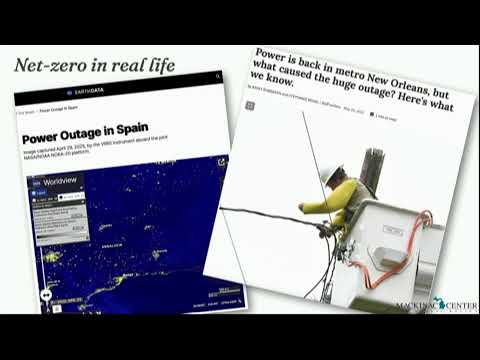
Hayes cited statutory context including Public Act 235 of 2023 and the governor’s My Healthy Climate Plan as drivers of the state’s decarbonization targets; he quoted Midcontinent Independent System Operator (MISO) staff who describe retiring dispatchable coal and gas plants while adding variable wind and solar as increasing reliability risks. Hayes pointed to recent regional examples—emergency orders and rolling outages in other ISOs, summer and winter reliability notices and a sharp increase in a MISO capacity auction price—as evidence of stress on systems undergoing rapid transitions.
He also raised lifecycle and supply‑chain concerns for renewable technologies, citing studies and reporting about mineral extraction, battery supply chains and reported labor practices in some manufacturing regions. Hayes concluded the committee should prioritize reliability and affordability and consider lower‑cost decarbonization pathways that keep adequate dispatchable capacity while achieving large CO2 reductions.
In question‑and‑answer, members asked about incentives, the role of small modular reactors, and balancing climate goals with reliability. Hayes said federal production and investment tax credits create incentives for particular resources and argued policymakers should evaluate tradeoffs among cost, reliability and environmental justice concerns. Hayes said the study will be published in the coming weeks and invited members to review modeling details.
The committee received the presentation and posed questions; no committee action followed at the hearing.