Get Full Government Meeting Transcripts, Videos, & Alerts Forever!
Get email alerts on the Public Space Digital Kiosks topic
No spam. Unsubscribe anytime.
Seattle Council approves concept for interactive downtown kiosks after debate over cameras, term and revenue
Summary
The City Council voted 7-2 on June 3 to adopt Resolution 32170 granting conceptual approval for interactive media kiosks in downtown Seattle and selected business districts after a heated debate over privacy, contract length and distribution of revenues.
The Seattle City Council on June 3 adopted Resolution 32170, granting conceptual approval for the Downtown Seattle Association (DSA) to install, maintain and operate interactive media kiosks in the Metropolitan Improvement District and select neighborhood business districts.
The resolution passed 7-2 after council members debated amendments that would have banned camera technology on the kiosks and shortened the vendor term. The council adopted one amendment to allow surplus revenue beyond amounts earmarked for business improvement areas (BIAs) to be used for improvements in other neighborhood commercial districts.
The committees that considered the proposal — Governance, Accountability and Economic Development — voted unanimously in committee to move the resolution forward. Councilmember Andrew Hollingsworth, chair of the committee and sponsor of the resolution, said the kiosks would provide wayfinding, real‑time transit information, multilingual emergency information, free Wi‑Fi (without storing information), and revenue for BIAs and the DSA. Hollingsworth said phase 1 would install 30 kiosks ahead of the 2026 FIFA World Cup; phase 2 would add 30 more in the downtown core and 20 additional units in Ballard, SoDo and the West Seattle Junction.
Supporters included representatives of the Downtown Seattle Association and several business improvement areas. John Scholes of the DSA told the council the kiosks would help visitors and residents find businesses and attend events. Lauren Lundberg, deputy director of the SoDo Business Improvement Area, said the kiosks would elevate visibility for local businesses and provide revenue-sharing that could fund district services.
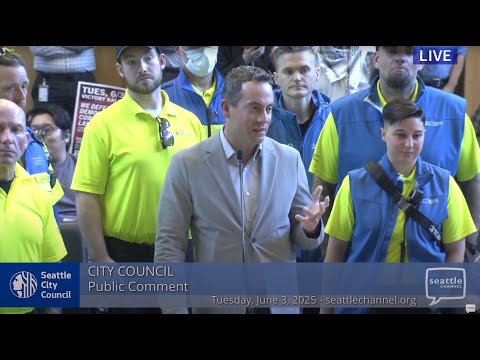
Opponents and privacy advocates urged caution. Multiple public commenters, including Kate Rubin and others, argued the kiosks could be visually intrusive, pose safety and privacy risks, and offered only limited revenue. Witnesses asked the council to ban cameras, require explicit privacy protections against device tracking, prohibit use of kiosk revenues for policing, and slow the timeline for further study.
Councilmember Alex Strauss offered three amendments. Amendment A would have prohibited camera technology on kiosks; it failed 4-5. Strauss said the ban was a “common-sense” privacy protection; opponents, including Hollingsworth, said cameras on kiosks are limited to user-activated selfie features in other cities and that a camera ban could chill vendor investment. Amendment B (version 2), moving to limit the vendor term to a single 17-year permit with no renewals, also failed 2-7; proponents argued for flexibility given rapid technological change, while opponents said a shorter or nonrenewable term would make the business case impossible and likely kill the proposal. Amendment C, which redirected any revenue beyond amounts already allocated to BIAs and DSA toward improvements in other neighborhood business districts, passed 8-1.
Councilmember Sarah Nelson, council president, said the kiosks have been studied in committee and described privacy protections the city expects the vendor to include. Councilmember Kiran Saka and others argued the kiosks offer economic and wayfinding benefits important for the World Cup timeline. Councilmember Rink opposed the final resolution, citing the Seattle Design Commission’s negative recommendation and concerns about the length of the proposed term.
The resolution authorizes conceptual approval; the council directed the ordinance establishing permit terms and technical conditions to return to committee for detailed review. The ordinance with final permit language, conditions and contract terms is scheduled for a committee hearing on June 12, when the council will review the full term-permit ordinance and related contract terms.
What the council approved is a conceptual framework and revenue-sharing approach; it does not finalize permit language, camera rules, device technical standards, or privacy terms. Council actions recorded at the June 3 meeting included roll-call votes on the resolution and the three amendments.
Next steps: committee staff will draft the term‑permit ordinance and vendor contract language for consideration at a subsequent committee meeting. The council record shows proponents hope to deploy 30 kiosks in phase 1 ahead of the 2026 FIFA World Cup, with a larger roll‑out contingent on final contract execution and the ordinance’s terms.