Get Full Government Meeting Transcripts, Videos, & Alerts Forever!
Get email alerts on the Juvenile Facility Closure topic
No spam. Unsubscribe anytime.
Lawmakers, Northern Michigan Officials Criticize Closure of Shawano Center in Grayling
Summary
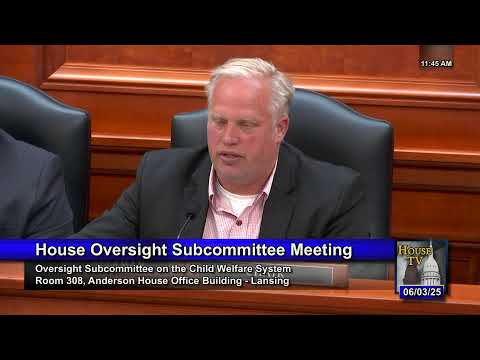
Members of the Michigan House Oversight Subcommittee on Child Welfare System heard testimony Jan. 24 from local officials who said the state's decision to close the Shawano Center in Grayling left a gap in secure placement for violent and high-risk juvenile offenders.
Members of the Michigan House Oversight Subcommittee on Child Welfare System heard testimony Jan. 24 from local officials who said the state's decision to close the Shawano Center in Grayling left a gap in secure placement for violent and high-risk juvenile offenders.
The testimony centered on three witnesses: Roscommon County Prosecutor Michael Edwards, Roscommon County Juvenile Referee Jake Collini, and Otsego County Court Administrator Jamie Fietak, who told the committee the closure was announced by the Michigan Department of Health and Human Services (MDHHS) on Jan. 24 but that the replacement Macomb County facility is not ready to receive juveniles.
Why it matters: Northern Lower Michigan officials said Shawano served as a centrally located state-operated residential option for male juveniles with extreme behavioral challenges. Witnesses said removing that option increases risks to communities and families, pushes youth into more expensive private placements or back into homes before programming is complete, and strains scarce local resources.
Roscommon County Prosecutor Michael Edwards told the panel the closure "simply lacks honesty, foresight, and transparency," and said the state27s stated reasons24that the Macomb facility is "newer, more modern" and that Shawano needed significant repairs24did not match his observations or publicly available information about services Shawano provided. Edwards said Shawano offered segregated pods for different offense types, addiction and cognitive behavioral treatment, small-class educational programming, on-campus medical and psychiatric services, and extensive outdoor and family programming.
Edwards said Shawano had 17 male juveniles at the time of the Jan. 24 announcement, down from about 25 the month before, and that although the physical campus had 40 beds it had been staffed for roughly 25 juveniles. He told members the Macomb facility reportedly has 60 beds but only 20 available now and that he understood it would take about $14 million to open the remaining 40 beds, a cost borne by Macomb County rather than the state.
"Closing the Shawano Center simply lacks honesty, foresight, and transparency," Edwards said.
Roscommon County Juvenile Referee Jake Collini said Shawano had been a placement the courts relied on since the 1970s and that returning youth from Shawano have shown reduced recidivism. Collini warned that removing the residential "top end" of the juvenile continuum weakens diversion and probation options, calling the system without that resource "a house of cards." He urged that, if reopened, Shawano be funded and staffed to open all beds rather than partially operate.
"Reopening Shawano at the existing site would go a long ways to instill confidence in our legislature that the people North Of U.S. 10 are recognized and heard," Collini said.
Otsego County Court Administrator Jamie Fietak described cases she said Shawano successfully served and the role of in-person family visitation and counseling offered by the Grayling facility. She said when staff tried to place a youth last summer, her office contacted 20 facilities and found none willing to accept a high-assaultive juvenile; she said that juvenile later was waived to adult court and remains at large.
"When our kids were there, the parents were able to go and visit. And they would have functions for the families," Fietak said.
Committee members raised safety and staffing records. Representative Rick McDonald cited a December 2023 Michigan Occupational Safety and Health Administration (MIOSHA) investigation and $40,000 fine that the Free Press reported, noting the report documented staff injuries including sprains, broken bones and bites and quotes an employee raising safety fears. Witnesses responded that policy changes limiting staff restraints statewide reduced staff27s ability to respond in some situations and that some positions at Shawano were not posted or filled before closure.
Witnesses also described a "chilling" workplace communication they said circulated after the closure announcement, requiring staff who emailed outside the facility to copy MDHHS27s legal team. Edwards said some employees told him they feared job repercussions for speaking publicly; he said at least some staff confirmed elements of his written statement to the committee.
Committee members pressed why MDHHS closed Shawano before the Macomb facility was fully operational. Representative Regas asked, "So why would they close Shawano before the Macomb facility was operational and ready to receive juveniles?" The witnesses said the Macomb site had no juveniles, little furniture, few staff or teachers, and that some youth were placed in expensive private facilities or returned home early.
Witnesses and members discussed budget line items Edwards referenced in online materials: he said the governor's 2025 budget included a $7.6 million reduction and loss of 58 positions tied to the Shawano closure while adding about $16.1 million for Macomb with 11 positions; Edwards asked the committee to examine whether reopening Shawano would be more cost-effective.
The subcommittee did not take a formal vote on policy. Chair Merriman said the committee would continue oversight and schedule MDHHS to answer these questions.
"We'll be having [the] department in and we'll be asking them some of these questions too," Chair Merriman said.
The hearing record shows a mix of local officials urging reinstatement or fuller staffing of Shawano, committee members requesting MDHHS testimony, and repeated concerns about placement availability, staff safety, and communication from the department.