Vendor Placer AI demonstrates location-data tools to Fairview board, shows July 3 event spike

3633769 · June 3, 2025

Loading...

AI-Generated Content: All content on this page was generated by AI to highlight key points from the meeting. For complete details and context, we recommend watching the full video. so we can fix them.

Summary

Chase, a senior account executive at Placer AI, told the Fairview board during a vendor presentation that the company’s location‑analytics platform can map visitor patterns, traffic routes and trade areas to help cities with grant writing, retail recruitment and infrastructure decisions.

Chase, a senior account executive at Placer AI, told the Fairview board during a vendor presentation that the company’s location‑analytics platform can map visitor patterns, traffic routes and trade areas to help cities with grant writing, retail recruitment and infrastructure decisions.

Placer’s demonstration focused on geofencing — drawing a perimeter on a map to count devices that enter a place — and on how that data can be used in grants and planning. ‘‘We observe the longitude and latitude of devices. That’s it,’’ Chase said, adding Placer builds a privacy‑first panel and does not collect names or phone numbers. He said Placer’s panel covers about 30,000,000 devices, representing about 8 percent of the U.S. population.

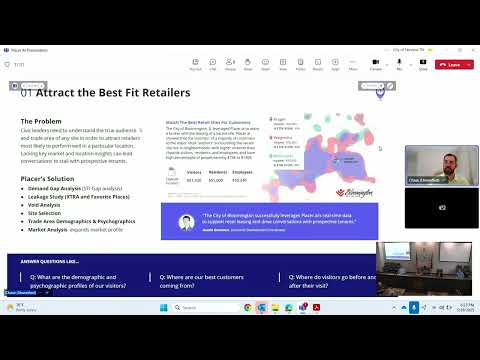
The presentation showed several use cases relevant to Fairview: trade‑area maps that display where visitors to a Walmart or park travel from, vehicle counts and hourly traffic patterns (sourced from INRIX for vehicle volumes), route analyses that show which roads visitors use in and out of a place, and event measurement. When the board asked about the town’s July 3 event, Chase created a polygon around downtown Fairview and reported about 12,000 unique visitors within that geofence on July 3. He cautioned the figure reflects people counted only once per day within that drawn area.

Board members and staff asked about technical limits and accuracy. Chase said vehicle counts tied to INRIX typically lag and are available by month and year (Placer had data back to 2019 and expected 2024 data soon), while people‑count metrics have a roughly three‑ to four‑day lag. For origin analysis, he showed a heat map and a ZIP‑code breakdown indicating many visitors came from nearby ZIP codes and that 21 percent of Walmart visitors in the example traveled 10–30 miles.

Fairview participants also raised privacy concerns and use for children and schools. Chase said Placer does not receive device data for minors and does not geofence schools or other sensitive locations. He recommended using demographic breakdowns of households (for example, households with children) rather than geofencing facilities that serve minors.

On onboarding and sustained use, Placer said customers receive a customer success manager, training materials and prebuilt reports in an "academy" to avoid the platform becoming unused after purchase. Placer also described a process for adding points of interest or custom geofences: the company’s team can add locations, or local staff can draw them in the platform. In the demonstration, board members helped the presenter draw a large geofence covering City Hall, adjacent green space and nearby parking lots to approximate the festival footprint.

No formal action, vote or contract decision was taken during the session. Board members asked questions about report sharing, the size and shape of geofences, expected lags, and whether Placer data could be used to compare developer traffic studies to real‑time observed routes. Chase said the platform could show routes to and from a pinned location and be used to verify or supplement engineered traffic studies, with the caveat that people‑count data can exceed vehicle counts when multiple people occupy cars.

Placer framed the product as an additional source of place‑based evidence — useful for showing where nonresidents use roads, for estimating event attendance inside a custom perimeter, and for demonstrating trade‑area draw to prospective retailers or grant reviewers. Board members indicated interest in follow‑up but did not commit to a purchase during the meeting.

Placer’s representative pointed the board to the company trust center on its website for privacy and data‑use documentation and described customer examples in other Tennessee communities such as Columbia and Clarksville County Economic Development. Staff and board members asked Placer to add a Fairview point of interest for future evaluation and to provide follow‑up materials and onboarding details.

The presentation concluded after roughly a 40‑ to 50‑minute demonstration and a brief Q&A. No town policy or procurement decision was made during the meeting; next steps would be staff follow‑up if Fairview chooses to pursue a contract or trial.