Lifetime Citizen Portal Access — AI Briefings, Alerts & Unlimited Follows
Arkansas health officials present new controlled‑substance listings, update disposal rule to mirror DEA standards
Loading...
Summary
Arkansas Department of Health staff told a legislative committee they will add multiple fentanyl‑related and synthetic drugs to the state controlled‑substances list and update disposal rules to remove hospitals from the state take‑back process; the committee reviewed both rules without objection.
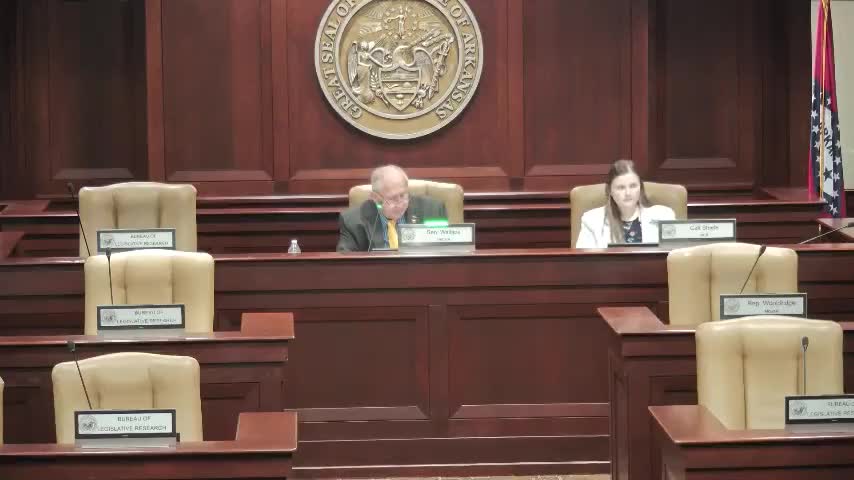
Members of a legislative committee reviewed two rule changes from the Arkansas Department of Health on controlled substances and disposal processes, department officials said, and the panel recorded the review without objection.
The Department of Health presented proposed amendments to the state controlled‑substances list and separate rule changes governing disposal at health‑care facilities and registrants. Laura Shue, general counsel for the Department of Health, said the agency seeks to update the list regularly and that the rulemaking began in the fall of 2024 and had been approved earlier by the governor’s office and the Board of Health in October 2024.
The proposed schedule additions include a group of fentanyl‑related compounds and other synthetic drugs. Shane David Branch, chief health systems licensing and certification for the Department of Health, said “items 1 through 9 are fentanyl related substances to follow the DEA [and] would be included into schedule 1.” He and agency staff listed other additions and clarifications that would mirror recent federal scheduling actions and identify positional isomers of already‑controlled drugs (for example, 3‑methylmethcathinone, also called 3‑MMC) for inclusion on the state list.
Agency staff identified several other specific changes: alpha‑PHP‑type synthetic cathinone positional isomers, three substances already listed as Schedule I by the DEA, the synthetic opioid 2‑methyl AP‑237, and a synthetic cannabinoid (ADB‑BUTANACA) designated as a positional isomer of an existing listed compound. Xylazine is proposed for Schedule III with exemptions for veterinary and pharmacy use; Nick Scholl, section chief for pharmacy services and drug control, said of xylazine that it would “be included as a schedule 3 controlled substance, with exceptions made for, veterinary and pharmacy use to provide exemptions for those under this language.” The Department also proposed adding zuranolone — an FDA‑approved oral treatment for postpartum depression — to Schedule IV to mirror federal scheduling.
The Department said it received one public comment from the Cannabis Industry Association on definitions relating to plant‑derived precursors such as THCA and total THC. Branch said the agency is reviewing those concerns and that changes to state definitions following recent legislation are already underway: “With Act 629 of 2025, some of the definitions had been clarified to include this THC component and upon our scheduling action … that would be our intent would be to update that to reflect that language,” he said.
The second rule under review updates disposal language for controlled substances in state rules to align with federal requirements and Department practice. Agency staff explained they removed language that required unwitnessed partial doses to be sent to the Department and removed “hospitals” from the list of entities that use the Department’s take‑back process, because hospitals are DEA registrants and follow federal DEA disposal procedures. As Nick Scholl explained during questions, “With them being DEA registrants, the DEA has direct oversight over hospital controlled substances.”
Senator Love pressed the Department on whether the change meant the state had not been complying with an older rule. Department staff answered that hospitals were following the hospital‑specific rule and federal requirements, and that the current change brings the general disposal rule into alignment with existing hospital rules and federal law. The Department said long‑term care and assisted‑living facilities — which are not DEA registrants — still send unwanted medications to the Department for inventory and destruction under the state take‑back process.
The committee recorded that both items had been reviewed “without objection.” The Department said the updates are intended to follow federal scheduling decisions, clarify disposal responsibilities between DEA registrants and nonregistrants, and address public comments and pending litigation identified from 2023 and subsequent 2025 legislation.
Less central details discussed included the timing of the rulemaking (drafting began fall 2024), that the Board of Health approved the amendments in October 2024, and that the Department currently updates the controlled‑substances list more frequently than once per year (agency staff said they are “about on a 6 month schedule”).