Get Full Government Meeting Transcripts, Videos, & Alerts Forever!
Get email alerts on the County Finance topic
No spam. Unsubscribe anytime.
Louisa County revenue committee outlines allocations tied to projected data center and reactor revenues
Summary
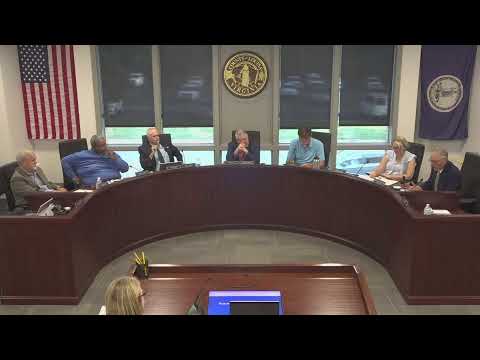
The Louisa County Board of Supervisors’ revenue work group presented a recommended allocation framework on June 2 that would automatically split future new revenues among priorities such as planned capital, roads, rural preservation and tax rebates.
The Louisa County Board of Supervisors’ revenue work group presented a recommended allocation framework on June 2 that would automatically split future new revenues among priorities such as planned capital, roads, rural preservation and tax rebates.
The committee, which supervisors Rachel Jones and Ray Woodward represented, described the presentation as the product of six months of work intended “to take care of the citizens of Louisa County,” and emphasized the recommendations are a working document to be refined with public input. “This is an accumulation of the past 6 months of work, and our primary mission has been, to take care of the citizens of Louisa County,” Supervisor Jones said.
Why it matters: The county’s revenue forecast assumes new revenues from large-scale private investment and possible public utility projects—specifically an assumed 25 data centers (cited as “Amazon Web Services” in staff remarks) and one modular reactor—could produce sizable, recurring tax and real‑estate receipts. The committee presented allocations so any incoming dollars would be committed by percentage to named priorities rather than being spent ad hoc.
Key points from the presentation
- Revenue assumptions: staff used a conservative scenario of 25 data centers and one modular reactor to estimate future receipts. Committee members described those assumptions as conservative and illustrative rather than guaranteed. “Some of the new revenue sources we’ve identified are the Amazon Web Services… Our assumptions were conservative. We used the 25 data centers as the basis for our assumptions,” a staff presenter said.
- Estimated scale: The committee showed an illustrative fiscal‑year‑2031 (FY31) scenario of roughly $36,500,000 in new money; the presentation translated the allocation percentages into dollar amounts under that estimate (for example, roughly $9 million toward planned capital projects and about $6.2 million toward road projects in the FY31 example).
- Proposed allocation percentages (committee recommendation): 5% for tax rebates/reductions; ~25% for planned capital projects; 17% for road projects; 15% for rural preservation; 10% public safety/judicial facilities; 10% recreation; 9% water/sewer infrastructure; ~4.5% for harmful‑algal‑bloom (HAB) mitigation; 3% for airport upgrades; 1% each for general‑fund and long‑term capital reserves; 0.1% for litter mitigation. The committee said percentages can be adjusted by the board over time.
- Uses and constraints explained: The presentation noted some uses are limited by law or external programs—school debt cannot be prepaid in the same way as other VRA (Virginia Resources Authority) loans and state formulas may change (the presenters warned that a higher local revenue base could reduce state school funding via the local composite index). Staff also listed payoff of certain non‑education VRA loans, additional local matches for programs such as SmartScale, and funding for long‑term capital as potential uses.
Board response and next steps
Supervisors commended the work group, raised questions about affordable housing and public engagement, and asked for additional review. Supervisor Barnes asked that affordable housing (for teachers, first responders and similar local workers) be considered for inclusion in the allocations; supervisors Jones and Woodward said they had discussed that and expected future review by subsequent work‑group members.
Chairman Adams said he would rotate additional supervisors onto the group to solicit broader input and recommended continuing public engagement; he proposed appointing two more supervisors for two‑month terms to expand the committee’s membership through November.
The committee characterized the allocation table as advisory — “not chiseled in stone” — and recommended using percentage allocations so the plan scales automatically with changing receipts. The board did not adopt the allocations as binding policy at this meeting; the presentation was accepted for further consideration and public comment.
Sources and evidence: Presentation and discussion by the revenue work group and staff during the June 2 Louisa County Board of Supervisors meeting. The committee repeatedly described the document as a recommendation and invited public input.