Get Full Government Meeting Transcripts, Videos, & Alerts Forever!
Get email alerts on the Transportation Bike Ped topic
No spam. Unsubscribe anytime.
Sammamish seeks public feedback as city maps priority bike-and-pedestrian network
Summary
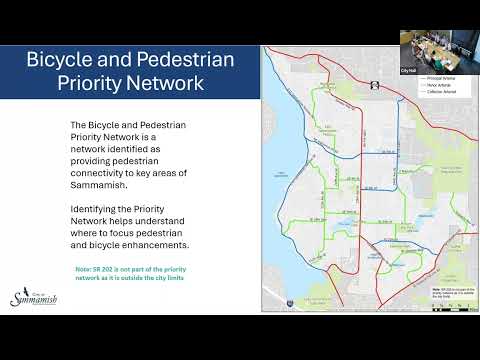
Public works staff presented Sammamish’s draft bike-and-pedestrian priority network to the Sustainability Commission, describing level-of-traffic-stress goals, project prioritization steps and a schedule that includes a second public open house this summer and council review before the end of the year.
At a meeting of the Sammamish Sustainability Commission, city public works staff described a draft bike-and-pedestrian plan intended to align with the city’s Transportation Master Plan and guide projects for the city’s six‑year Transportation Improvement Plan.
Public Works staff said the plan’s main objective is to identify a priority network and facility recommendations that will improve safety and connectivity for people who walk, roll and ride bicycles. Staff explained the plan uses Washington State Department of Transportation methodology for “level of traffic stress” (LTS) to score routes and sets different baseline LTS targets by road type (generally LTS 2 on principal and collector arterials, LTS 3 on minor arterials). Staff noted those baseline goals can be modified on an individual corridor if the City Council directs it.
Staff showed maps of existing gaps in sidewalks and bike facilities and said those maps reflect only the city right-of-way and do not include nearby King County trail facilities. “This map is showing what we control and own,” a member of the public works team said, underscoring that good connectivity to the neighboring King County trail can change how stressful a route appears in the city’s own inventory.
The project team summarized public engagement to date: a February open house attended by about 20 people plus an interactive online map that drew about 260 comments from more than 100 unique commenters. Staff said the design team is completing a future-conditions memorandum that will incorporate funded projects (for example, the Lewis Thompson project) and will produce facility recommendations and a short list of roughly 10 candidate projects for possible addition to the city’s capital plan. The staff timeline calls for a second community open house in June or July, a tentative City Council work session this summer, a public hearing in the fall and adoption later this year.
Commissioners and residents asked about several implementation issues: how steep slopes factor into the LTS scoring, whether e‑bike speeds and classifications will be addressed in policy, and how planners will improve access from city streets down to the King County trail where access points are limited. In public comment, James Eastman, who identified himself as an Eastlake resident, urged the commission to support the plan and noted the importance of ebikes as “a game changing technology” that increases the reach of cycling for many users.
Staff emphasized funding constraints and explained that adding a project to the six‑year Transportation Improvement Plan or the citywide capital plan makes a project eligible for grant applications. They said project prioritization will use the city’s existing scoring criteria (with potential refinements for this plan) and that some corridors with major physical constraints will be evaluated differently through corridor studies.
Next steps listed by staff include finishing the future-conditions memorandum, drafting facility and design recommendations, public engagement through a second open house, coordination with the planning and parks commissions, and presenting a draft to the City Council for review and adoption.