Get Full Government Meeting Transcripts, Videos, & Alerts Forever!
Get email alerts on the Immigrant Services Language Access topic
No spam. Unsubscribe anytime.
Baltimore council hears request to expand language access and immigrant legal services
Summary
The mayor's Office of Immigrant Affairs presented citywide language-access work, ARPA-funded programs and a revamped "Safe City Baltimore" legal-services strategy; councilmembers pressed for new funding and data and the mayor's office committed to pursue budget increases.
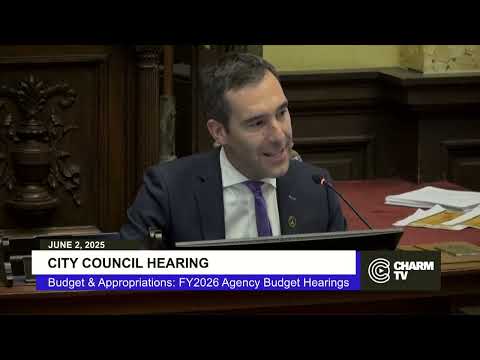
Baltimore City Council heard a presentation from Catalina Rodriguez Lima, director of the Mayor's Office of Immigrant Affairs (MEMA), on the office's language-access work, community outreach and plans to expand immigration legal services.
MEMA told the council it now serves roughly 50,000 foreign‑born Baltimore residents and manages the city's language access program after a recently adopted local law (referred to in the presentation as Title 6). Director Catalina Rodriguez Lima said MEMA's role is to expand the capacity of service-delivery agencies rather than directly provide all services.
The presentation and ensuing council discussion focused on three immediate issues: (1) expanding language‑access support across city agencies, (2) a citywide legal‑services strategy called Safe City Baltimore, and (3) a request from Councilwoman Ramos for additional budget allocations for legal services and community support.
Rodriguez Lima highlighted recent and planned work: MEMA has four full‑time staff and two part‑time contractors; it onboarded nine agencies in 2024 and is supporting nine additional agencies (bringing the current total cited to 18) with the goal of reaching 25 agencies across cohorts 3 and 4. The office reported translating 283 “vital documents” into 14 languages, facilitating more than 2,800 in‑person or virtual interactions, and training over 1,700 city employees through a Workday language‑access module. MEMA said it reached more than 55,000 social media users and about 7,000 newsletter subscribers in five languages, and hosted a Baltimore immigration summit that drew nearly 300 participants.
On language access, Rodriguez Lima described program elements available to agencies: telephonic interpretation at no cost to city departments, document translation services, staff training, a language access oversight committee drawn from community members who review materials, and “I speak” cards to help limited‑English‑proficient residents request services. She said MEMA will continue monthly outreach, neighborhood partnerships and a targeted summer campaign to publicize residents' language‑access rights.
MEMA also described two ARPA‑funded initiatives: the Baltimore New American Access Coalition (BNAC), a bilingual/bicultural case‑management program that has enrolled more than 800 households (about 2,800 residents across 25 ZIP codes and from 32 countries) and has submitted over 2,000 applications for services; and ARPA investments in language‑access infrastructure including simultaneous‑interpretation equipment and pilot AI tools to reduce translation costs.
On legal services, MEMA described a three‑tier revamp to its Safe City Baltimore strategy: (1) community education and family preparedness (guardianship forms, workshops to reduce the risk that children enter foster care), (2) expanded access to legal screening and representation for non‑detained residents, and (3) case management and emergency support for families affected by detention. MEMA said it has partnered with the American Bar Association Commission on Immigration and with AMICA (formerly Care Coalition) to provide legal consultations and representation; AMICA has supported roughly 30 families under the current program. Rodriguez Lima said the office had activated a first year of services after a $50,000 administrative investment earlier this year.
Council members pressed for specifics and resources. The Council President (name not specified in the transcript) said, “Baltimore is going to continue to follow all federal laws, period,” and added, “as long as Brandon Scott is mayor and I am president, we are not gonna turn our backs on our immigrant community.” The Council President asked MEMA to provide economic data quantifying immigrants' contribution to city growth. Rodriguez Lima said the city's foreign‑born population has increased by about 3,000 people each year on average and that the Hispanic population grew more than 80% from 2010 to 2020; she said she would provide additional data by email.
Councilman Gray asked how MEMA's FY26 budget would address legal representation; Rodriguez Lima said the FY26 MEMA budget includes funding for AMICA to provide legal services and consultations for detained individuals and that MEMA is actively fundraising to expand services for non‑detained residents. Councilwoman Ramos pressed for immediate commitments and a budget ask on the record: “The ask for the legal services is $1,100,000 … The other ask is for $950,000 for our immigrant community for support. We need that commitment today,” she said. Calvin Young, chief of staff to the mayor, responded that the mayor's office is “working” with council on budget increases and said, “I can commit to you right now that we are absolutely this is 1 of the top priorities right now for the mayor's office to increase in this budget.”
Other council members asked about coordination with schools and health services. MEMA said it meets monthly with the school system (which operates a newcomer center) and has supported the Health Department in drafting a language‑access plan and translating clinical consent and enrollment documents. MEMA also noted a prior role in supporting survivors of the Key Bridge collapse with eight months of intensive case management and cited funds raised from the Baltimore Community Foundation; the amount reported in the presentation was not consistent in the transcript and is recorded below as “amount not specified.”
There were no formal votes or budget approvals during the hearing. Council members asked MEMA for follow‑up: (1) economic and entrepreneurship data quantifying immigrant contributions to the city's economy (requested within several weeks); and (2) a cost estimate and proposed budget for the Safe City Baltimore expansion, including the preventative legal‑services tier for non‑detained residents. MEMA agreed to provide the requested numbers after the hearing.
The hearing closed with repeated assurances from council leadership that the city will support immigrants and pursue language‑access implementation. No formal appropriation was adopted at the meeting; budget changes were described as under discussion between council and the mayor's office.
Two details to note: the presentation repeatedly used the acronyms “NEMA” and “MEMA” interchangeably; this article follows the presentation's preferred capitalization and refers to the office as the Mayor's Office of Immigrant Affairs (MEMA). Also, an amount referenced as funds raised from the Baltimore Community Foundation was cited inconsistently in the transcript; the precise figure was not available in the hearing record and is therefore recorded below as not specified.