Get Full Government Meeting Transcripts, Videos, & Alerts Forever!
Get email alerts on the Oversight City Performance And It topic
No spam. Unsubscribe anytime.
Council presses administration on CityStat targets, AI readiness and broken permitting system
Summary
Council members questioned OPI officials and the deputy city administrator about inconsistent CityStat performance targets, the effects of AI on jobs and how to fix the city’s permitting system; OPI said it will update metrics, launch AI planning and focus on technical integrations with Exela while emphasizing operational capacity.
Members of the Baltimore City Council Ways and Means Committee used the OPI budget hearing to press the administration on three specific concerns: unclear CityStat targets, preparing for artificial intelligence, and persistent permitting problems tied to the Exela system.
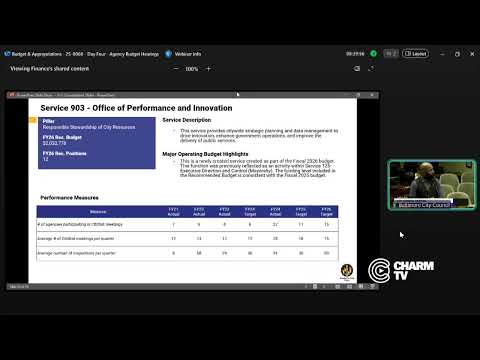
On CityStat targets, Councilwoman McCray noted the published FY24 participation figure of 27 agencies and asked why the FY26 target was listed as 15. OPI Executive Director D'Artagnan Williams said the earlier figure reflected issue-based CityStat sessions that involve multiple agencies; the FY26 target the administration published was intended to reflect agency-focused CityStat sessions. Williams told the committee the office expects to have 18 active stats by the end of the year — “13 agency based and 5 issue based stats” — and agreed to supply corrected FY26 targets.
Deputy City Administrator Shamaya Kearney told the committee the administration will work with agencies this summer on a “methodology plan” to document numerators, denominators and data sources so published metrics better reflect how measures are calculated. Kearney said the work will be done “hand in hand with agencies” and in partnership with BBMR and OPI.
Council President Cohen and other members asked about artificial intelligence and workforce impacts. Cohen urged the city to lead on AI and said, “We need to own the future.” Williams said the city is starting an AI research effort and is partnering with Google on a citywide AI forum focused on “equitable AI adoption” and guardrails. Williams described AI as having the potential to “add additional capacity to provide automated service responses” and to free staff from clerical tasks, while acknowledging potential job impacts.
On permitting, Council members described the system as “on fire” and said developers report the permitting process has worsened. Williams replied that while the city has both process and technology problems, much of the permitting delays stem from the technology and integrations — how Exela exchanges information and how inspections (for example, fire code) integrate with other systems. He said the city needs stronger in-house technical capacity and careful execution, adding that “technology is only as good as the people and the capacity behind the technology.” The deputy city administrator and Williams both said the administration intends a multi-pronged approach — process, training and technical fixes — and to document and catalog issues discovered after rollout.
Council members requested updated performance metrics and an accurate CityStat schedule; Williams and Kearney agreed to deliver corrected numbers and more documentation on methodology.