Get Full Government Meeting Transcripts, Videos, & Alerts Forever!
Get email alerts on the Budget Operational Modernization topic
No spam. Unsubscribe anytime.
Baltimore OPI proposes $2.03 million budget to modernize 311, permitting and city data systems
Summary
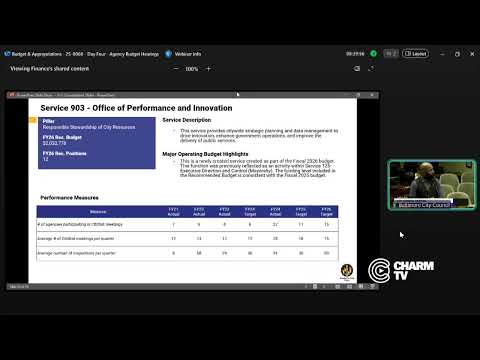
The Mayor’s Office of Performance and Innovation outlined a $2,030,000 FY26 budget focused on modernizing 311, accelerating permit reform, expanding CityStat sessions and building a citywide data warehouse; officials said the changes aim to improve service delivery and save costs.
The Mayor’s Office of Performance and Innovation (OPI) told the Baltimore City Council Ways and Means Committee that its recommended fiscal 2026 budget is $2,030,000 and is aimed at modernizing 311, accelerating permit reforms, maximizing Workday and building a citywide data warehouse.
OPI Executive Director and Chief Data Officer D'Artagnan Williams said the office’s work focuses on performance management, a civic design lab, data and analytics, and a project management office that together “form an integrated performance and innovation cycle.” Williams said the office’s goals include improving 311 handoffs and inspections, simplifying permitting workflows starting with the Exela system, and using Workday for stronger administrative and fiscal operations.
Why it matters: OPI officials said the proposed investments are intended to make city services faster and more reliable for residents and businesses, free up staff time through automation and produce measurable savings. Williams cited a water-billing coordination project that he said produced at least $1,400,000 in cost savings by reconciling agency billing and identifying vacant properties with ongoing water use.
The presentation listed several active projects: 311 reimagining, parking enforcement workflow improvements, traffic-calming data products, downtown canvassing to identify broken curbs and sidewalks, a partnership on a payment/product project referred to in the presentation as “Taxil” with the Department of Finance and Visa, and an ADA-compliance project that OPI said is on track to deliver to plaintiffs ahead of schedule.
Williams said OPI and the Department of General Services are building a citywide data warehouse “rather than bring external consultants in to start from scratch,” and that approach “will save millions of dollars” and allow more agencies to fold into a common data foundation. He added, “Data is not just information data is infrastructure and it helps us understand insights across the city to control cost and ultimately deliver better services.”
Council members pressed for clarity on the office’s performance measures during the hearing. OPI said the CityStat program will expand: Williams said the office expects to have 18 CityStat sessions running by the end of the year — “13 agency based and 5 issue based stats” — and acknowledged that some published FY26 targets should be updated. Deputy City Administrator Shamaya Kearney told the committee the administration will work over the summer with agencies to document methodology — numerators, denominators and data sources — and to refine published performance targets.
The presentation also flagged work to prepare the city for responsible AI adoption. Williams said OPI is partnering with Google on a citywide AI forum focused on “equitable AI adoption” and building guardrails for use cases such as automated service responses and transcription-driven action-item generation.
Next steps: OPI officials agreed to provide the committee corrected performance targets for FY26 and an updated CityStat schedule. Committee members asked the administration to continue collaboration with council analysts and agency leads while OPI implements its projects.
No formal vote or ordinance was taken on the budget at the hearing; the session moved to a recess and scheduled the next item (Enoch Pratt Free Library) for the evening meeting.