Get Full Government Meeting Transcripts, Videos, & Alerts Forever!
Get email alerts on the Public Bidding Subtrade Scope topic
No spam. Unsubscribe anytime.
Appeals Court Hears Dispute Over Whether Electrical Subcontractor Must Perform Excavation and Concrete Work Under Chapter 149 §44F
Summary
The Massachusetts Appeals Court heard argument in AMP Electrical Inc. v. WM Schultz Construction, docket number 24P941, over whether excavation and concrete duct‑bank work shown on revised electrical drawings became part of the electrical filed subbid under chapter 149 §44(f).
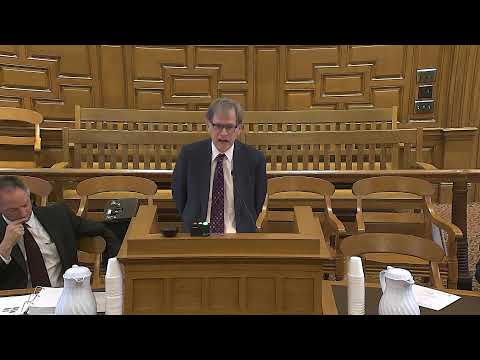
The Massachusetts Appeals Court, sitting in Boston before Chief Justice Amy Blake and Justices Peter Sachs and Andrew D'Angelo, heard argument in AMP Electrical Inc. v. WM Schultz Construction Inc. and another, docket number 24P941. The core issue is whether an electrical filed subbidder may be required to perform excavation and concrete work (the parties discussed figures in the tens of thousands of dollars) shown on electrical drawings and added by addenda shortly before bidding.
Appellant AMP Electrical, through counsel Bartheem Skirk, argued that the public‑bidding statute (chapter 149, section 44(f)) contemplates separate specification sections for each trade and that substantial excavation or concrete fabrication is not customary electrical work and therefore should be part of the general contractor’s scope. Skirk told the court that the addenda and a revised drawing (E401) were not specifications for the electrical trade and that the awarding authority’s engineers never made a reasoned determination that excavation of that magnitude was customary for an electrical filed subbidder.
John McNamara, representing appellee WM Schultz Construction, and Christopher Petrini, for the Town of West Springfield (third‑party), countered that the addenda process is the standard mechanism to allocate work and that addendum number 3 revised electrical drawing E401 before bid submission to show the concrete‑encased duct bank and trenching as electrical work. McNamara said the addenda were published to all prospective bidders and that question number 15 (a pre‑bid inquiry) and addenda responses put prospective electrical bidders on notice.
Arguments focused on statutory text and industry practice: which documents comprise the contract (specifications, plans and addenda), whether an electrical drawing can contain specifications that obligate a filed subbidder, and how to draw the line between incidental trenching (customary) and large excavation/concrete work (arguably not customary). Counsel disputed the practical consequences of the court adopting either party’s rule; appellees said upholding the addenda notice process preserves fair, uniform bidding, while appellant warned that requiring subs to absorb substantial non‑customary scopes shortchanges the filed‑sub framework in §44(f).
The trial court’s summary judgment decision was a focal point; the lower court granted summary judgment for Schultz and the town argued (and counsel for Schultz re‑urged) that the addenda and the published E401 revisions resolved the matter. The parties also debated whether the subcontractor could or would sub‑contract the disputed items and whether the awarding authority had the obligation to make a reasoned, on‑the‑record determination about what work was customary to a given trade.
The panel heard questions about the timing of the addenda (one issued roughly three days before bid) and statutory thresholds that trigger separate specification sections (the transcript cites a $25,000 estimate threshold in §44(f) for listing a class of work). Counsel noted that some figures discussed in argument exceeded $80,000, raising disputes about whether the work should have been listed in an electrical subsection of the specifications.
The court took the matter under advisement at the close of argument.