Get Full Government Meeting Transcripts, Videos, & Alerts Forever!
Get email alerts on the Criminal Appeals Identification Sufficiency topic
No spam. Unsubscribe anytime.
Appeals Court Hears Challenge to Sufficiency of Evidence in William R. Wheeler Case
Summary
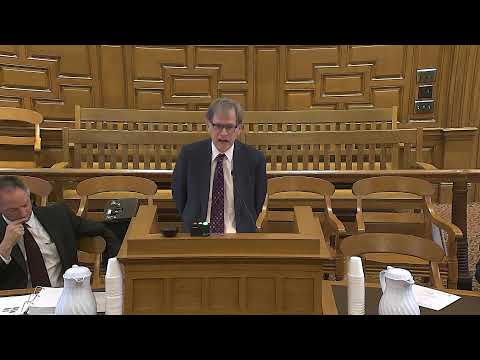
Chief Justice Amy Blake and Justices Peter Sachs and Andrew D'Angelo heard oral argument in Commonwealth v. William R. Wheeler, docket number 24P549, in a session of the Massachusetts Appeals Court in Boston.
Chief Justice Amy Blake and Justices Peter Sachs and Andrew D'Angelo heard oral argument in Commonwealth v. William R. Wheeler, docket number 24P549, in a session of the Massachusetts Appeals Court in Boston.
The defense, represented by Mr. DeMaria, asked the panel to reverse convictions for operating under the influence and negligent operation, arguing that “the prosecution cannot meet its burden of proof” because there was no in‑court identification of the driver and no direct evidence tying Mr. Wheeler to driving at the moment of the crash.
The issue of identification was central to the argument. Mr. DeMaria told the court there was “no in court identification” and that the complaining witness’s statement that “it was a man” was insufficient without probing her angle of view or securing a direct in‑court ID. The defense emphasized that other people were at the scene, including a roommate, and that the Commonwealth’s trial presentation lacked direct corroboration tying Wheeler to the driver’s seat at the time of impact.
Elizabeth Simonian, appearing for the Commonwealth, urged the court to affirm the convictions, saying the Commonwealth produced “ample circumstantial evidence” including two admissions by the defendant (one at the scene and one at booking), testimony that the defendant was the only person standing next to the vehicle when officers arrived, the vehicle’s registration to the defendant, and failed or problematic field sobriety tests. Simonian also told the panel that the booking video contains a statement that the defendant drank shortly before leaving the location in question.
The panel questioned both sides about preservation of specific sufficiency objections, the relevance and effect of an absence of in‑court identification, and whether testimony that the defendant drove back to the scene sufficed to prove operation. The justices repeatedly framed the review as one that must view the trial evidence “in the light most favorable to the Commonwealth” while also testing whether the Commonwealth’s circumstantial proof could legitimately support each element charged.
Defense counsel also challenged the impairment evidence, noting the lapse of hours between drinking and the incident alleged and pointing to the booking video and the lack of physical corroboration (e.g., keys, seat‑height consistency). The Commonwealth responded that the totality of evidence — crash severity, admissions, officer observations and sobriety testing — provided a legally sufficient basis for the jury’s findings.
The panel did not announce a decision at argument. Chief Justice Amy Blake closed the argument and said the “case is under advisement.”