Legislative budget changes reduce some college programs; TEA briefed on cash-on-hand proviso
Summary
Board staff told the TEA committee that state appropriations rose overall between 2020 and 2025 but lawmakers cut several longstanding line items and added a proviso requiring colleges to certify cash-on-hand as of June 30, 2025; that certification could affect distributions.
Vice President Frisbie briefed the Technical Education Authority on the Legislature’s budget actions, which included higher overall state aid for two-year institutions in recent years but reductions and eliminations of several specific line items and a new proviso that could delay or withhold state aid for some colleges.
The briefing matters because the proviso requires community colleges to certify their cash-on-hand as of June 30, 2025; colleges with more than six months cash on hand may be ineligible for some of the state aid in the proviso, Dr. Frisbie said. Blake Flanders will be asked to certify eligibility for community colleges under the budget language, she said.
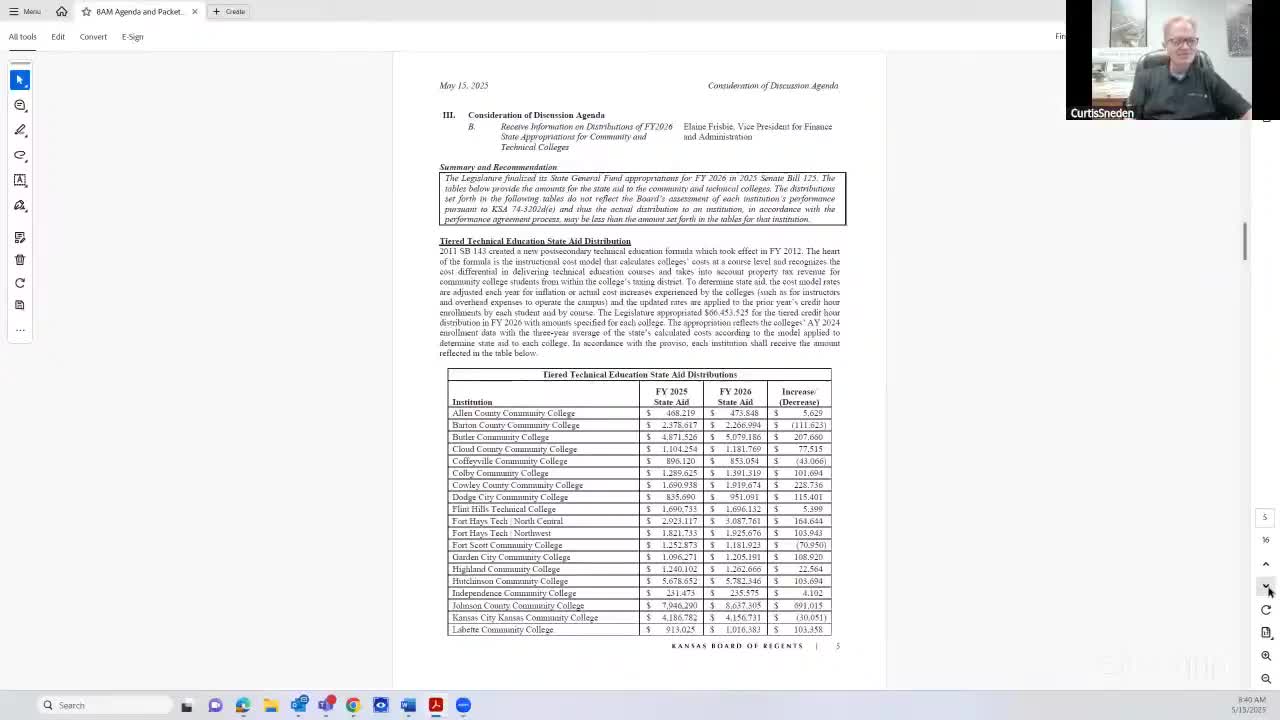
Frisbie reviewed multi-year funding trends, saying total distributions through the Regents’ office rose from about $176,000,000 in fiscal 2020 to about $258,000,000 in fiscal 2025, then decline slightly in fiscal 2026 to just under $250,000,000. She said the Legislature consolidated some lines, merged cap-outlay aid into a $12,400,000 line for fiscal 2026, and increased funding tied to the three-year rolling enrollment average used for tiered aid.
She also identified specific reductions and eliminations: the Kansas Technology Innovation and Internship program was removed (about $179,000 cited), funding for technical equipment at community colleges and Washburn Tech (just under $400,000) was cut, and a $500,000 competitive grant program the board previously administered was dropped. Cybersecurity and IT infrastructure funding for universities and two-year colleges was zeroed for fiscal 2026. The Campus Restoration Act funding was reduced by about 7.65 percent to $92,350 per community college for 2026, Frisbie said.
On the new proviso language, Frisbie said community colleges will need to submit a certification form (being drafted) documenting cash on hand; staff expect to allow precertification and to prioritize distribution to eligible colleges within the first quarter of the fiscal year. “There is a concern on some legislators’ part… that some colleges have too much cash on hand,” she said, explaining the proviso’s genesis.
Board member Dave Rice said the cash-carryover measure was concerning, arguing colleges may hold reserves for construction or to stabilize operations and that penalizing prudent reserves could harm taxpayers in the long run. “I don't think anybody's really trying to stockpile taxpayer money,” Rice said. Another member, Ray Frederick, said he was still trying to understand the legislators’ reasoning.
Frisbie said the board’s staff will draft the certification form and work with colleges through the summer; she expected to have materials to present to the full TEA later in the month.
The committee received the briefing for information; no committee action was required.