
KDADS sets July 1, 2025 go‑live for MFEI; temporary ‘bridge’ rates to cover new IDD waiver enrollees for one year
Get AI-powered insights, summaries, and transcripts
Subscribe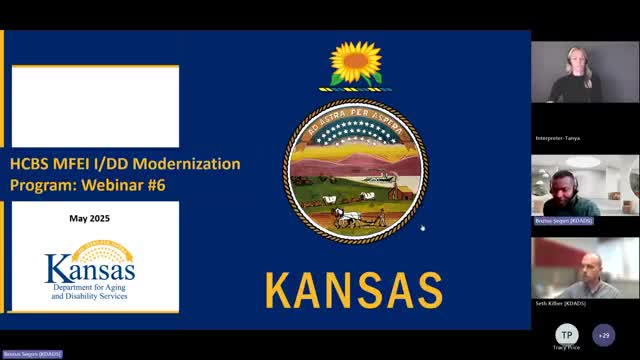
Summary
Kansas Department for Aging & Disability Services told providers and families that its new MFEI assessment will go live July 1, 2025. KDADS will apply a temporary, standardized “bridge” reimbursement rate for new HCBS IDD waiver participants from July 1, 2025 through June 30, 2026 while a permanent funding method is developed.
The Kansas Department for Aging & Disability Services (KDADS) said Friday that its new Medicaid functional eligibility instrument (MFEI) will go live on July 1, 2025, and that the agency will apply a temporary, standardized “bridge” reimbursement rate for participants who newly enroll on the home- and community‑based services (HCBS) intellectual and developmental disabilities (IDD) waiver.
KDADS Assistant Commissioner Seth Kilber said the bridge rate will apply only to people who are newly enrolled on the waiver after the July 1 go‑live date and will expire June 30, 2026. "We're still currently on track for a July 1, 2025 go live date," Kilber said. The agency plans a permanent, acuity‑based reimbursement structure after the one‑year transition.
Why it matters: The change replaces the legacy tiered rates for new enrollees and is intended to prevent service delays tied to uncertainty about reimbursement while the state transitions to an MFEI‑based funding model. KDADS said the bridge rate was designed to be cost neutral to the state's services budget by using average reimbursement for new enrollees from state fiscal year 2024 and by incorporating a 1.5% IDD rate increase approved for state fiscal year 2025.
Major points from the webinar:
• Scope and timing — KDADS said the MFEI will be completed by Community Developmental Disability Organization (CDDO) assessors but that KDADS will own the final eligibility score. Training prompts for CDDO assessors begin May 29; the offline application for CDDOs opens June 23; and July 1 is the announced go‑live date for all IDD assessments. Kilber said the bridge reimbursement begins for any new waiver participant whose initial assessment occurs on or after July 1, 2025, and that existing participants will retain their legacy tier scores (with the 1.5% increase).
• How the bridge rate was set — KDADS said it began with the average rates paid to residential and day service providers for people newly enrolled in SFY2024 and adjusted for the SFY2025 1.5% increase to produce a standardized, budget‑neutral rate. Kilber said the rate aims to reduce disruption for providers and families during the transition.
• Billing codes and examples — Kilber provided billing examples for how providers will bill under the temporary structure: a new participant’s day habilitation would use code T2021UB (the UB modifier to mark new‑enrollee bridge rates); residential services for a new enrollee would be billed using T2016UB. Kilber said providers who believe the bridge rate does not cover a person’s higher needs should request additional funding through KDADS’ extraordinary funding (EF) process.
• Extraordinary funding (EF) — KDADS staff said EF remains available for participants with complex medical or behavioral needs regardless of whether they are on a legacy rate or the bridge rate. Robin, a KDADS staff member with prior EF experience, described EF as variable in timing and said renewals are currently annual but KDADS is considering extending renewals (for standard EF) to every other year. On how long initial EF approvals take, Robin said she could not give a definitive timeline and that it can involve back‑and‑forth between providers and managed care organizations (MCOs): "I wanna say a month, but I don't want to be held to that either."
• Service planning and interRAI tools — Kilber said all three MCOs will use the interRAI service‑planning instruments to inform person‑centered plans. Because KDADS is constrained by a licensing agreement with the interRAI vendor, the state cannot distribute the proprietary tool itself; however, Kilber said completed service plans and the completed MFEI will be provided to families and providers to inform planning and appeals. Kilber emphasized training and certification for assessors and care coordinators and said KDADS will monitor assessments for consistency and quality.
• Training and oversight — KDADS said it has KSTrain modules for CDDO assessors and will work with the MCOs and the interRAI vendor on care‑coordinator training and certification. Kilber said a benefit of the new process is that KDADS will receive standardized assessment data and be able to QA and spot‑check for quality and consistency — a capability he said the state lacked previously.
• Grants and administrative funding — Kilber said various ARPA‑funded grants (day services, conflict‑free case management, HCV provider expansion) have closed and awards are being finalized. He said administrative implementation costs are paid through Medicaid administrative funds and federal mechanisms rather than the Medicaid services bucket.
What KDADS did not provide Friday: the agency said it had not finished the final rate tables and that a KMAP provider bulletin with specific rates will be released when the policy and rates have final approval. Kilber said the agency hoped to publish rate details in the coming weeks.
Voices from counties and providers: Shelley Harrington of Sedgwick County asked whether the bridge policy was an official policy and how it would be communicated under CDDO contracts; Kilber and a deputy secretary replied that KanCare/Medicaid rate approvals and KanCare policy are involved and that KDADS treats the bridge approach as a KanCare policy. Several providers and advocates pressed KDADS about transparency of the interRAI tool and how families can review or appeal assessments; Kilber said completed assessments and service plans will be available to families and providers and that KDADS will retain the assessment data for oversight and appeals.
Next steps and forward look: KDADS reiterated it will continue stakeholder outreach, finish the provider bulletin via KMAP with finalized rates, and hold one more webinar before the July 1 go‑live. The bridge payment period is time‑limited to June 30, 2026, after which KDADS intends to implement a permanent funding methodology tied to MFEI and related assessment data.
Ending: KDADS framed the bridge rate as a temporary, cost‑neutral step to reduce service disruption while the state moves to an MFEI‑driven funding model. KDADS asked providers, CDDOs, MCOs and families to participate in remaining trainings and feedback sessions leading up to the July 1 launch.