Get Full Government Meeting Transcripts, Videos, & Alerts Forever!
Get email alerts on the Motor Vehicle Definition topic
No spam. Unsubscribe anytime.
Appeals Court hears whether dirt bike on Tremont Street qualified as a "motor vehicle" in Commonwealth v. Hall
Summary
At an Appeals Court hearing in Boston, defense and Commonwealth lawyers disputed whether a dirt bike involved in a Tremont Street crash met Massachusetts’ statutory definition of a "motor vehicle," turning on precedent and which statutes apply to motorized bicycles and recreational vehicles.
May it please the court: the Massachusetts Appeals Court heard oral argument Monday over whether a dirt bike ridden on Tremont Street should be treated under the Commonwealth’s motor-vehicle statutes or under distinct provisions for motorized or recreational bicycles, a legal distinction that affects which offenses and penalties apply.
The issue matters because the defendant, Rufus Hall, was convicted and the trial judge denied his motion for a required finding of not guilty; on appeal, defense counsel argued the evidence was legally insufficient to prove the vehicle was a "motor vehicle" under Chapter 90 definitions, while the Commonwealth argued that a recreational or dirt bike used on a public way is a motor vehicle under Chapter 90B.
Daniel Di Maria, defense attorney for Rufus Hall, told the court the Commonwealth “failed to prove it was a motor vehicle and not a motorized bicycle.” Di Maria argued the record lacks required technical evidence — cylinder capacity, transmission type and speed — that would distinguish a motor vehicle from a motorized bicycle under the statutes, and invoked principles of statutory construction and the rule of lenity to press that the conviction should not stand absent proof the device met the motor-vehicle definition.
Lindsay Conkey, representing the Commonwealth with Assistant District Attorney Molly Paris supervising, said the case presented a straightforward legal principle: “a recreational vehicle is a motor vehicle at all times unless it is being operated off of a public way,” and the collision occurred on Tremont Street, which she described as a public way. Conkey argued that, even if a particular dirt bike could meet motorized-bicycle technical thresholds in some configurations, the legislature’s treatment of recreational vehicles means one operated on a public street is governed as a motor vehicle for purposes relevant here.
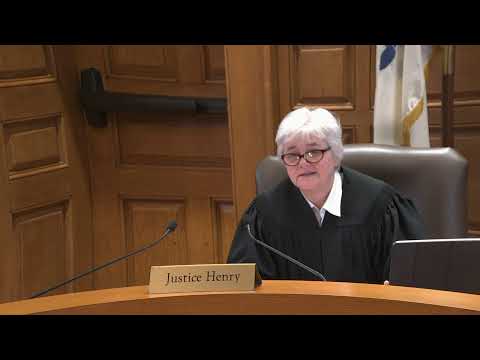
The judges pressed both sides on statutory text and precedent. Justice Henry asked for the body-camera video that the parties had introduced but the court had not yet received; defense counsel said he would file and send the footage immediately. Both sides referenced Griswold and other Appeals Court decisions (Dupree, Lopez, Zoltega) about whether motorized bicycles are subject to the traffic-law provisions in Chapter 90 and whether the location, speed and type of vehicle control the statute’s application.
Defense counsel emphasized a 2010 amendment to the recreational-vehicle statute that added operating-under-the-influence and reckless-operation provisions, arguing that amendment’s structure suggested the legislature intended those operational offenses to be placed specifically in the recreational-vehicle chapter rather than to subsume all motorized-bicycle conduct into motor-vehicle provisions. The Commonwealth responded that the amendment was not briefed below and does not negate the evidence that the device at issue here was a dirt bike being operated in a public lane.
Both parties acknowledged evidentiary gaps in the trial record. Conkey said the record contained officers’ testimony that the device sounded like a motorcycle and was in a public lane but conceded the record lacked technical measurements of engine size or speed. Di Maria said the absence of such technical evidence made the motor-vehicle element legally insufficient. The Commonwealth told the court the jury received a “fulsome” instruction that addressed vehicle categories and that any reference to motorized-bicycle definitions at trial was limited and harmless given the Commonwealth’s theory.
After extended questioning, the panel took the case as submitted. “Well briefed, well argued, really interesting case, and it’s submitted,” the presiding justice said, and the court recessed.
No decision was issued at argument; the Appeals Court will issue a written disposition in due course.