Get Full Government Meeting Transcripts, Videos, & Alerts Forever!
Get email alerts on the Autism Services And Policy topic
No spam. Unsubscribe anytime.
Autism council urges statewide needs assessment, seeks ABA coverage to age 26
Summary
Autism Spectrum Disorder Advisory Council co-chair Jamena Miller told the Rare Disease Advisory Council that her panel is pressing state leaders to fund a statewide autism needs assessment and to expand certain services for adolescents and young adults.
Autism Spectrum Disorder Advisory Council co-chair Jamena Miller told the Rare Disease Advisory Council that her panel is pressing state leaders to fund a statewide autism needs assessment and to expand certain services for adolescents and young adults.
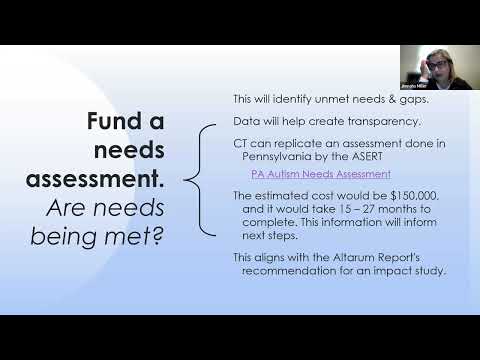
Miller, who serves as a co-chair of the autism advisory council and as a parent of a child with autism, said the council has been tracking bills including House Bill 7108 and HB 7109 and that a needs assessment would “identify unmet needs and gaps.” She said the assessment is estimated to cost $150,000 and would take a little over two years to complete if funded.
The assessment, Miller said, would collect data from Connecticut residents and caregivers and would be used “to inform policy and service delivery” and posted on the Department of Social Services website if funded. She described one other provision in HB 7108 — section 5 — as a proposal to create a working group to design a “complex case” team for youth who spend extended time in hospitals and need coordinated, cross‑agency follow up.
Why it matters: Miller said the autism waiver in Connecticut has a long waiting list and that adding slots without expanding provider capacity will not by itself solve access problems. The panel is also advocating to expand private‑insurance coverage of applied behavior analysis (ABA) beyond the current age cap: HB 7109 would extend coverage up to age 26, the council said.
Miller said the council supports removing the age cap because ABA is “the only autism service with an age cap” under some private plans and because extending coverage could reduce pressure on Medicaid and long waiver wait lists. She told the RDAC that “the wait list is currently at 14 years,” a figure she cited as context for the council’s priorities.
RDAC members noted overlap and some disagreement around statutory language. Leslie Bennett, RDAC co-chair, told Miller the rare disease council “share[s] a lot of your concerns, especially with the special ed and several of the bills.” Bennett said the RDAC’s earlier objection to HB 7108 concerned a proposed statutory change to the definition of intellectual disability and that any such change should include broader consultation.
What was not decided: Miller asked OPM and DSS to secure funding for the needs assessment; the council is awaiting that funding. There was no formal vote or binding direction recorded at this meeting on any of the bills.
Those who spoke on this topic included Jamena Miller (co‑chair, Autism Spectrum Disorder Advisory Council), Leslie Bennett (co‑chair, Rare Disease Advisory Council), Michelle Spencer Manson (clinical geneticist, Yale), and Mary Caruso (caregiver representative).
The autism advisory council provided background on membership, interagency representation (OPM, DSS, DDS, DCF, DPH and others), and on legislative tracking. Miller said the council uses third‑party assessments (Alterum was cited) to recommend a statewide study and emphasized policy uses for the data if funding is obtained.
The RDAC and ASDAC agreed to continue coordination and to exchange contact information for follow‑up as legislation progresses.