Habersham County outlines recycling upgrades, presents mixed cost and revenue figures
Loading...
Summary
County staff described site and equipment upgrades at recycling centers, reported rising tonnage and revenue, and presented air‑space valuation for the landfill; presenters and commissioners noted gaps in the accounting, including unclear salary inclusion and mattress recycling options.
Habersham County staff on Tuesday reviewed recent upgrades to the county’s recycling centers, presented financial summaries showing higher tonnage and gross revenue in 2024–25, and said those gains nevertheless leave some county costs and future landfill‑space questions unresolved.
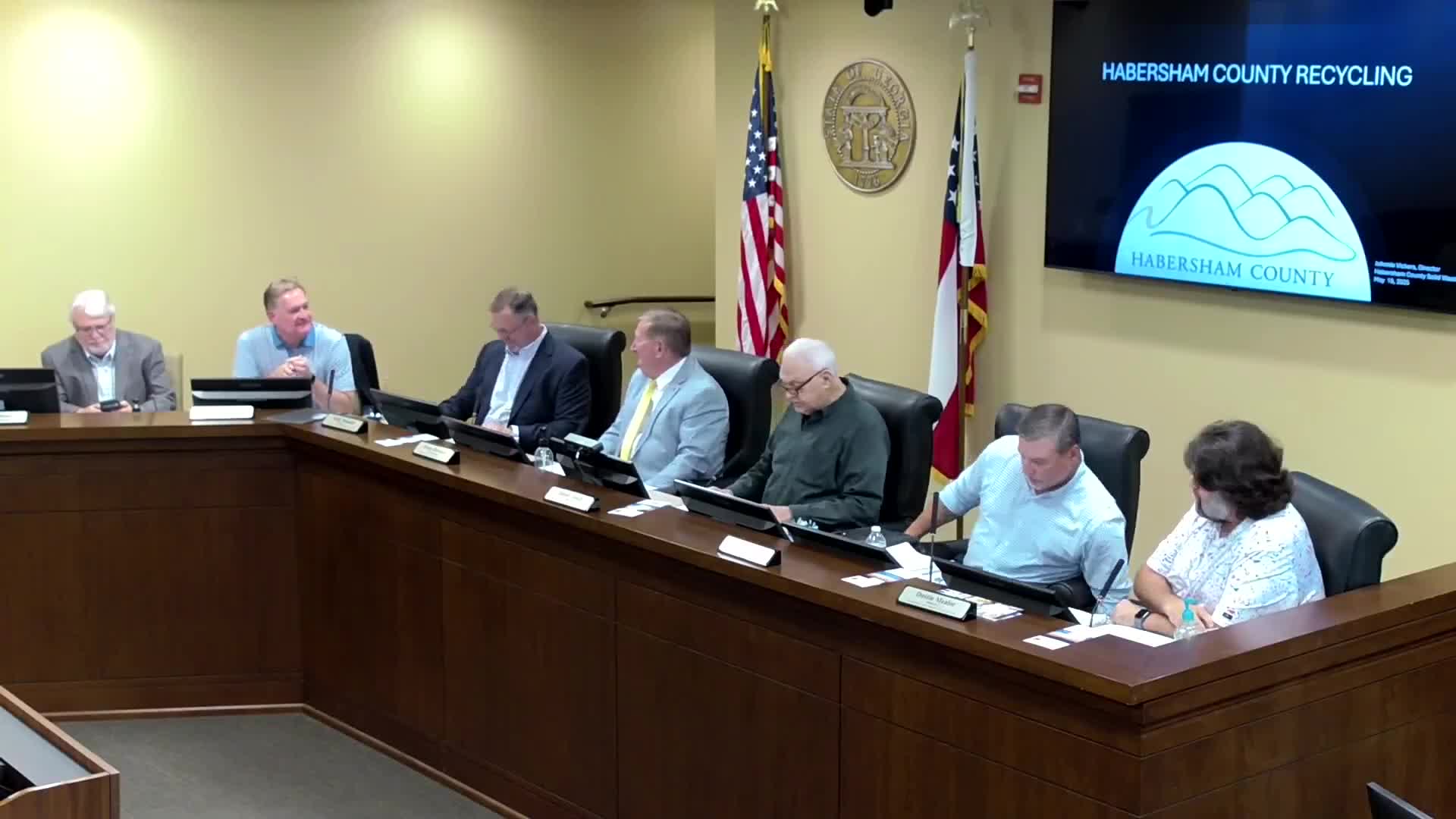
In a presentation to the May 2025 work session, Mister Bickers, a Habersham County staff member, summarized equipment and building improvements at the Clarksville, Cornelia and Kinney recycling sites, listed partnerships for textiles and electronics collections, and walked the board through recent tonnage, revenue and “airspace” calculations for the county landfill. “Recycling plays a crucial role in extending life of our landfill, reducing waste, and creating a more sustainable future for Habersham County,” Bickers said.
The presentation matters because recycling affects both the county budget and remaining landfill capacity: Bickers used a per‑ton tipping fee and measured density to convert recycled tonnage into cubic yards of landfill airspace and an estimated avoided tipping‑fee value.
Bickers described one‑time site upgrades split across fiscal years 2024 and 2025. He said Clarksville and Kinney coordinator offices were repaired or replaced and portable restrooms were replaced with operational restrooms. He listed several capital items reported in the slides: four concrete pads ($18,960), electrical panels and meter bases ($13,840), a used roll‑off truck ($79,000) and four self‑contained compactors ($99,003.51). Bickers also said four open‑top collection containers were replaced; the slide listed a figure that was not clearly audible. Separately, he said Clarksville and Kinney upgrades “totaled about $23,446.51.”
On operational performance, Bickers said the county increased collection‑center hours in February 2024 (from three days a week to six) and added partnerships with American Thrift Store and Children’s Healthcare of Atlanta for clothing and Textile collection and with Fusion Green for electronics collection in Cornelia. He reported higher gross revenues and higher tonnage for June 2024–April 2025 compared with May 2023–May 2024: the presentation listed $34,470 in potential revenue for 439.87 tons (May 2023–May 2024) and $37,588 for 509.72 tons (June 2024–April 2025).
Bickers also presented two different summaries of costs and “profit” that appear inconsistent in the slide deck. For May 2023–May 2024, he said a transport and labor cost summary was about $37,200, and elsewhere on the same slides he reported a figure described as $307,200 that produced a negative return of $2,730 for that period. For June 2024–April 2025, he presented a transport cost indicated as $17,651 and a stated profit of $17,782; other slide lines listed different intermediate totals. Bickers told the board that the slide figures do not include some salary line items and that salary estimates (as discussed separately for the next budget cycle) are “about $93,000–$94,000” for part‑time employees and partial roll‑off truck labor, remarks he said were not included in the materials shown.
On the value of landfill airspace, Bickers used a county tipping fee of $60 per ton and a compacted density of 1,200 pounds per cubic yard (0.6 tons per cubic yard) to calculate that a cubic yard of landfill space is worth $36. Using that method he reported that 381.23 tons (May 2023–May 2024) would equal about 635.38 cubic yards of airspace (valued at roughly $22,873.68) and that 461.82 tons (June 2024–April 2025) would equal about 769.70 cubic yards (valued at roughly $27,709), as shown on the slides.
Board members pressed staff on accounting and convenience. “Since we don’t offer a curbside pickup, that’s a great deterrent to recycling, I would imagine,” said Miss Akins, a county official, asking whether convenience explains lower capture rates. Bickers agreed, saying the centers’ conversion to self‑contained compactors — which allow residents to walk directly to the containers rather than climb metal steps — made the sites easier to use and corresponded with apparent increases in tons collected.
Commissioners also asked whether the recycling numbers shown were net of personnel and other operating costs; Bickers said the slides included materials, hauling, fuel and some labor/transport figures but did not include the full salary allocations and that those figures would be addressed in the upcoming budget work. The presentation noted statewide recycling rates for certain materials and cited the Georgia Recycling Coalition as an example of broader outreach and infrastructure efforts.
The presentation also flagged practical limits: Bickers said the county has struggled to find consistent outlets for used mattresses and that a prior mattress recycling partner in Atlanta operated only briefly. He urged continued partnerships, expanded recycling initiatives and community outreach to divert material from the landfill and “extend its usability.”
No formal motion or vote followed the presentation. County staff indicated the financial details and salary allocations would be clarified in forthcoming budget materials and recommended continued investment in recycling infrastructure and partnerships.