Get Full Government Meeting Transcripts, Videos, & Alerts Forever!
Get email alerts on the Recycling topic
No spam. Unsubscribe anytime.
Habersham County details $257,800 in recycling-site upgrades; tonnage and revenue rising but personnel costs unclear
Summary
County staff reported roughly $257,806 in one-time recycling-site and equipment upgrades split between FY2024 and FY2025, said the presenter, and showed rising recycling tonnage and gross revenue; the presentation noted some operating costs — notably full salary totals — were not included in the presented revenue figures.
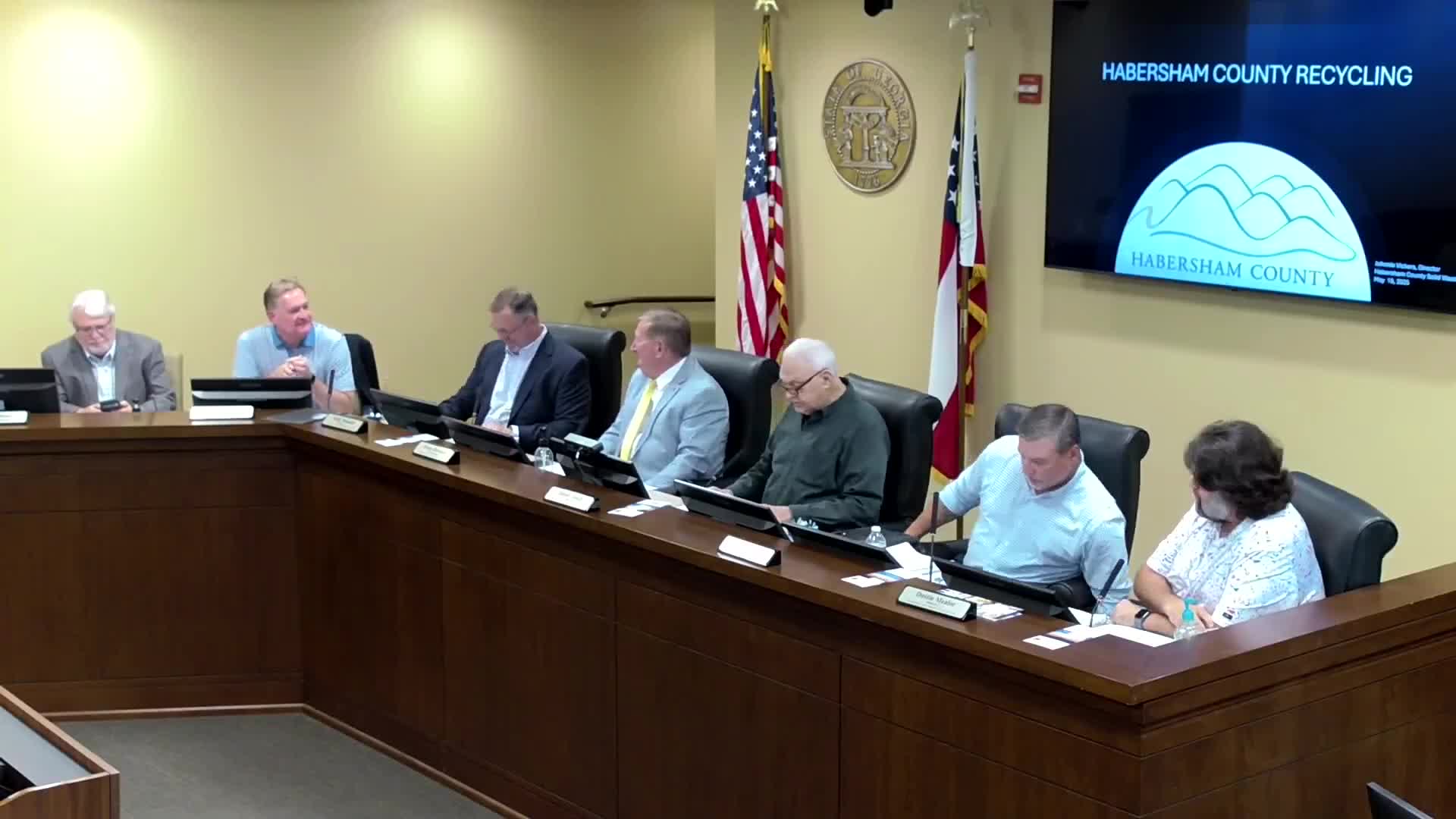
Habersham County staff presented an overview of recent recycling-site upgrades and operating figures at the county’s May 2025 work session, reporting about $257,806 in one‑time capital improvements split between the FY 2024 and FY 2025 budgets and describing a rise in recycling tonnage and gross revenue while noting that full personnel costs were not included in the presented profitability numbers.
The county staff member leading the presentation, Mister Bickers, said the upgrades included concrete pads, electrical panels and meter bases, a used roll‑off truck, four self‑contained compactors and replaced open‑top containers. “The self contained compactors enhance hauling by compacting cardboard and paper rather than hauling loose and bulking material,” Bickers said, noting the compactors improve accessibility for elderly and handicap users by eliminating metal steps.
Why this matters: County officials said recycling diverts material from landfill airspace, reduces hauling inefficiencies and can affect how quickly the county’s landfill uses remaining capacity. The presenter translated recyclables tonnage into landfill “airspace” value and showed that recycled material displaced an estimated $22,874 to $27,709 in landfill tipping‑fee value in the compared reporting periods.
Details from the presentation included specific line items and performance figures. Bickers listed equipment and site costs as: four concrete pads ($18,960), panels and meter bases ($13,840), temporary power service (reported as $4,160), a used roll‑off truck ($79,000), four self‑contained compactors ($99,003.51) and four open‑top collection containers (reported as roughly $22,079). Bickers said Clarkesville and Kinney recycling‑site upgrades (including new buildings and restroom work) totaled about $23,446.51. The presenter gave a grand total for the one‑time site and equipment upgrades of approximately $257,806.32, split evenly across FY2024 and FY2025 budgets (about $128,900 charged to each fiscal year).
On volumes and revenue, Bickers gave the following totals from his slides: May 2023–May 2024 produced roughly 439.87 tons and $34,470 in revenue; June 2024–April 2025 produced roughly 509.72 tons and $37,588 in potential revenue (the latter period covered about 10 months). After listing trailer rental and hauling fees, he showed net outcomes that varied across periods: one period showed a small negative return when certain costs were included, while the more recent period showed a positive net. When asked whether the figures shown were gross or net revenue, Bickers answered, “It’s gross.”
Bickers also explained the county’s formula for valuing landfill airspace (converting compacted cubic yards to tons and multiplying by the county tipping fee of $60 per ton) and used that to estimate the monetary value of airspace saved by recycling. He said the county’s compacted municipal solid waste density was 1,200 pounds per cubic yard (0.6 tons per cubic yard) and applied that figure to the reported tons of recyclables.
Members of the work session raised operating‑cost questions during the discussion. One questioner noted salary and personnel costs and asked whether those were included in the presenter’s cost figures; Bickers said the slides covered materials, hauling, fuel and related transport costs but that the full salaries figure was not in front of him. A separate speaker estimated total salaries for the recycling operation at roughly $93,000–$94,000, but that figure was offered as an estimate in the discussion and was not presented as a confirmed line item in the slides.
Bickers described operational changes since late 2023 and 2024: collection‑center hours were increased from three days to six days per week; a used roll‑off truck entered service; partnerships were formed for clothing/textile and electronics collections (cited partners included American Thrift Store, Children’s Healthcare of Atlanta and a local vendor, Fusion Green); and the county ground a year’s worth of yard debris and offered the mulch back to residents free of charge. He told the meeting that the self‑contained compactors were set on poured concrete pads and required electrical meter bases installed in coordination with the electric utility.
No formal motions, votes, or policy changes were recorded during the presentation. The session remained a staff briefing and discussion; staff did not present a resolution or request for an immediate vote during the segment covered in the transcript.
Ending: County staff asked for follow‑up questions and indicated some budget and salary details would be clarified later as the county finalizes its next budget materials. The presentation closed with a staff appeal to continue supporting and improving recycling efforts to extend landfill life and reduce waste.