
Council hears community grant update, camp capacity change and a spike in public records work
Get AI-powered insights, summaries, and transcripts
Subscribe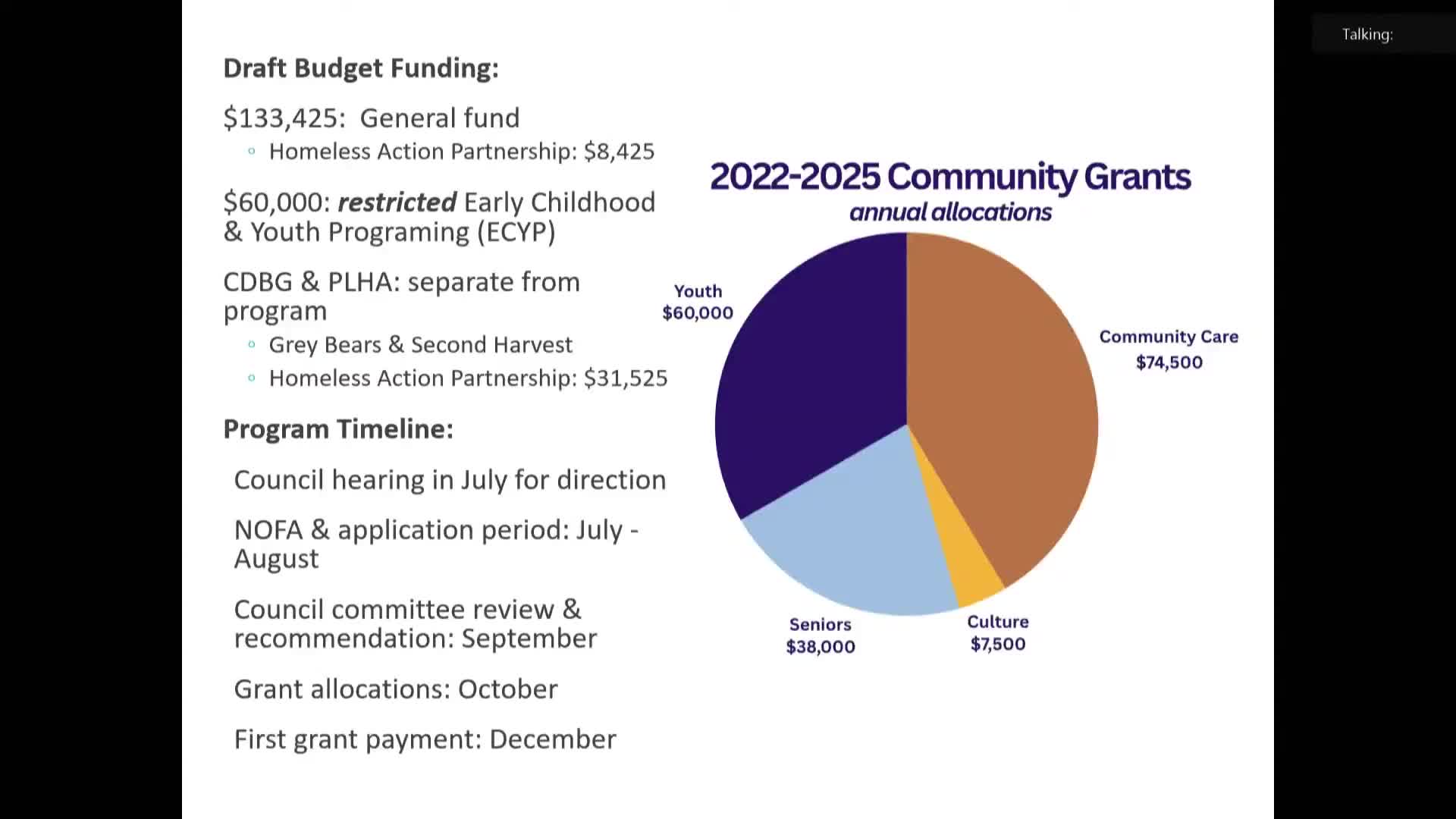
Summary
Staff outlined the community grant program (roughly $133,000 in draft allocation, with $60,000 ECYP restricted for early childhood/youth), a 20% capacity increase for the Camp Capital "Littles" program, and the city attorney described a sustained rise in public records requests that is consuming staff time.
City staff used the May 29 budget hearing to brief the council on the community grant program, youth programming and trends in public-records requests.
Community grants and ECYP funds: Chloe (community grants lead) said the draft budget earmarked about $133,000 for the community grant program but noted much of that funding is not yet directed to specific grantees. She said $60,000 in ECYP (early childhood and youth programming) funds are restricted and historically used for children- and youth-focused grants. Staff proposed a July hearing to set program cycle length, form an ad hoc review committee, and run a notice-of-funding-available period over the summer with final council recommendations sought in September.
Staff clarified that several large nonprofit recipients (Second Harvest, Gray Bears, Community Bridges) were moved out of the general community grant cycle and funded separately through CDBG or restricted funding in recent years; staff said awards from prior CDBG allocations are being rotated across recipients and the city will continue to apply for CDBG funds to support these core service providers.
Camp Capital "Littles": Recreation staff reported a modest capacity increase for the Camp Capital Littles (pre‑K age cohort) — a roughly 20% bump in seats — accomplished by changing session limits rather than adding new space. Staff suggested resident-priority registration and session limits (as used in prior junior-guard programs) to maximize access.
Public Records Act workload: City Attorney Sam (online) described a marked increase in large public-records requests. She told the council that across four recent large requests the clerk’s office gathered “approximately 20, 30, 40 thousand documents,” roughly 15,000 of which reached the city attorney’s office for review and about 4,000 documents were produced to requesters. Sam explained that many documents are nonresponsive, privileged, or exempt (personnel or law-enforcement records), requiring attorney review and sometimes rolling productions for very large sets.
Why this matters: staff said the growth in records requests demands more staff and attorney time and can slow responses to other priorities; the council asked for ongoing reporting on PRA workload and potential options to streamline responses (search-term scoping, IT-assisted email searches, and rolling productions when needed).
Other notes: staff confirmed the community grant program’s past total allocations and described the July ad hoc review timeline; the council asked staff to consider requiring regular reporting from grantees and to explore a possible four-year grant cycle and more frequent check-ins for larger awards.