Get Full Government Meeting Transcripts, Videos, & Alerts Forever!
Get email alerts on the Urban Forestry topic
No spam. Unsubscribe anytime.
Verona arborist outlines urban-forest plan, ash-borer strategy and volunteer events at Arbor Day presentation
Summary
City of Verona certified arborist presented an urban-forest strategic plan funded by a DNR grant, outlined emerald ash borer treatment and phased removals, and promoted planting and volunteer opportunities including an Arbor Day library planting and a May 18 restoration day.
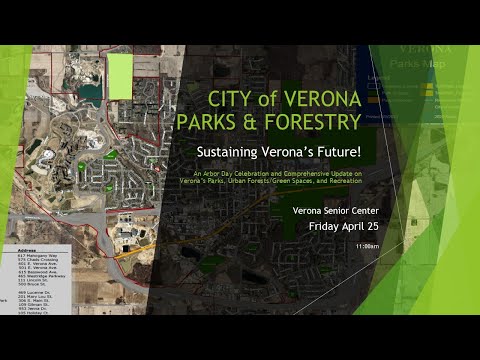
Jerry Halesman, the City of Verona’s certified arborist, used an Arbor Day presentation to summarize the city’s urban-forest work, describe its response to emerald ash borer and announce planting and volunteer opportunities.
Halesman told attendees the Parks and Forestry division manages roughly 4,800 public trees across about 34 parks and nearly 200 acres and said the city’s tree canopy is about 16 percent. “We have over 4,800 trees that the city manages,” he said. He said the city plants about 300 trees per year and is working to increase canopy toward a 20–30 percent goal.
The nut graf: the presentation described how a DNR urban-forestry grant and an updated strategic plan are shaping near-term actions — including an inherited- or “heritage” ash program to retain a limited number of high-quality ash trees, continued chemical treatments for selected trees, and phased removals and replacements to reduce long-term treatment costs and improve species diversity.
Halesman explained the emerald ash borer (EAB) remains the primary pest threat to Verona’s ash trees and said the city has treated ash trees “since about 2014, ’15” on a semiannual cycle. He described a heritage-ash program to identify roughly 50 high-quality ash trees to retain with continued treatment while other ash trees would be removed and replaced over a five- to ten-year period. “We’re identifying mature, like, valuable trees that we want to keep around, removing the less healthy trees,” he said.
On treatment costs and methods, Halesman gave general examples rather than certainties: private arborists typically charge about $10–$15 per inch of diameter-at-breast-height (DBH) for treatments, and a trunk-injection example for a large tree could be on the order of “$300 every two years,” depending on size and product. He described trunk injection as a “systemic” method that delivers pesticide into the tree’s vascular system.
A central theme of the presentation was species diversity. Halesman said Verona will follow diversity guidance he described as DNR-approved limits — commonly summarized in urban forestry practice as a 10/20/30 rule (no more than 10 percent of a species, 20 percent of a genus, 30 percent of a family) — to reduce the risk that a single pest or disease wipes out large portions of the canopy. “Diversity, diversity, diversity,” he said.
He detailed program and equipment updates funded in part by grant and city resources: updates to the city’s approved street-tree list, new electric pruning saws and a battery-powered utility truck, improved in-house grinding and removal capacity, and plans for root-barrier and suspended-pavement trials on sidewalks with buckling problems. Halesman said the urban-forestry strategic plan was required for the DNR grant and helped update planting standards and the approved-tree list.
Halesman also reviewed pests and diseases the city is monitoring beyond EAB, including spongy moth caterpillars (which the city treats or traps on affected trunks), beech-leaf disease, elm pests, scale insects, anthracnose and other fungal and bacterial diseases. He emphasized standard maintenance and correct pruning techniques — including a three-cut method — to limit decay and hazards.
Community engagement and near-term events were called out as implementation elements: Halesman promoted an Arbor Day tree-planting at the public library scheduled for 1:30 p.m. (the presentation initially announced a 1:00 p.m. start but the time was confirmed at 1:30 p.m.), a volunteer restoration day on May 18 for hillside work and prairie restoration, and the city’s “Adopt an Ash” sponsorship option for residents who wish to fund treatment of a specific ash tree.
He also gave brief updates on several park projects and programs including Century School Park (native-plant and playground planning), Deerwood Lake Park plantings supported by a retail partner, an expanded ice-rink season at a city park, and early planning for a community recreation center in the former library/church building with a target to begin programming by December of this year. On pesticide use he said pesticide application is confined to large areas such as athletic fields and certain restoration sites, and the city is limiting pesticide use elsewhere.
The presentation included multiple audience questions and brief clarifications about treatment timelines, removal cadence and whether the city or state would remove specific trees flagged in maps. Several practical recommendations were highlighted (plant species matched to planting sites, wider terraces where possible to reduce root damage to sidewalks, use of cultivars or hybrids to gain both native benefits and urban tolerance).
Ending: Halesman closed by inviting volunteers to the library planting and the May 18 restoration day and by offering to share the city’s approved street-tree list and urban-forest strategic plan on request. “If you want to keep your ash around and it’s on the list to get removed, you can sponsor the Ash Tree,” he said, describing the city’s Adopt an Ash program.