Get Full Government Meeting Transcripts, Videos, & Alerts Forever!
Get email alerts on the Animal Control Facility Budget topic
No spam. Unsubscribe anytime.
Kerr County officials, residents debate how to cover $1.5M-plus shortfall on new animal control facility
Summary
Commissioners and residents on Monday discussed options to complete a voter-approved animal control facility after staff and the project team reported additional costs. Commissioners weighed using reserves, budget reallocation or delaying purchases; no formal action was taken.
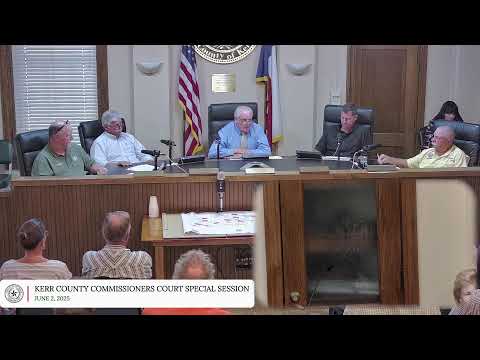
Kerr County commissioners and a roomful of residents on Monday discussed how to pay for previously unbudgeted costs to complete a voter‑approved animal control facility, but they took no formal action.
Commissioner Holt, who led the item, described three cost tracks and a set of “partially operational capable” and “fully operational capable” build options. Holt said an initial set of cuts and reuse of existing equipment could reduce near-term spending but that the county still faces an additional funding need for the project this year and beyond.
The conversation centered on detailed cost estimates offered by staff and the project team: Holt identified roughly $487,000 to reach a “partially operational capable” level with new kennel and equipment purchases and additional items that, when combined across two budget years, the court record shows could total about $820,000. Holt and project staff later said retrofits and deeper cuts could lower construction costs by about $40,000, but kennel and equipment costs remain the major driver. Holt recommended finding $212,000 this year to purchase new kennels and critical equipment to allow an initial move and operate using some existing furnishings and equipment.
Several residents and shelter volunteers urged the court not to cut key elements, citing animal welfare and staff safety. Gail Wright, a resident who said she had attended the meeting, told the court: “The citizens of Kerr County are that homeowner, and we need to send a strong message that we will not tolerate being lied to and overcharged. Please stop spending our money.” Shelly Sandy, who provided written handouts about cat‑room outfitting, warned that some laminated cabinets and other reused fixtures “harbor disease” and could reduce quarantine capacity. Karen Johnson, volunteer dog rescue coordinator for Kerrville Pets Alive, said cutting dog kennels “will make our euthanasia rate go way up” and stressed that sally ports are necessary for safe animal transfers into the building.
Project details and funding options presented during the meeting included: - Kennels: Holt said the fully new, “gold‑plated” kennel package for dogs would cost roughly $311,000 for 32 new dog kennels; isolation and quarantine kennels were noted as essential and cost‑drivers. Holt proposed a reduced kennel footprint of 18–20 as a possible compromise to lower cost but several volunteers said that would not meet current demand. - Cat kennels: New fabricated cat kennels were estimated at about $88,563; some commenters urged reuse of existing stainless steel rolling cat units but raised sanitation and capacity concerns for certain cabinets and fittings. - Furnishings, fixtures and equipment (FFE): New FFE was estimated at about $124,000; the project team suggested moving existing compatible furniture where practical to save costs. - Rainwater collection grant: Holt said a rainwater collection element is part of the facility and that a grant of roughly $125,000 is available to offset costs for water tanks and pumps. - Fence and gates: Holt outlined an entrance/ perimeter fence and automated gate package costing about $18,000 and discussed a potential donated 700–900 foot fence offered by UGRA that would incur moving and installation costs.
Commissioners and staff discussed three broad funding approaches: using year‑end unspent budget lines, adding the project to the 2026 budget, or selling the county’s existing animal control property and committing proceeds to the project. Court finance staff reported $536,000 in interest earnings on bond proceeds, and participants said the county’s existing property could be valuable (participants referenced a rough market estimate in the millions but did not present an official appraisal).
Fred Henneke, chair of the county’s Capital Improvement Planning committee, reminded the court the committee vetted the project in detail before the bond and urged commissioners to fund a properly functioning animal control facility. Henneke said the voters approved a new facility as presented in bond materials and urged the court to allow initial operations with later improvements, if necessary.
County Judge Kelly and other commissioners said they remained committed to building the facility as approved by voters but stressed they must identify funding sources. Commissioner Holt reiterated his recommendation to fund the $212,000 near‑term gap to enable an initial move and to dedicate proceeds from the sale of the old property to achieve full build‑out.
No formal motions or votes were taken on expenditures at the meeting. Commissioners asked staff to continue evaluating options and to return with recommended funding sources and a more detailed cost‑reduction plan.