Get Full Government Meeting Transcripts, Videos, & Alerts Forever!
Get email alerts on the Pending Loads topic
No spam. Unsubscribe anytime.
Utilities, Energy Division and stakeholders debate pending‑loads treatment and project risk; advice letters due this cycle
Summary
Workshop participants discussed how pending loads will be treated in distribution planning, with a joint pending‑loads advice letter due June 30, 2025 and a CPUC resolution expected in September under the Track 1 framework.
Stakeholders at the May 22 workshop pressed utilities and Energy Division for details about how pending loads and project prioritization will be treated in the 2025 distribution planning cycle.
Why it matters: Whether utilities treat pending loads as part of scenario inputs affects project prioritization and whether an area faces higher risk of capacity shortfalls. Pending‑load treatment also informs advice letters and possible CPUC guidance on how to allocate limited capital among competing needs.
Key points from the workshop:
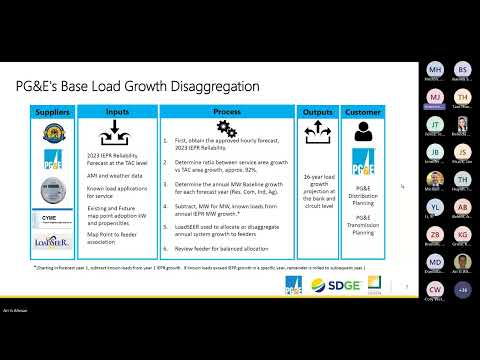
• Pending‑loads advice letter and timing — Workshop facilitators reminded participants that the IOUs planned to file a joint pending‑loads advice letter (tier 3) on June 30, 2025; a CPUC resolution was expected in September under the Track 1 framework discussed at the workshop. PG&E and others noted the pending‑loads advice‑letter process will inform how pending loads are included in scenarios and planning.
• Early implementation and examples — SCE and SDG&E said they included selected pending loads under an early‑implementation arrangement with Energy Division for the current 2024–25 planning cycle. SCE said examples included Tesla‑related charging and Port of Long Beach projects; SDG&E said it included some truck‑stop and port coordination information.
• Risk profiling and categories A/B — Utilities explained that adopting or excluding pending loads changes a risk profile for capacity planning. PG&E described a framework in which pending loads (categories A and B in their pending‑load framework) create higher localized service risk if not incorporated into project designs; Mark Jimenez said using pending‑load data can change where utilities expect to build capacity and what projects they prioritize.
• Project prioritization and execution tracking — The IPE said it will review project prioritization and project execution tracking (the latter is new in the IPE scope for this cycle). Utilities said project prioritization decisions will be included with their GNA filings and that project execution metrics will be tracked for the IPE’s review.
• Regulatory path — Energy Division staff and workshop presenters said the advice‑letter outcome and a forthcoming resolution will clarify pending‑loads treatment and how utilities must document pending‑load assumptions in the GNA filings.
Next steps: Utilities will file the joint pending‑loads advice letter (June 30); stakeholders can comment through the advice‑letter process and the IPE will review execution‑tracking metrics once utilities file them.