Get Full Government Meeting Transcripts, Videos, & Alerts Forever!
Get email alerts on the Child Welfare topic
No spam. Unsubscribe anytime.
DCFS officials cite staff turnover and timeliness gaps while reporting decline in foster-care population
Summary
Arkansas Division of Children and Family Services (DCFS) presented technical rule changes and a third-quarter performance report to a legislative committee, reporting staffing-driven delays in investigation timeliness, county caseload swings, and continued declines in the number of children in foster care.
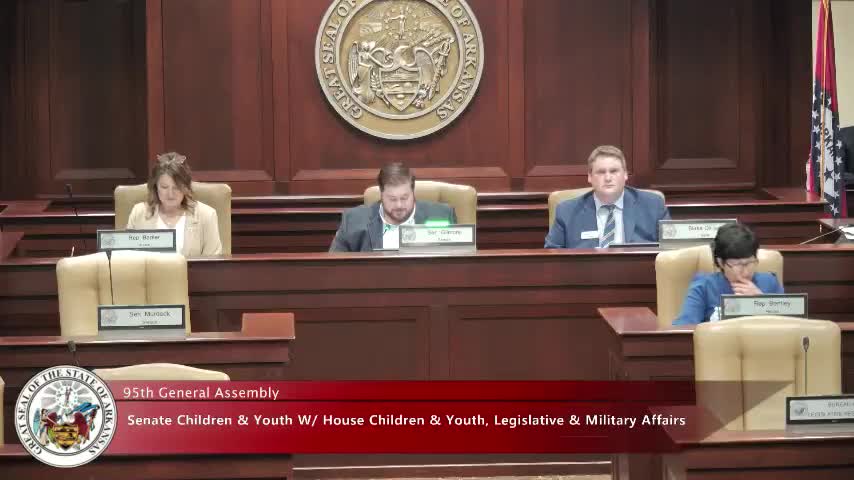
The Division of Children and Family Services at the Department of Human Services presented technical rule revisions and its third-quarter performance report to a joint legislative committee on June 1, 2025, saying workforce turnover has affected the timeliness of investigations while foster-care numbers continue to decline.
The rules packet — described by Assistant Director Amber Sartain as reflecting current DCFS practice on “safety and risk management” — includes technical changes and replacement of outdated terminology, and the committee voted to review the rules. “There is no fiscal impact. We didn't receive any public comments during the public comment period,” Sartain said.
Tiffany Wright, director of the division, told the committee that for the quarter covering Jan. 1–March 31 the Tala Beasley hotline received 8,154 child-maltreatment reports; 6,677 were assigned to DCFS, 5,090 were accepted for investigation and 1,587 were assigned to differential response. “Sixty-two percent of our maltreatment reports were found true for neglect, followed by 24 percent for physical abuse,” Wright said.
Wright and members discussed continuing challenges with timeliness of initiating and closing investigations. Wright said turnover causes older reports to be deprioritized when new reports arrive and that the division is “continuing to focus on this with our staff across the state.” She told legislators the division has convened its investigations team to drill into local patterns.
The report showed 1,512 in‑home cases at quarter end serving about 3,500 children, and monthly home‑visit rates that have improved in recent fourth quarters. DCFS reported a falling foster‑care population and roughly equal numbers of entries and discharges; discharge reasons listed 40% reunification and 25% adoption. At quarter end more than 78% of children in care were in family‑like settings, monthly visits to children in foster care were 85%, and 75% of siblings were placed together.
Wright said reoccurrence of maltreatment within the measured period was about 6%, which she said remained below the national standard. The number of children available for adoption at quarter end was 97, and DCFS finalized 21 adoptions in the quarter; 40% of those adoptions were by relatives and 34% involved youth older than 10.
Lawmakers pressed for county‑level detail after committee members pointed to large caseload swings in particular counties. Representative Wardlaw asked why Bradley County’s reported caseloads went from 0 in one report to more than 22 in another; Wright explained that a reported “0” signifies no assigned county caseworker at the time and that cases are moved to neighboring counties when necessary. She confirmed the agency regularly moves cases to ensure they are worked and said workforce shortages drive much of that variation.
Members asked about retention measures. Wright said turnover has improved from roughly 60% to about 48% and that the recent pay plan is expected to assist recruitment and retention. She described non‑monetary efforts including trauma‑informed supports (CSIRT training), work groups with the University of Arkansas to redesign new‑staff training, supervisor training initiatives and periodic workload analyses intended to balance staff and cases across counties. The division reported a recent hiring event produced six hires.
On criminally severe maltreatment, Representative Tosh asked who leads those investigations; Wright said the hotline assigns calls either to DCFS or to the Crimes Against Children Division (CACD) of the Arkansas State Police and that more severe allegations typically go to CACD.
Committee members also reviewed a statutorily required overturned‑investigations report (submitted Dec. 1, 2024 under Act 1025 of 2017). Wright walked through the example for one county, showing the number of hotline reports, accepted investigations, findings and appeals; in Benton County the report listed 5,349 hotline reports, 2,124 accepted for investigation, 312 found true (14%), 29 appeals and two overturned findings (about 6.9% of appealed cases). Wright said a follow‑up report for 2025 would be submitted next month.
The committee moved to review the DCFS rules packet and approved the rules review by voice vote. No public comments were reported during the notice period.
Committee members asked DCFS to provide additional county‑level staffing numbers offline and to return with more definitive information on training and retention steps.
What happened next: the committee approved the rules review and closed the item; DCFS said another overturned‑investigations report will be filed next month.