
House adopts conference report on housing bill, creates CHIP tax-increment program with $200 million cap
Get AI-powered insights, summaries, and transcripts
Subscribe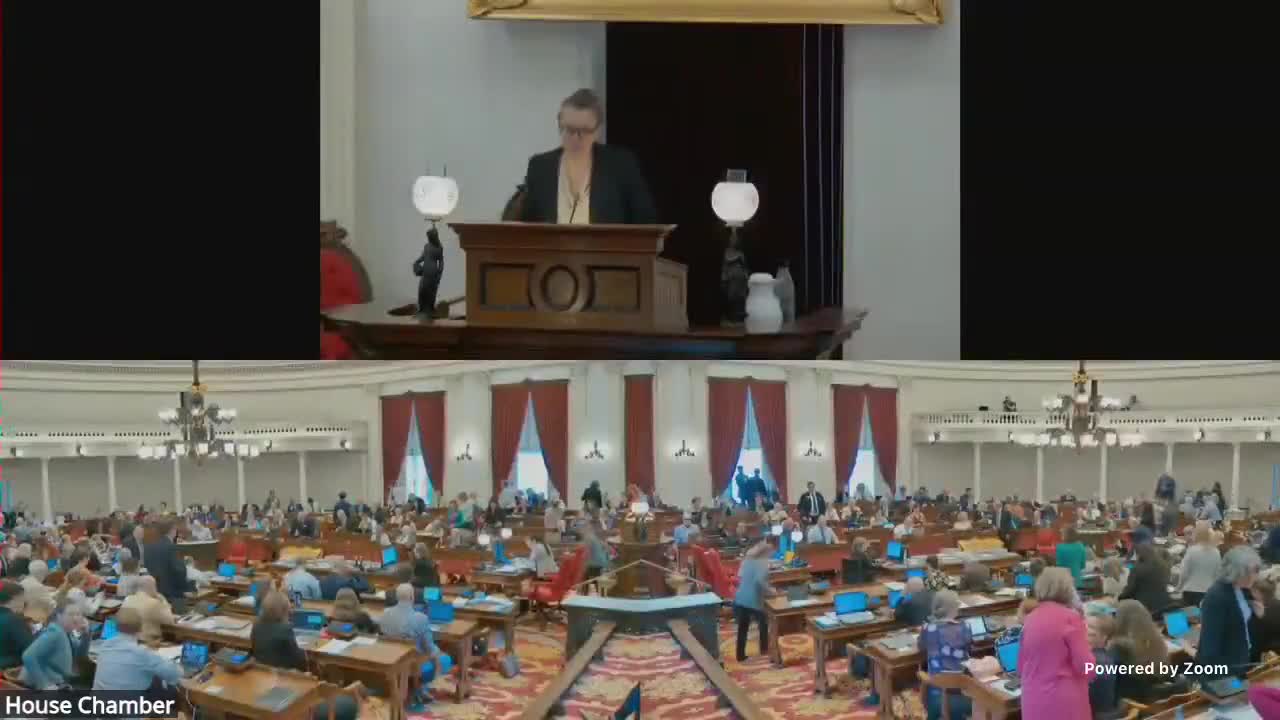
Summary
The Vermont House adopted the committee of conference report on Senate Bill 127, an omnibus housing bill that establishes a Community and Housing Infrastructure Program (CHIP) using tax-increment financing, sets a $200 million program cap, and includes reporting and review provisions.
The Vermont House adopted the committee of conference report on Senate Bill 127 on a roll-call vote, approving a package of housing measures that creates the Community and Housing Infrastructure Program, a tax-increment financing (TIF) tool with a $200,000,000 cap to support infrastructure for new primary residences.
The bill matters because it creates a new financing tool — CHIP — intended to encourage development of primary residences across urban and rural Vermont, while including guardrails intended to limit impacts on the statewide education fund. Member from Woodstock, Representative (House member), who presented CHIP provisions for the conference committee, said the measure balances the need for infrastructure financing with protections for the education fund.
Under the conference report, CHIP generally follows existing statewide TIF rules for eligible improvements but narrows the purpose to projects that create new primary residences under section 19 o 7. The program sets a $200 million lifetime cap on approved projects; projects that qualify as affordable housing may retain 85% of education-property increment, while other qualifying projects may retain 75%. Applications must be submitted on or before Dec. 31, 2035. The Vermont Economic Progress Council (VEPSI) will review CHIP applications; VEPSI requested up to 90 days to approve an application from the date it is deemed complete to allow for site visits and review. The conference report also sets an automatic review of retention percentages at the end of 10 years and mandates annual reporting by VEPSI, with a fuller review at the 10-year mark.
The conference committee removed several items from earlier drafts: a residential universal design study committee was omitted for now; a VHFA study on off-site modular housing was omitted because the conference budget did not fund the study and the agency indicated limited staffing; and the previously proposed sunset of the statewide TIF program was removed from the bill. The Land Use Review Board review and recommendation on limits to municipal housing appeals was advanced to a November 15 due date for legislative consideration, after the conferees deferred a final decision.
During floor questions, members pressed for fiscal clarity. A member asked for estimates of how much would be withheld from the education fund; the presenter said precise fiscal impacts could not be predicted with confidence and that the $200 million figure is an aggregate limit on initial approvals over a multi‑year period. The House adopted the committee of conference report by roll call: 137 yes, 2 no. The House then suspended the rules to message its action to the Senate forthwith.
The bill contains several implementation and oversight mechanisms: VEPSI will prepare annual reports, VEPSI may develop guidelines rather than formal rules for some items, and the statute limits inclusion of contiguous parcels (contiguous parcels already developed will not be rolled into a CHIP project; later-developed contiguous parcels would be a separate project). The conference report also sets definitions for “affordable housing” and “moderate-income housing” and specifies that at least 15% of units be affordable to qualify for certain exemptions of the but-for test, while 25% of units are required to qualify for a higher increment tied to moderate-income housing.
Representative (Member from Woodstock) characterized the conference report as a compromise that has the governor’s support and asked the body to approve the report. Following adoption, the House voted to message the action to the Senate, and the session recessed.
Less critical details and next steps: the statute references existing TIF rules for eligible improvements; the Vermont Housing Finance Agency (VHFA), Vermont Housing Conservation Board, and the director/commissioner of Housing and Community Development were added to VEPSI membership in nonvoting or voting roles as described in the report. Legislators noted that CHIP uptake may be constrained by workforce capacity, permitting, and willing communities and that annual legislative review will allow monitoring of program performance.