Get email alerts on the Ev Charging Standards topic
No spam. Unsubscribe anytime.
Building Code Council committee debates EV-charging terminology, utility exceptions and percentage targets
Summary
The State Building Code Council’s Building, Fire, and Plumbing (BRFW) committee on May 30, 2025, discussed proposed amendments to state EV-charging code language, including aligning terms with the International Energy Conservation Code and International Code Council, adding a utility-capacity exception for new buildings, and revising the split among EVSE, EV‑ready and EV‑capable parking spaces.
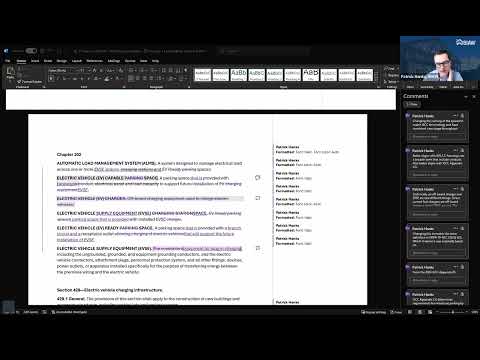
The State Building Code Council’s Building, Fire, and Plumbing (BRFW) committee on May 30, 2025, discussed proposed amendments to state EV-charging code language, including aligning terms with the International Energy Conservation Code (IECC) and International Code Council (ICC), adding a utility-capacity exception for new buildings, and revising the split among EVSE, EV‑ready and EV‑capable parking spaces. Todd Byreuther, serving as BRFW pro tem, opened the working session and said, “So today, we're gonna have a very focused committee meeting... only discussing and potentially taking action on the EV charging proposal.”
The conversation mattered because committee members are preparing a recommendation to the SBCC and staff for rulemaking (CR102). Patrick Hanks of the Building Industry Association of Washington proposed edits to tighten terminology (using “EVSE” rather than “EV charger”) and to bring Washington’s language into closer alignment with model codes. “In 90% of cases, the actual EV charger is located inside of the electric vehicle, and the EVSE, the external thing that we call the charger, that's not the charger. It's just supplying electrical current to the internal charger,” Hanks said.
Committee members and stakeholders debated three principal technical and policy issues: 1) terminology and definitions (EVSE/EV‑ready/EV‑capable) and consistency with IECC/ICC language; 2) a proposed exception allowing jurisdictions to reduce or convert required EVSE/EV‑ready spaces to EV‑capable spaces if a utility certifies in writing it cannot provide sufficient power within a set timeframe; and 3) how to calculate required spaces for mixed‑use buildings and whether to cap required EV infrastructure against dwelling-unit counts to avoid disproportionately high requirements for projects with high parking ratios.
On the utility exception, proponents said the text was drawn from the 2024 IECC (appendix) and is intended to prevent construction delays when utilities cannot provide the requested electrical capacity. Patrick Hanks described the practical scenario: when a utility certifies a percentage of required capacity it cannot deliver, “the building official can work with the builder to figure out... adjusting the requirements to be based off that.” Several committee members supported a form of the exception but questioned parts of the ICC language — notably the two‑year timeframe cited in the model code. Some members said two years felt short and suggested the timeframe needed refinement; others said keeping the period short helps avoid long construction delays and aligns with the committee’s intent to avoid blocking occupancy.
Participants also discussed how the three categories (EVSE, EV‑ready, EV‑capable) should be treated together so totals match the committee’s overall adoption target. Committee drafting had increased total infrastructure coverage compared with the existing Washington code (committee proposal raises combined coverage nearer to a 60% long‑term target split across the three categories). Climate Solutions provided public comment opposing rollbacks to EV‑ready requirements and urging higher ready/SE shares, arguing that “EV‑capable spaces are far less cost effective, requiring higher future costs to bring the parking spaces up to a level where EV infrastructure can be installed.” Jeremy (public commenter) noted that load‑management systems can allow a single 40‑amp circuit to serve multiple stalls, saying load limiting and “load management systems... could serve 4... parking spaces with that 40 amp circuit.”
Committee members asked staff to clarify several items before final recommendation: (a) whether the IECC exception should apply to all occupancies or be limited (the IECC exception cited applies to one‑ and two‑family dwellings in its residential appendix, while BRFW discussed applying a version to IBC occupancies), (b) the appropriate timeframe for utility certification (two years in ICC text vs. suggestions of longer windows), (c) whether to cap required EV infrastructure to dwelling‑unit counts for small multifamily projects that have high parking ratios, and (d) how state statute language (the committee referenced “RCW 19 27 5 42 b” in the meeting) interacts with any changes for particular occupancies.
There was no formal committee vote because the meeting began without quorum and a quorum was not established during the discussion. The committee and staff agreed to post a revised BRFW draft incorporating the conversation and suggested edits so absent members can review before the council meeting. Todd Byreuther said staff would publish an updated draft and that committee members could send further language proposals; Patrick Hanks agreed to draft suggested edits to the utility exception for staff to upload.
AI generated
The text on this page is AI generated. Summaries, highlights, analysis, and video transcripts are all produced from the original source material.
AI can make mistakes, so if you spot one, and we will fix it for everyone.
Note: the source content is unaltered by us. Any content source we link to, be it a video, an audio recording, or a document, is presented exactly as its publisher released it. That publisher is usually a government body, sometimes an individual official or another organisation.