
Senate adopts $2026–27 budget with big boosts for K‑12, property tax relief and long‑term care
Get AI-powered insights, summaries, and transcripts
Subscribe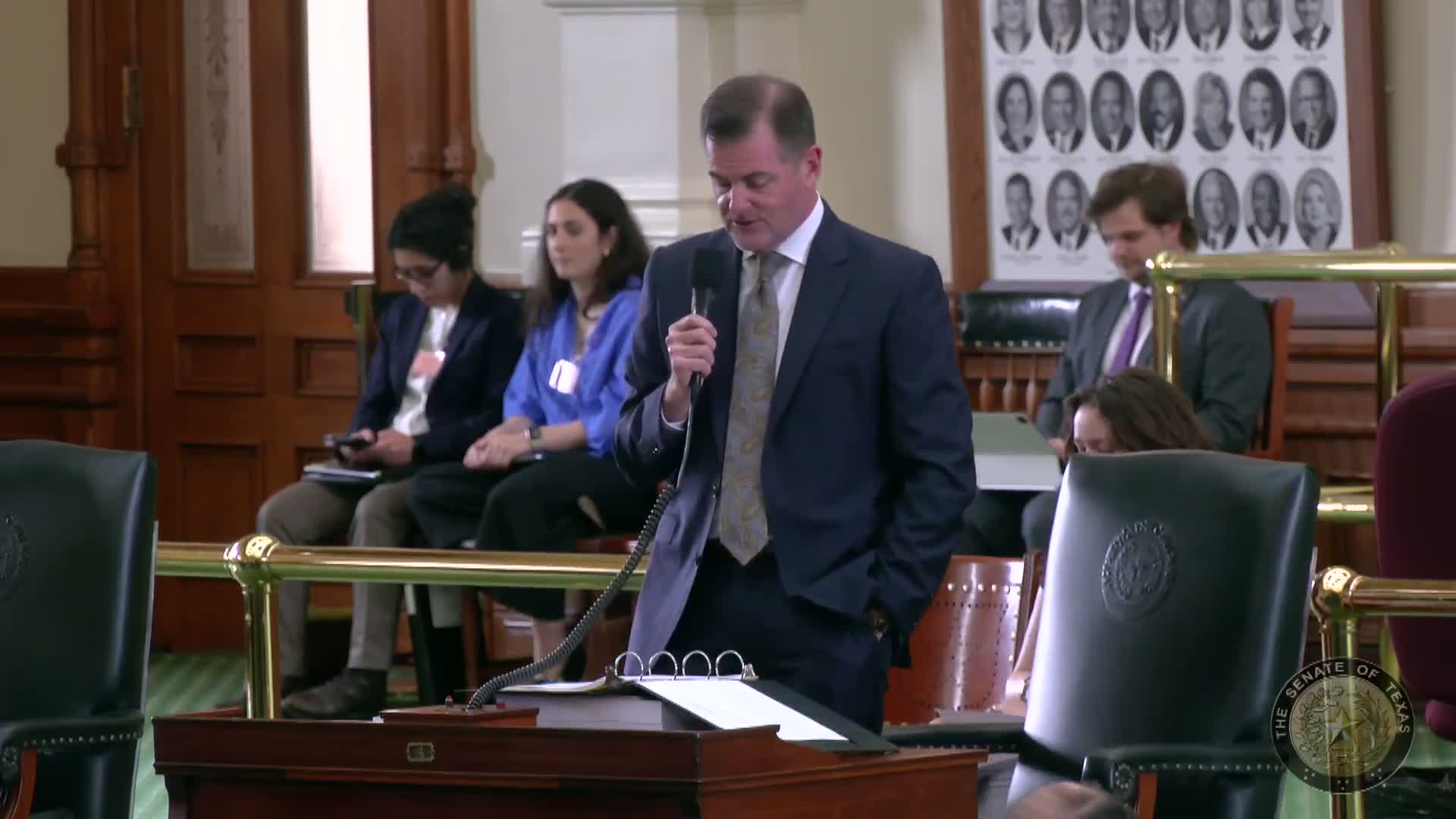
Summary
The Senate adopted the conference committee report on Senate Bill 1, the two‑year state budget for fiscal 2026–27, approving major new investments in public education, property tax relief, health care and infrastructure.
The Senate adopted the conference committee report on Senate Bill 1, the statebiennial budget for fiscal 202627, after conferees laid out changes negotiated with the House and senators discussed key allocations.
Senator Huffman moved adoption of the conference committee report for Senate Bill 1 and described the package as a budget that “falls within all constitutional and statutory spending limits and meets the needs of our rapidly growing state.”
The budget increases funding for public education, provides property tax relief and directs new money toward public safety, infrastructure, health and human services and workforce programs.
The conference report includes an additional $13,600,000,000 in all funds for the Foundation School Program (FSP) over the current biennium, funding labeled by conferees as the largest single increase for public education in state history. The report also increases property tax relief measures: conferees said the plan adds about $10,000,000,000 in new property tax relief in the biennium and that cumulative, ongoing relief tied to prior actions would total roughly $51,000,000,000 for the 202627 biennium. The package raises the homestead exemption to $140,000 and adds an extra $60,000 exemption for taxpayers 65 and older and people with disabilities; it also includes a $125,000 exemption for business personal property.
On teacher pay and workforce supports, conferees said the budget creates a permanent teacher pay allotment rather than a one‑time bonus, expands the teacher incentive allotment and makes targeted investments in early literacy, special education and career and technical education. "We're funding outcomes, opportunity, and excellence," Senator Creighton said while describing the education investments.
Health and human services items include a substantial increase in wages for community attendants who support people with disabilities in the home: conferees reported the budget funds an average minimum wage of $13 per hour (described on the floor as a rise from about $8.11 two sessions ago), with associated payroll taxes and benefits increases included. The conference report also provides $100,000,000 for operations at the Dallas State Hospital, expanded funding for rural hospital grants (described as $150,000,000 total including base funds), and money for inpatient mental‑health facilities and juvenile crisis outreach teams.
Public safety and law‑enforcement priorities in the report include funding for additional Department of Public Safety commissioned officers, expanded anti‑gang program support and investments intended to strengthen recruitment and retention for correctional and parole officers.
Infrastructure allocations highlighted by conferees include a $5,000,000,000 second tranche for the Texas energy fund to support grid reliability and targeted funding for water, wastewater, flood and transportation projects across the state.
Several senators questioned details and tradeoffs. Senator Bettencourt pressed conferees on the magnitude and mechanics of the property tax relief; conferees reiterated the approach of state payments replacing amounts homeowners otherwise would pay and noted that roughly one quarter of the budget is devoted to tax relief. Other senators asked about specific agency forecasts, the status of legacy pension payments and how increased Medicaid forecasts affected totals; conferees said updated forecasts and utilization trends drove some of the larger health‑care increases.
The conference committee report was approved on a floor vote (30 ayes, 0 nays). The Senate record shows conferees presented the report on the floor, and senators debated allocations before the final voice and roll votes.
What this means: The CCR enacts a large, multi‑billion dollar budgeting package that targets public education, property tax relief and health care workforce pay increases while preserving what conferees described as constitutional spending limits and reserves. Implementation details, federal approvals for some programs and administrative rulemaking remain to be completed.
Key numbers and next steps: the conferees and sponsors said the FSP increase totals $13.6 billion in all funds; new, headline property tax relief in the bill was presented as $10 billion for the biennium with a $51 billion cumulative commitment when combined with prior measures; community attendant funding increases were discussed as raising the average minimum to $13/hour and adding payroll/benefit buckets; and the energy fund second tranche was described as $5 billion. Many programs will require agency rulemaking or federal waivers to take effect, and finance offices must implement the approved appropriations.