Get Full Government Meeting Transcripts, Videos, & Alerts Forever!
Get email alerts on the Signs topic
No spam. Unsubscribe anytime.
Seguin council eases temporary-sign limits, approves new sign chapter to Unified Development Code
Summary
The Seguin City Council on May 20 adopted a revised sign ordinance that relaxes several limits on temporary signage — including banners, feather flags and ground signs — and incorporates the city’s sign rules into Chapter 6 of the Unified Development Code.
The Seguin City Council on Tuesday adopted a revised sign ordinance that moves the city’s sign rules into Chapter 6 of the Unified Development Code and loosens several restrictions on temporary signage.
The change matters because it alters how businesses, developers and community groups may use banners, feather flags, ground signs, portable signs and real-estate/contractor signs across the city, and it replaces the sign language formerly in Chapter 82 of the Code of Ordinances.
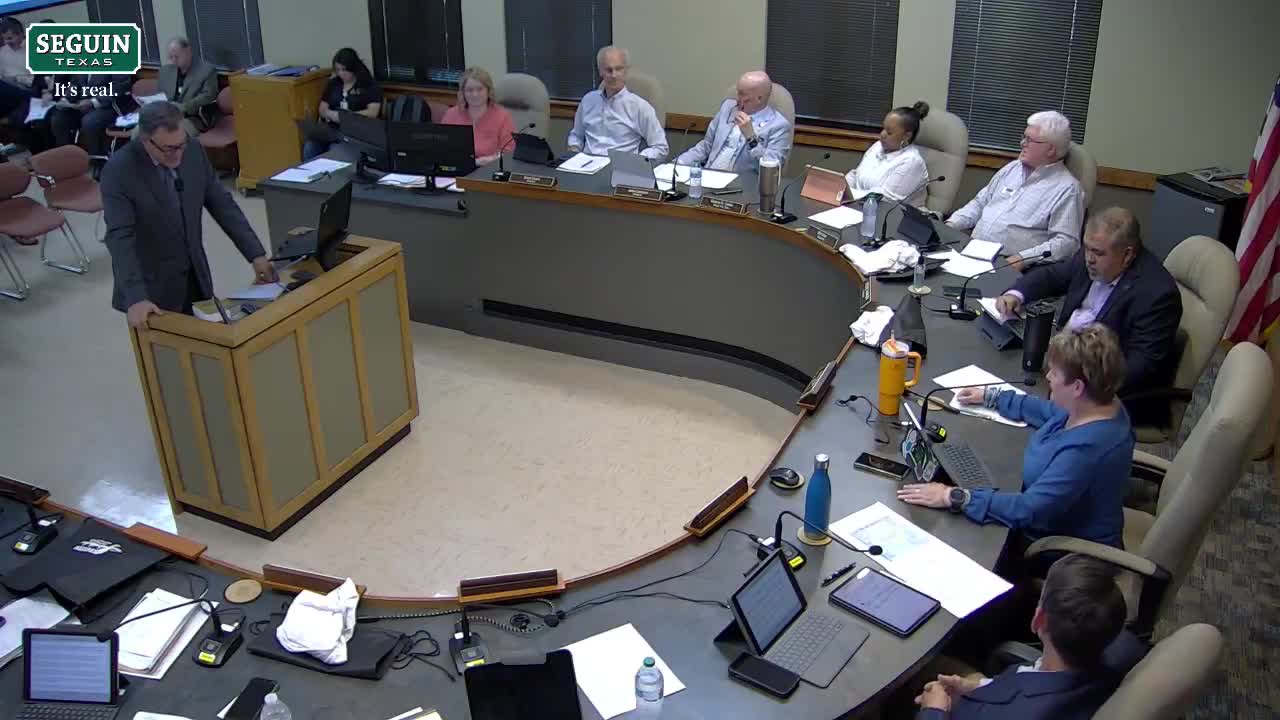
At a presentation before the vote, Pam Centeno, planning staff, summarized community survey results and staff recommendations. Centeno said the proposed code sets limits for decorative flags (one per 100 feet of frontage and one per lot under the draft), banners, feather flags, ground signs, portable signs and real-estate/contractor signs and explained the survey basis for the proposals. She told the council that 72 percent of respondents preferred limiting banners to one per business and that responses split between 30 and 60 days for banner display; staff proposed 60 days. Centeno also said 57 percent of survey respondents favored a 10-foot maximum height for feather flags and a 30-consecutive-day limit for those flags, and that ground-sign respondents favored a 6-foot maximum and 30 consecutive days.
Council discussion focused on enforcement and aesthetics. Several council members thanked staff for the outreach and work; one council member asked who would enforce the rules, and Centeno answered that planning and code enforcement would handle compliance and that staff generally tries to work with property owners before issuing citations. Council members raised the subjective nature of “what looks good” and emphasized prioritizing enforcement on signs that are tattered, torn or create safety issues for traffic.
Councilmember Biesenbach moved the set of amendments described on the record; Councilmember Carlson seconded the amendment. The council voted to adopt the ordinance as amended; the motion carried, with one no vote recorded.
The ordinance as amended increases flexibility for temporary signs in several ways the council specified on the record: allowing removal-after-business-hours for certain portable signs instead of a 30-calendar-day cap; permitting two real-estate/contractor signs on larger or corner lots; removing a numerical cap on banners per tenant; changing the banner time-limit enforcement to require removal when banners become worn, tattered or in disrepair; and requiring that banners attached to poles, ground stakes or supports remain upright, visible and in good repair. Staff said the final ordinance text will be updated so the matrix of changes is consistent across all sections.
Staff and council members emphasized the ordinance will be a “living” document: council and staff said they expect to monitor how the rules work in practice and return to amend them if compliance or aesthetics become problematic. The ordinance will be codified into the Unified Development Code and becomes part of the city’s sign regulations going forward.
The council’s packet included photographs and survey results that Centeno cited in her presentation. Enforcement will follow existing notice and municipal-court procedures if voluntary compliance is not achieved.
The council also approved related, non-substantive housekeeping changes required to insert Chapter 6 sign regulations into the code.
Councils typically return to code topics after implementation; council members said they anticipate reviewing the ordinance’s effects and making adjustments in future meetings.