Get Full Government Meeting Transcripts, Videos, & Alerts Forever!
Get email alerts on the Municipal Finance topic
No spam. Unsubscribe anytime.
Findlay mayor proposes monthly operational forecast and shifts to capital funding rules
Summary
At a Strategic Planning Committee meeting, city leaders discussed an updated operational forecast, monthly budget tracking, and proposals to shift capital funding rules — including allocating interest and hotel-motel tax revenue to capital and changing the income-tax split from 80/20 to 90/10 — to reduce volatility in the general fund.
At a City of Findlay Strategic Planning Committee meeting, Mayor (name not specified) told the committee staff has prepared a draft operational forecast and proposed changes to how the city allocates revenues between operations and capital to reduce year-to-year volatility.
The mayor said staff will move departments to a monthly budget model so the city can track performance year-round. "One of the things that drive drives Rob Martin and my myself crazy is that it's the annual budget, and we don't really have a monthly breakdown," the mayor said.
Why it matters: Committee members heard the city has absorbed several one-time and shifting costs into its operating budget during recent years — including routine street repairs that historically had been treated as capital — and staff wants to avoid relying on highly variable revenue sources in operating calculations.
Key proposals discussed included allocating interest earnings and hotel-motel tax revenue directly to capital, and decreasing the portion of income-tax collections routed to operations from the current 80/20 split to a proposed 90/10 split. The mayor described moving interest earnings and hotel-motel receipts "directly to capital" so those variable streams would not be counted on for operating expenses.
Committee members and the auditor raised governance and transparency questions. The mayor proposed a one-year look-back approach so capital allocations for a given year would be set based on the prior year's actual collections, providing a buffer against refunds and collection timing issues. "What we could instead do is look at doing a look back and that the capital allocation for the next year would be off of the prior year's collections," the mayor said.
Andrew (Auditor) cautioned that relying on variable revenue can create risk when interest income drops. "Back in 2009 and 10, when rates dropped and went to 0, I mean, we saw a lot of communities really relying heavily on that within just general operations," Andrew said, arguing that directing those receipts to capital provides flexibility without exposing operations to sharp declines.
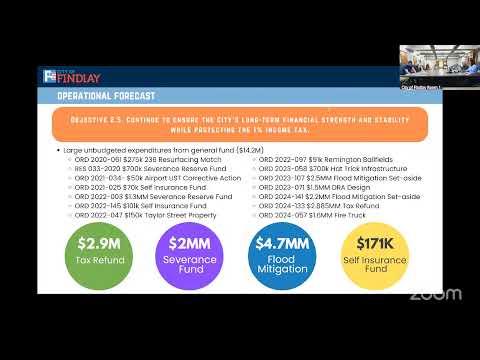
Officials noted recent nonrecurring uses of the general fund, which make year-to-year comparisons harder: a $2,885,000 tax refund paid this year; $2,000,000 paid to a severance fund; $4,700,000 toward flood mitigation; and $171,000 to the self-insurance fund. The mayor said those are examples of strategic, one-time transfers that should be visible in a formal operational forecast.
Discussion vs. decision: The committee discussed and directed staff to continue developing the operational forecast and modeling for the allocation changes; there was no formal vote on the funding-shift proposals at the meeting.
Ending: Staff said it will return with updated revenue projections from the auditor and updated forecast tables for review before any council action.