
Vermont senators debate bill letting state set water standards above federal Clean Water Act
Get AI-powered insights, summaries, and transcripts
Subscribe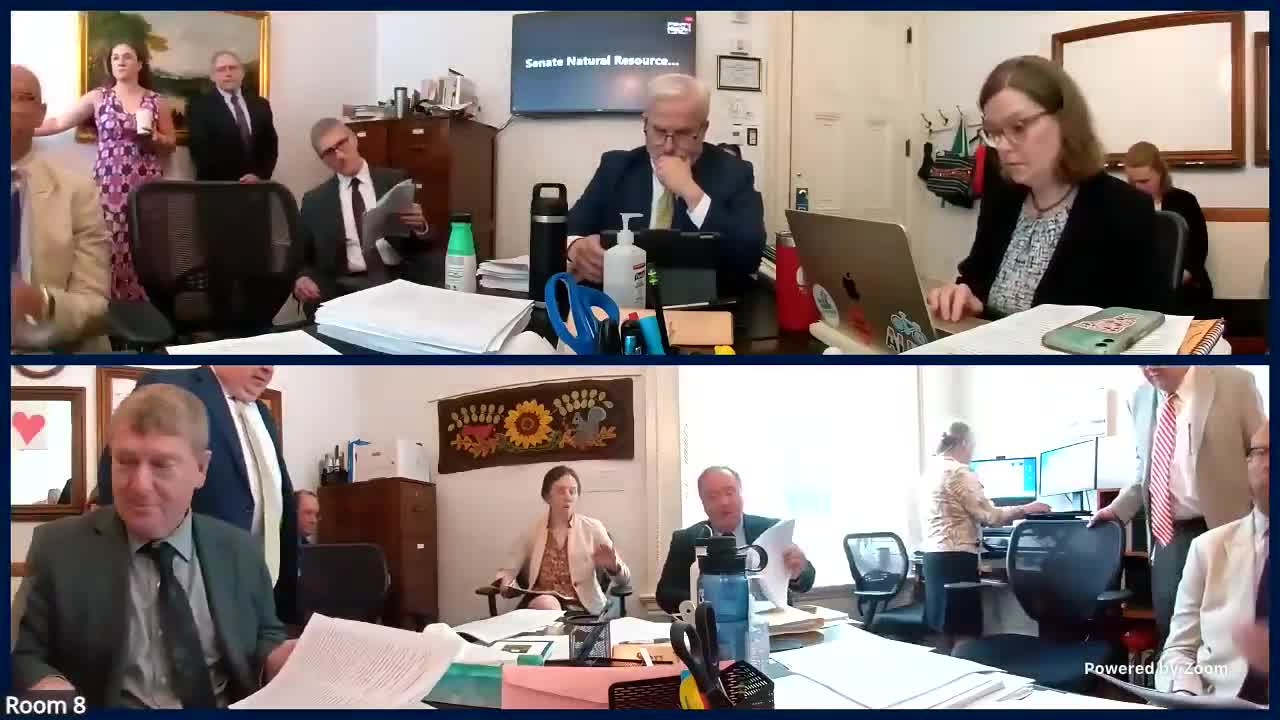
Summary
Senators and agency representatives discussed differences between House and Senate versions of a bill on CAFO permits: whether the state secretary may adopt rules more stringent than the federal Clean Water Act, a stakeholder inspection-plan requirement, and a temporary freeze of federal-law references to a 2025 baseline.
Senators and agency staff discussed a bill to change how Vermont regulates concentrated animal feeding operations, focusing on three differences between the House and Senate versions: whether the state may write rules that go beyond the federal Clean Water Act, a stakeholder-led inspection plan for farms, and a temporary statutory reference to federal law as it existed on Jan. 1, 2025.
The matter before the Senate Natural Resources & Energy Committee centers on the standard by which the secretary of the Agency of Natural Resources may adopt CAFO permit rules. The Senate-passed text would require state rules to be “equivalent to” the federal Clean Water Act; the House proposal would allow the secretary to adopt rules at least as stringent as federal law and potentially more stringent.
That change drew the sharpest attention in the discussion because it affects how the state and farms would be regulated if federal rules change. Michael O'Grady, a staff member who reviewed the side-by-side bill comparison for the committee, summarized the three principal House changes, including the rulemaking authority shift on pages 24–25 of the draft and the stakeholder inspection-plan language on page 29. O'Grady also described a provision on page 37 that would, for a limited period, treat federal references as frozen to their Jan. 1, 2025 text.
Agency of Agriculture representative Steve Collier said the proposed House language raises concerns about regulatory clarity and cost for farmers. "It's not easy to understand. But every definition in here is the linchpin of the framework," Collier said, referring to the federal permit manual and the way terms such as CAFO and nutrient management plan are defined and applied. He told senators that advocates pushing for greater state authority had driven the House change and warned that moving beyond federal text without legislative clarity could impose added costs on farmers.
The stakeholder-report change in the House draft would require the secretary of Natural Resources, after stakeholder coordination with the secretary of agriculture, to receive a plan proposing which large and medium operations should be inspected, the proposed inspection frequency and thresholds, and an estimate of the staffing or other resources required to implement inspections. Committee staff clarified that the bill as drafted would require a plan to be delivered by stakeholders but would not itself enact the inspection plan as statute; formalizing an inspection mandate would require separate legislation.
The third major House change would treat federal references to the Clean Water Act in state law as fixed to how they appeared on Jan. 1, 2025, until April 1, 2029. Committee staff characterized that change as a temporary ‘‘freeze’’ of federal cross-references so the state would not automatically inherit future federal amendments during the stated period.
Committee members and agency staff said they supported stakeholder engagement but differed over whether the state should be permitted to set standards above federal law. Several senators said they were reluctant but would support the bill as it came back from the House to avoid killing a package that both committees had worked on. Agency of Agriculture witnesses urged that any expanded state authority be accompanied by clear legislative direction and consideration of costs borne by farmers.
The committee recorded a straw poll on the Natural Resources side as 4–0–1 in favor (four yes, zero no, one abstain) on the current posture of concurrence; senators noted the straw poll was a preliminary signal rather than a final vote. The bill also includes a clarifying change to the emergency exemption language governing seasonal application of manure (pages 15–16), which agency staff said corrected an earlier, unintended statutory modification.
What the committee did not do in the session reviewed was convert the straw poll into a final concurrence vote; members said the next steps could include concurrence, further amendment, or sending the matter back for additional work depending on later decisions.
The discussion drew repeated references to Vermont's agencies — the Agency of Natural Resources and the Agency of Agriculture — and to federal law (the Federal Water Pollution Control Act / Clean Water Act). Staff told senators the bill’s conforming edits appear throughout the draft to reflect the House change on the rulemaking standard and related citations.
Committee members repeatedly emphasized they wanted clarity for farmers and careful engagement between ANR, the Agency of Agriculture, and stakeholders if the committee approved language that allows the state to adopt standards above federal law.
The committee recorded the procedural straw poll and heard agency concerns; no formal enacted change or final vote occurred in the portion of the meeting covered in the transcript.