Get Full Government Meeting Transcripts, Videos, & Alerts Forever!
Get email alerts on the Light Rail Permitting topic
No spam. Unsubscribe anytime.
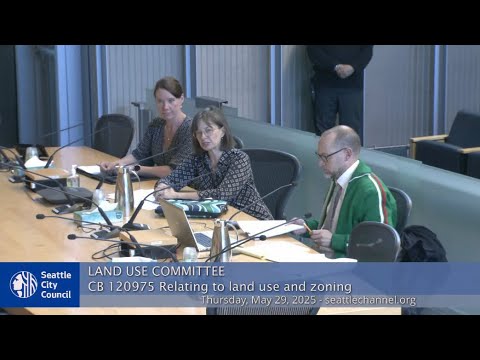
Land Use Committee opens public hearing and debates amendment on light-rail permitting ordinance; vote delayed to next meeting
Summary
Committee members debated a walk-on amendment requiring Sound Transit to submit pre-submittal community outreach plans for large light-rail permits tied to council bill 120975; departments will review the amendment and the committee agreed to postpone a final committee vote to June 4, 2025.
The Special Land Use Committee opened a public hearing on May 29 for Council Bill 120975, an ordinance that would amend Seattle’s land-use code to streamline permitting for light-rail transit facilities and support construction of the West Seattle Link Extension and the Ballard–Lincoln section.
The bill, described by committee staff as updating both substantive development standards and procedural permitting standards for essential public facilities, was presented by central staff and representatives from the Seattle Department of Construction and Inspections (SDCI) and Sound Transit. Committee members and staff noted two recent developments that frame the proposal: the Federal Transit Administration’s publication of a Record of Decision for the West Seattle Link Extension and a change in state law reinforcing light rail’s status as an essential public facility under the Growth Management Act and related transportation statutes.
Council member Rivera offered a walk-on amendment (Amendment 1) that would require applicants for major, permanent light-rail-related permits to submit a pre-submittal community outreach plan; SDCI would review whether the outreach was implemented and the SDCI notice of decision would summarize public comment and explain how the decision addressed that comment “where feasible.” Rivera characterized the amendment as “a way to show our work,” saying the requirement would document outreach Sound Transit has already been conducting.
Sound Transit and SDCI staff said they support robust community engagement but had seen the amendment only shortly before the meeting and requested time to review its operational impacts. SDCI staff explained that the amendment would be a new pre-submittal requirement and that the provision directing the permitting decision to summarize outreach and how the decision responds to public comments is not currently required of other permit applicants; the department said it would need to assess how that change would affect internal processes and any additional staff time or cost.
Council members split on procedure. Council member Strauss and others urged advancing the bill out of committee the same day while deferring the amendment to full Council so members could have more time to review the language. Council member Rink and others said they supported the bill’s goal of keeping projects on time and on budget but wanted more time to understand operational impacts and costs. Council member Mark (as recorded) said the amendment’s language (“to the extent feasible”) provides flexibility and argued the change is mainly about documenting outreach.
After discussion, the committee did not take a final vote on the ordinance or the amendment. Chair Mark Solomon said he would give colleagues and departments time to review the amendment; the committee set a plan to revisit council bill 120975 and the proposed amendment at the next Land Use Committee meeting on June 4, 2025. Central staff and departments will consult with Sound Transit and other partners, and the committee anticipates that associated Transit Way agreement legislation and an alignment-adoption resolution will follow later and would be scheduled for full Council consideration on June 10, 2025.
Public comment during the committee meeting included one in-person and one remote speaker. Comments ranged from opposition to Sound Transit capital spending to general criticism of City Hall; the committee record shows no substantive project-specific testimony that changed the committee’s deliberations.