Get Full Government Meeting Transcripts, Videos, & Alerts Forever!
Get email alerts on the Film And Creative Economy topic
No spam. Unsubscribe anytime.
Honolulu Film Office briefs committee on industry growth, tax-credit uncertainty and workforce goals
Summary
Valeria Constantino of the Honolulu Film Office gave an extended briefing on Hawaii's film industry, citing economic multipliers, projects that generated tens of millions in local spending, and legislative risks to the state tax credit; the office urged clearer policy signals and stakeholder work ahead of potential special-session action.
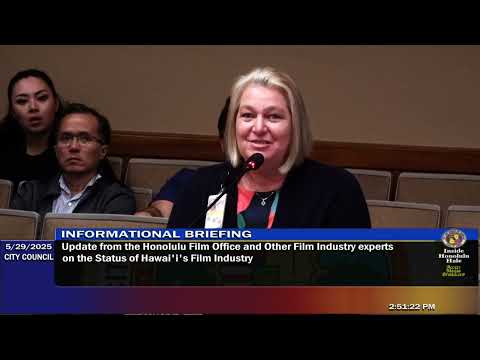
Valeria Constantino, senior film industry development specialist in the Office of Economic Revitalization, told the Honolulu City Council Committee on Innovation, Technology and Entertainment on May 29 that the city and state film offices are working to grow Hawaii’s film industry through marketing, workforce development and tax-credit outreach.
The film office presented economic figures and case studies to show the industry’s local impact. Citing a state cost-benefit analysis, Constantino said the film tax credit generated roughly $150 million in increased GDP and about $95 million in earnings for 2023, and that state data show the sector returns several dollars in GDP for each dollar spent on the tax credit. She gave production-specific examples, saying Rescue High Surf hired about 788 crew and 1,350 extras and spent more than $65 million, while NCIS Hawaii spent nearly $80 million and hired about 1,100 local people.
Constantino warned that legislative uncertainty has slowed development and that some large projects are sensitive to a per-production cap in Hawaii’s current tax credit. "It is active. It is the credit that allowed Lilo and Stitch to shoot a % here in Hawaii. And it is funded," Constantino said, adding that the office is aggressively communicating the credit's availability. She said part of the Lilo and Stitch production — "around $45.5 million" of the project — was filmed in Hawaii while the remainder went to another country because of the cap.
Committee members asked whether program attrition was due to ratings, credits or industry cycles. Constantino described a "perfect storm" of factors, including network and studio restructuring, the development cycle for shows, and the recent SAG-AFTRA and WGA labor actions. She said the office is pursuing outreach, a producer-in-residence program with the Hawaiian International Film Festival, and closer coordination with the Department of Business, Economic Development & Tourism and county film offices.
On legislation, Constantino identified Senate Bill 732 (SB 732) as a complex bill with multiple elements the industry would like to preserve or rework; she and stakeholders hope elements can be advanced in a special session if called. She flagged House Bill 796 (HB 796), which proposed a five-year sunset on tax credits, as particularly damaging to business certainty and said the industry is seeking a gubernatorial veto.
Council members discussed the University of Hawaiʻi-backed film studio project and workforce ties to community colleges and university programs. Angela Melody Young, testifying for CARES, thanked the committee for local ordinance work supporting a university film studio and noted the project's workforce-development potential.
The briefing was informational; the committee did not take formal legislative action during the presentation. Constantino asked the committee to help communicate the credit's stability to studios and to support stakeholder engagement in the interim.