Get Full Government Meeting Transcripts, Videos, & Alerts Forever!
Get email alerts on the School Safety topic
No spam. Unsubscribe anytime.
Seattle committee debates levy language on school safety after Garfield parents urge return of officers
Summary
Chair Maritz Rivera opened the committee’s May 29 meeting to consider amendment 1 to the Families, Education, Preschool and Promise levy, a proposal that would add implementation principles prioritizing equitable access, nonpunitive approaches to safety and measures to avoid contributing to the school‑to‑prison pipeline.
Chair Maritz Rivera opened the committee’s May 29 meeting of the Select Committee on the Families, Education, Preschool and Promise Levy to consider 12 proposed amendments to the levy ordinance. One of the most contested was amendment 1, sponsored by Councilmember Rink, which would add implementation principles emphasizing equitable access for historically underserved communities, prioritizing nonpunitive approaches to safety, and ensuring investments “do not contribute to the school‑to‑prison pipeline.”
The amendment’s sponsor framed the change as guidance for how levy funds should be used. “This amendment ensures that we are addressing root causes of violence through non punitive approaches,” Councilmember Rink said, adding that the levy should not repeat “mistakes of the past.” Central staff analyst Jasmine Marwaha told the committee the amendment would provide high‑level guidance only and would not bind the Council to specific services or change the proposed property tax rate.
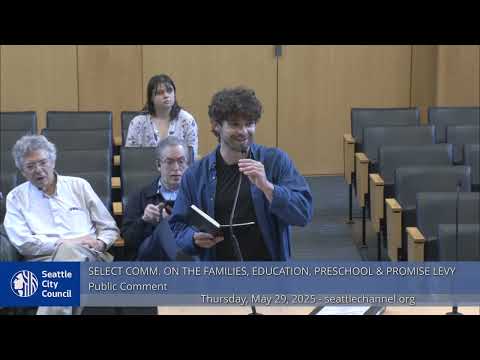
The public comment period preceding the briefing drew parents and educators from Garfield High School, who pressed the committee to prioritize immediate on‑site safety measures. “We need both SROs back in the school and all of the community based efforts at mental health services…Get at the root causes of violence. It's not 1 or the other. It's both that are needed,” said Mark Jacobson, who identified himself as a Garfield parent. Another parent, David Jacobson, said Garfield has experienced multiple shootings and argued SROs and clearly defined police roles could have prevented recent tragedies.
Other speakers pressed the committee from the opposite direction. Substitute teacher Oliver Miska and others said they supported the levy’s goals but objected to limiting nonpunitive investments or restricting community‑led responses. “We do not want punitive practices in our schools. They don't make students feel safe,” Miska said, urging the Council to preserve restorative and community‑led approaches.
Council members questioned how SROs or other safety investments would be implemented if the amendment passed. Jasmine Marwaha and Chair Rivera repeatedly described the ordinance as setting broad buckets of spending and said the Department of Education and Early Learning (DEEL) will lead a public stakeholder process to craft the implementation and evaluation (I&E) plan — the subsequent document that will specify contracts and programs. Marwaha noted the levy text as proposed would not change expected revenues and that specific allocations would be decided in the I&E plan and subsequent budget actions.
Several councilmembers emphasized a “yes‑and” approach rather than an either/or framing. Councilmember Kettle told the committee that “school resource officers can also promote school safety” when the program is done well. Councilmember Hollingsworth, whose district includes Garfield, said families and students in her district have asked for community resource officers as part of a broader safety strategy. Councilmember Saka urged flexibility, noting the decision to place officers inside a school is often a school‑level, fact‑specific choice and could include civilian SRO models.
Legal and procedural limits were discussed but not resolved. Council President Nelson asked whether the decision to allow officers on school grounds is made by the Seattle School Board; staff replied that school‑board policy governs school grounds, while officers in public right‑of‑way are within city authority, and that any SRO deployment would require coordination with the district.
No vote was taken on amendment 1. Chair Rivera and staff emphasized the department’s forthcoming stakeholdering process, and Rivera said the committee will vote on amendments at its June 12 meeting, with full Council consideration scheduled for June 17.
The committee’s discussion left two clear points: the amendment would signal the Council’s preferred approach to school safety by prioritizing nonpunitive, root‑cause investments if adopted, and operational decisions about SROs, civilian alternatives, or other school safety staffing would be developed later during DEEL’s I&E process and through partnerships with Seattle Public Schools.