
Charter school growth raises lease, funding and oversight questions; state authorizer, districts urge clearer review authority
Get AI-powered insights, summaries, and transcripts
Subscribe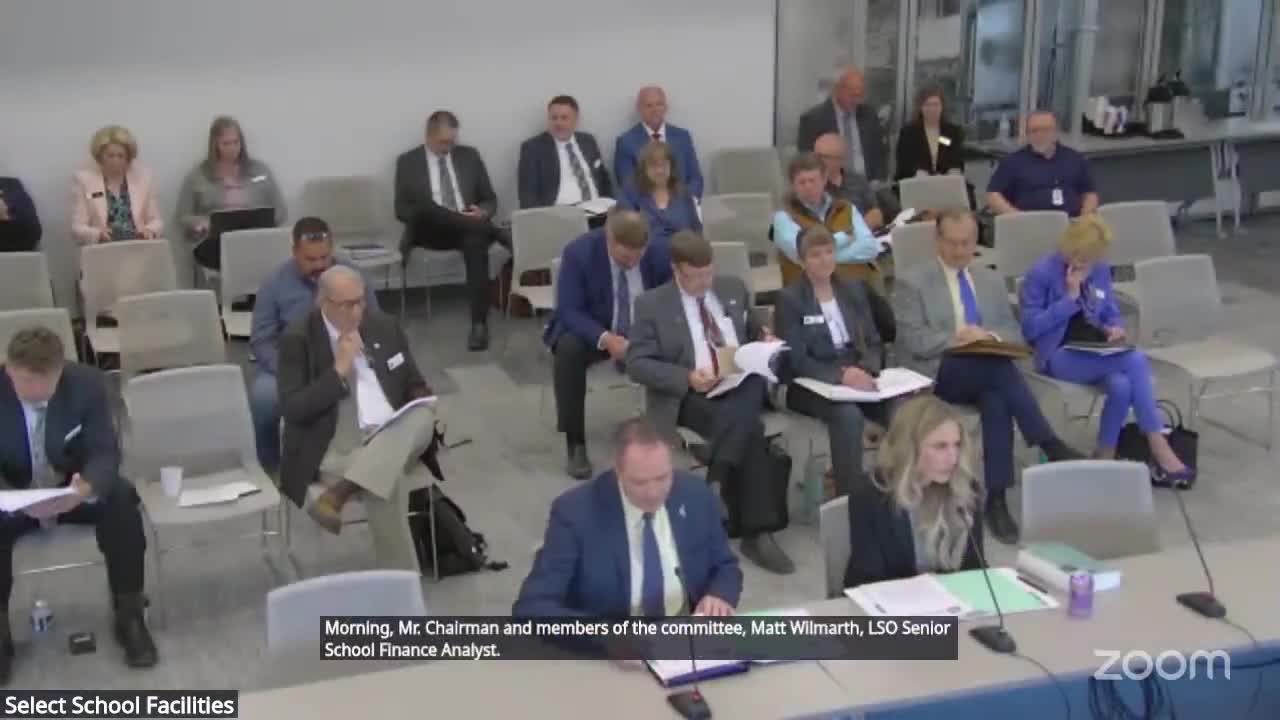
Summary
Committee members heard how charter schools are authorized and funded, learned state lease-reimbursement rules now apply immediately when a charter opens, and saw LSO estimates of about $17.7 million in state funding for roughly 1,214 charter-school students in 2024–25.
The Select Committee on School Facilities took a focused briefing on charter schools: how they are authorized, how the state funds operations and facilities, and how lease reimbursements are calculated and paid.
Who authorizes and how charters are funded
Tanya Heitrich and Matt Wilmarth of the Legislative Service Office summarized statutory authority (Wyoming Statute 21-3-303) and explained that charter schools are public schools within the district in which they operate; they must deliver the required state student services and employ licensed teachers. Charter schools may be authorized by the local district board or by the Wyoming Charter School Authorizing Board (the state authorizer). The 2021 and 2023 sessions modified charter statutes, and the legislature removed the three-year waiting period for lease reimbursement in recent sessions.
Funding entitlements and figures presented to the committee
Mister Wilmarth told the committee charter schools are entitled to school-level resources generated under the Education Resource Block Grant model and are also eligible for categorical reimbursements (special education, transportation, isolation, maintenance). Statewide for school year 2024–25 the committee was shown an estimated total state funding to charter schools of about $17,659,000 and a combined net ADM of about 1,214 students. LSO staff estimated additional central-office funding that will be proportionally entitled to charter schools beginning in school year 2025–26 at roughly $1,400,000 (an internal proxy to show the district-held central-office dollars that will be redistributed).
Leasing, authorizing fees and contingency proposals
Shelby Carlson of the State Construction Department explained lease reimbursements are paid immediately when a charter school comes online (the 3-year delay was removed in recent legislation) and that the department now pays quarterly to allow truing-up as operation & maintenance (O&M) amounts are finalized by the Department of Education. The State Charter School Authorizing Board can assess an authorizing fee (up to 3%); for 2024–25 the state authorizer assessed 0.5% to state-authorized schools, which generated about $37,500 — far short of the authorizer’s annual budget (FY26 estimated at ~$711,403, including two new staff positions). Carlson proposed a charter-school contingency fund of approximately $1,150,000 to allow the department to meet immediate lease obligations when new charters open.
District and authorizer perspectives
District representatives (Laramie County School District #1, Albany County #1, Fremont County #38) told the committee that charter schools have widely varying missions and facility needs: some charter schools occupy former district buildings, others lease privately owned space, and some districts have funded modular units or invested in improvements to meet charter-specific programming (for example, career-technical education in Fremont 38). District witnesses cautioned that former district buildings taken offline for capacity or consolidation reasons are sometimes later used as charter facilities; they said accessibility, acreage and modern design guidelines matter for reuse. Laramie County officials described certain lease structures in which private developers funded renovation up front and recover costs through lease fees, and noted potential long-term consequences (for instance, a charter’s eventual purchase of an improved building could remove that asset from the district inventory).
Authorizing-board officials (Janine Teske, chair) said the board’s contract process for new charters now includes stronger facility clauses and requires schools to seek board consent for post-contract changes of location; the board can deny applications, require corrective plans or amend contracts where facilities are inadequate. Teske and board members said they are working to strengthen the authorizer’s review and to identify statute adjustments where the model’s operational details (for example, eligibility for some categorical reimbursements) still reference district-only language. The state authorizer estimated its approved budget for FY26 at about $711,403, which LSO said would not be covered by the 0.5% fee collected this school year.
Numbers at a glance (as presented)
- Estimated charter-school ADM (2024–25): 1,213.693 - Estimated total state funding to charter schools (2024–25): $17,659,000 (approx.) - Estimated additional central-office funding to be proportionally entitled in 2025–26 (proxy): $1,400,000 - State-authorizer administrative fee collected (0.5%, 2024–25): ~$37,500 - Charter-school lease appropriation in the biennium (as discussed): $4,200,000 plus $1,900,000 associated with repeal of a three-year waiting rule
Committee concerns and next steps
Committee members raised questions about whether districts should be required to retain mothballed buildings for potential future public use, whether the state should consider repurchasing previously sold district buildings rather than paying long-term lease fees, and how to align student counts, ADM and square-foot calculations consistently. The authorizing board and district witnesses asked for clearer statutory authority and for adequate authorizer staffing. The department and LSO said they will pursue administrative changes (quarterly lease payments and ADM-based truing) and recommended the committee consider policy fixes to close statutory gaps the presenters identified.