
State Construction Department updates dozens of K–12 projects; asbestos, demo and site costs slow schedules
Get AI-powered insights, summaries, and transcripts
Subscribe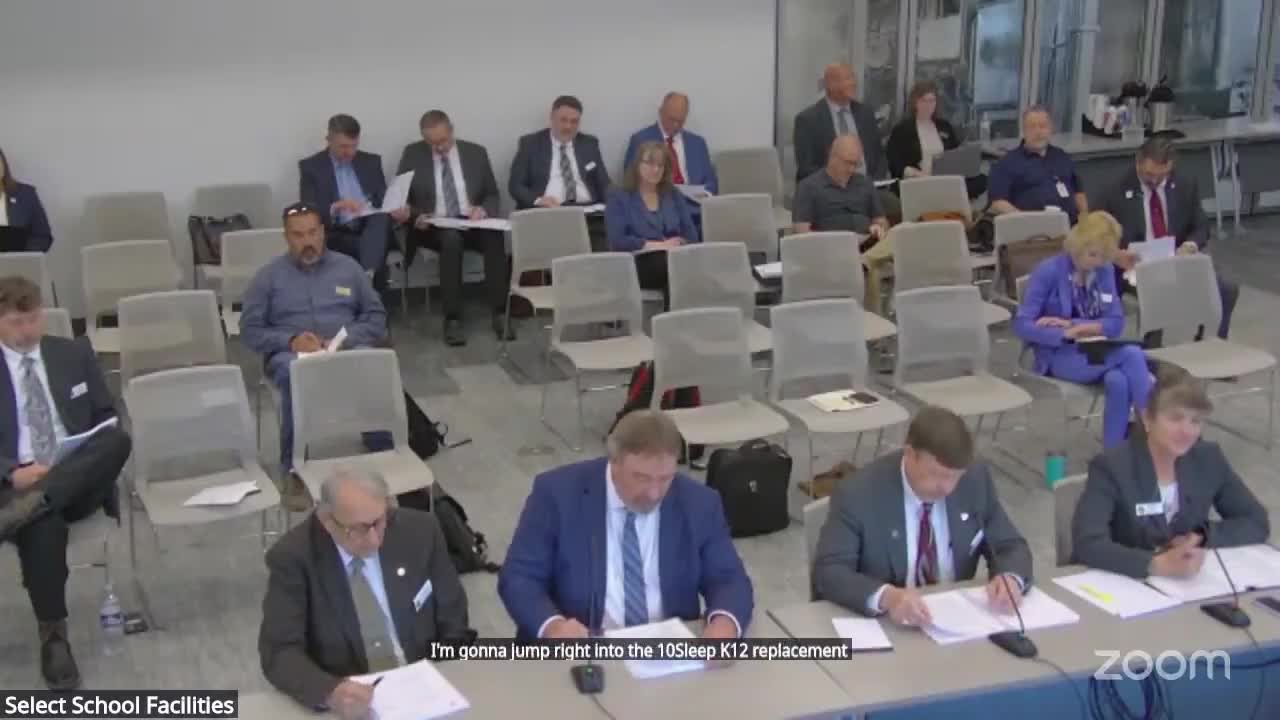
Summary
State Construction Department project managers reported progress and delays across multiple K–12 replacement and renovation projects, citing asbestos discoveries, contractor availability for demolition and high site costs for transportation/bus facilities as primary drivers of schedule and budget variability.
State Construction Department staff briefed the Select Committee on School Facilities on the status of ongoing K–12 capital projects and the practical issues driving cost and schedule variability.
Director Del McComley, Shelby Carlson (school facilities administrator) and John Rex (project management supervisor) reviewed more than a dozen projects — including new school replacements, high-school auditorium work, transportation/bus facilities and demolition contracts — and identified recurring causes of delay and overrun: unidentified asbestos-containing materials, limited availability of demolition and abatement contractors, and large, site-related costs for bus-storage and pavement.
Key project updates and issues
- Tensleep K–12 replacement: funded across 2020 and 2022 sessions; building 92% complete and district occupied the new building January 2025, but additional asbestos-containing materials found during abatement pushed final demolition and site-remediation completion into the fall. Staff said they are working to secure abatement contractors to finish the work.
- Riverton High School auditorium: appropriated $8,200,000 for design and construction in 2022 plus inflationary supplements; about 85% complete by expenditure and the building shell was expected to be finished in early May with remaining site work to follow.
- Little Powder K–8: construction contract awarded to Van Ewing Construction for $9,808,714; project 40% complete by expenditures and scheduled for substantial completion in November 2025 (reporters and members were told occupation may occur at fall break instead of winter break).
- Old-school demolitions: several demolition projects were bid; contractors’ pricing varies widely depending on whether the bidder recovers and resells materials (salvage) or simply hauls material offsite, and whether abatement (asbestos/lead) is required. Department staff gave multiple examples where preliminary surveys did not identify asbestos-containing spray-on materials or mastics that became friable only when demolition began, forcing crews to stop work and re-mobilize licensed abatement teams.
- Campbell County transportation building and other bus barns: design-stage estimates at 10% schematic design exceeded appropriated budgets; staff proposed advancing to 35% design and a value-engineering review to develop more reliable cost estimates. The department recommended separating site costs (extensive pavements, bus parking and coverage) from building cost-per-square-foot when reporting to the legislature because bus-storage and pavement can add millions of dollars to total project cost for large fleets.
- Campbell County High School replacement and other large high-school projects: design-phase funds were appropriated; district and state emphasized that hazardous-material abatement costs remain unquantified and will be requested once surveys and quantities are established. Staff said the new Campbell building will be roughly 190,000 square feet versus the existing ~300,000 square-foot facility, reducing future major-maintenance liability but requiring adjustments to adequacy and excess-square-footage calculations.
How asbestos and demolition choices affect schedules
Presenters repeatedly told the committee that hidden asbestos-containing materials — spray coatings on block, mastic under tile, or other nonfriable materials that become friable when disturbed — are the primary source of unplanned scope and delay. Abatement contractors are thinly resourced and often booked far in advance; when crews must pause work for abatement, entire schedules must be reset. Departments said salvage-minded demolition contractors sometimes offer significantly lower bids if they can recycle metal and concrete; those firms are typically in short supply.
Committee reaction and next steps
Members asked what the department is doing to capture lessons learned. Director McComley and staff said they are updating design and adequacy standards (including vestibules and security), contracting additional cost-estimating consultants so more accurate front-end estimates are available, and re-sequencing Mercer (most cost-effective remedy) studies so planning occurs before construction funding is requested. The department said it will present a more complete, dollarized budget to the commission in June and then to the committee in August.
No formal votes were taken on specific projects during the update.