Get Full Government Meeting Transcripts, Videos, & Alerts Forever!
Get email alerts on the Utilities topic
No spam. Unsubscribe anytime.
Kent County hears preliminary utility rate study recommending phased 4% annual increases, higher allocation fees
Summary
NewGen Strategies told Kent County commissioners that water and sewer systems will likely need phased annual increases and stronger reserve contributions to fund a five‑year capital plan — including a large Millington wastewater project — and reduce future general‑fund subsidies.
Kent County commissioners on March 26 received preliminary findings from NewGen Strategies showing the county’s water and wastewater systems will likely need phased annual rate increases and higher allocation fees to meet capital plans, debt service and reserve targets.
The study recommended a phased 4% annual increase to user rates and a 4% annual increase to allocation (connection) fees as a baseline, with an alternative 8% annual path that would reduce longer‑term subsidies. Mike Maker of NewGen Strategies told the board staff used conservative assumptions — “we're just being conservative here using about a 3% escalation rate” — for salaries, benefits and materials when projecting operating costs.
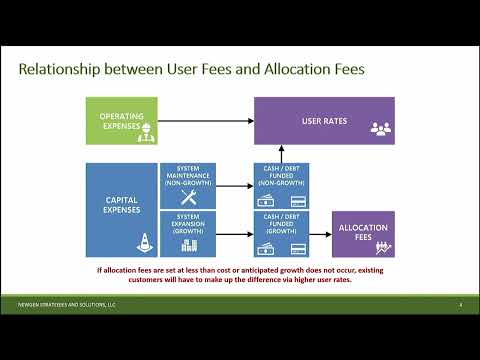
The study separates recurring operating costs, which the firm said should be covered by user rates, from growth‑related capital costs that allocation fees can fund. NewGen recommended two reserve targets: an operating reserve equal to 90 days (about 25% of operating expenses) and a capital reserve set at roughly 2% of fixed asset value. Maker estimated those capital reserve contributions at about $3,035,000 per year for water and about $130,000 per year for sewer based on the county’s asset inventory.
Maker said customer counts are modeled to grow about 2% annually for water and about 1% for sewer, with a one‑time larger customer addition when Millington brings on a new wastewater treatment plant (anticipated in 2028). NewGen modeled that Millington as a large capital driver and showed wastewater capital needs on a larger dollar scale (charts in the presentation used a top y‑axis near $12 million for sewer projects versus roughly $1.6 million for water projects in the immediate years).
On funding, NewGen outlined a combination of cash (PAYGO), debt and grants. Water projects shown in the plan were largely non‑growth replacements and financed with cash, while the Millington wastewater program was modeled largely as debt growth with some grant assumptions (the presentation cited ARPA and other grants already applied to Millington). Maker cautioned that grants are not guaranteed and that if allocation fees fall short of covering growth‑related capacity, existing ratepayers could face higher charges to cover those costs.
NewGen gave an example bill: a typical quarterly residential customer using 12,000 gallons would see about a $13.50 increase under a 4% across‑the‑board adjustment (from roughly $340 to about $353 per quarter in the study’s example). The firm also showed that phasing increases at 8% annually would lower required general‑fund subsidies later in the forecast — NewGen estimated that, with compounding, the larger step would reduce future subsidies by roughly a quarter compared with the 4% path.
There was no immediate decision. Commissioners and staff discussed the study’s assumptions, how to split any general‑fund subsidies between water and sewer, and whether to ask NewGen to run alternate scenarios or specific rate numbers as the county finalizes its FY2026 budget.
Ending: Commissioners directed staff to keep the study in the FY2026 budget discussion and to return with follow‑up runs if the board wants different rate or subsidy scenarios. No formal action or vote occurred during the work session.