
Monroe council directs staff to return with ADU fee options after sharp debate over system development charges
Get AI-powered insights, summaries, and transcripts
Subscribe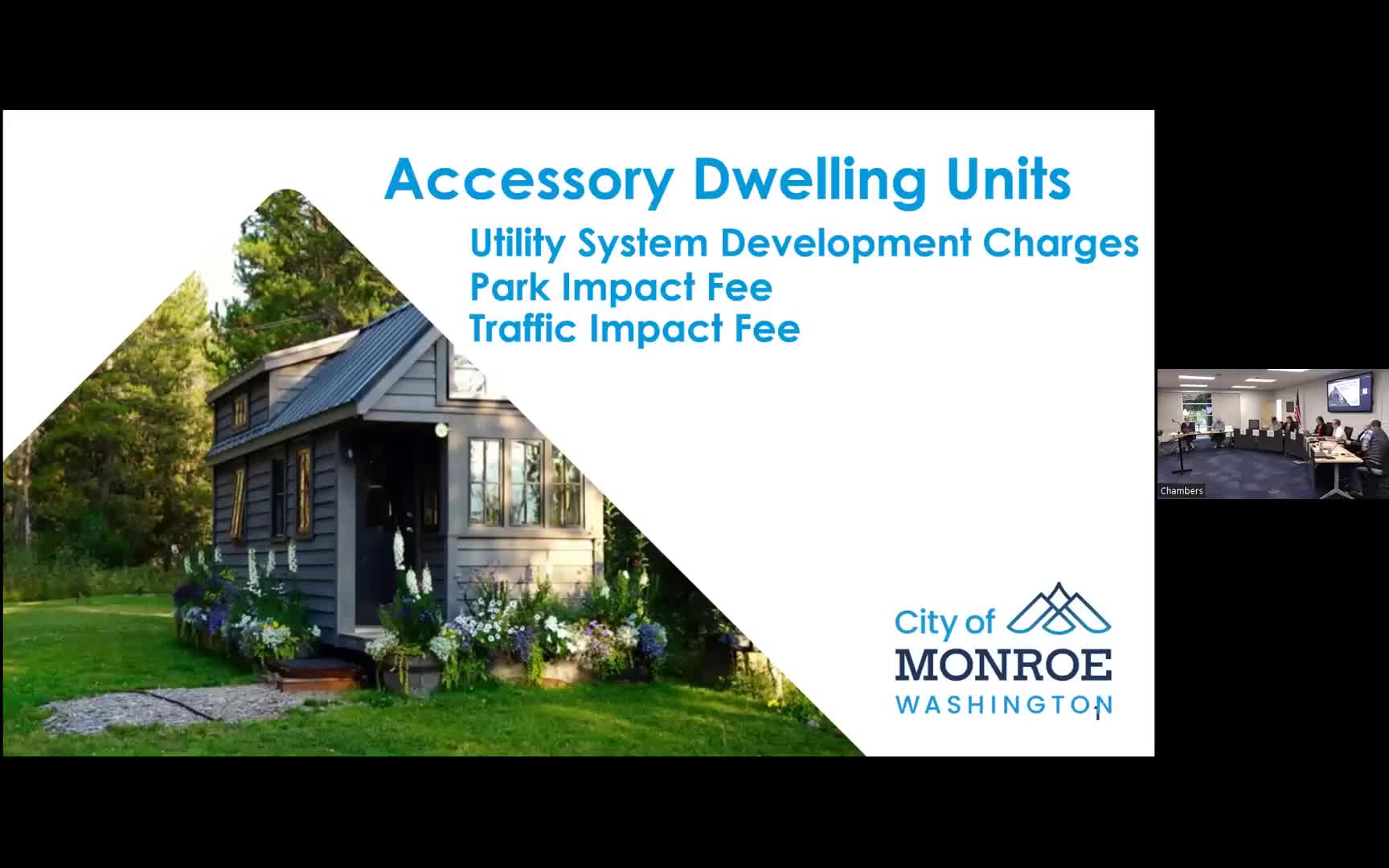
Summary
At a May 20 special workshop, Monroe City Council asked staff to return with alternative approaches to utility system development charges, park impact fees and transportation impact fees for accessory dwelling units, and later voted to advance the planning committee's transportation recommendation over objections from three members.
Monroe City Council members told staff on May 20 to return with alternative fee approaches for accessory dwelling units, including a deferred-charge option modeled on Arlington's policy and a 50% park/transportation-fee cap, after a lengthy discussion about who should pay for added utility and infrastructure costs.
The workshop focused on whether ADUs should be assessed system development charges (SDCs) and connection charges for water and sewer, park impact fees capped by state law at 50% of the primary unit's fee, and transportation impact fees (TIFs). Amy Bright and a city staff team described the policy choices and the technical basis for existing fees; Jacob (staff member) outlined how Monroe currently calculates SDCs by dwelling unit and noted that "accessory dwelling units are exempt from system development charges at this time." Council members pressed staff over whether charging SDCs on existing connections would discourage ADU construction.
Why it matters: The state's recent ADU law (House Bill 1337, codified at RCW 36.78.680 and .681) lowers some local barriers to ADU construction beginning July 1, 2025. Cities must decide how to apply capital-cost recovery fees when ADU growth increases demand on sewer, water, parks and streets; those choices affect the affordability and feasibility of ADUs for homeowners.
Most important facts
- Staff presented options ranging from continuing the current exemption (no SDCs for ADUs) to charging full SDCs plus physical connection charges. Alternatives included: (a) a full-charge P3 committee recommendation (SDCs + physical connection charge), (b) a 50% SDC reduction, and (c) the Arlington model (defer some fees until sale/condominiumization of a detached ADU).
- Several council members, led by Councilmember Gamble, argued that charging SDCs on an ADU that shares an existing utility connection would "make it worse for our residents" and could recreate the high-fee barrier the city previously removed; Gamble said: "Is that what we're proposing now? Which is an impact fee charge on an existing connection on a single family unit of upwards of 17,000 to $19,000." (Councilmember Gamble)
- Staff warned of operational complications when detached ADUs share a primary meter or side sewer: disputes over who pays for repairs, nonpayment shutoffs, and upsizing or refurbishment of old side sewers that may be needed to serve additional units.
- On parks and TIFs: staff noted the law caps park and transportation impact fees for ADUs at 50% of the primary unit's charge. Examples given in the presentation: a 50% TIF scenario would assess an ADU roughly $3,728 if the primary is a single-family residence (or $2,116 if the primary is a multifamily building). Park per-capita math produced smaller per-unit amounts (for example, a studio ADU per the staff table computed to $16.36 at a 50% reduction in the illustrative table).
Council direction and formal action
- During the workshop staff asked for council direction; a majority expressed interest in two options to be brought back for ordinance language: the Arlington-style deferred-charge approach and a 50% fee reduction option. Councilmember Walker asked staff to return with the Arlington model and a 50% option; council consensus supported asking staff to prepare those approaches.
- On transportation impact fees specifically, Councilmember Walker moved to advance the P3 committee recommendation (the 50%-of-primary-unit approach that P3 recommended for TIFs). The motion, seconded by Councilmember Beaumont, passed by a 4-3 vote. Mayor Jeffrey Thomas announced: "Motion passes with council members Hanford, Scarborough, and Gamble voting against."
Discussion highlights and concerns
- Several council members said the city's long-standing goal has been to encourage ADUs to increase housing supply and offer family-care options; they warned that high upfront fees would deter those outcomes. "When we're trying to make Monroe affordable and... help with affordable housing in our city and make it easy," Councilmember Hanford said, "I don't think the numbers are gonna spike because we've already been a city that welcomed ADUs."
- Other council members emphasized potential developer behavior: if ADUs can be condominiumized and sold separately, developers could build at scale and avoid fees under certain approaches; staff and Councilmember Walker asked staff to model the fiscal impact of a possible larger buildout ("a thousand ADUs") and to include capacity and worst-/best-case scenarios tied to water and wastewater plant limits.
- Staff noted some neighboring jurisdictions took different paths: Snohomish and Edmonds charge SDCs at permit phase, while Arlington deferred certain charges until sale or condominiumization, a hybrid approach that several councilmembers cited as attractive.
Next steps
- Staff will return with draft ordinance language for the two options the council asked to see (Arlington-style deferred charge and a 50% reduction approach), and with additional analysis on system capacity, potential revenue impacts, and design/implementation details such as required physical upgrades to side sewers.
- The council set hearings and readings to consider fee changes in June; July 1 is the effective date of relevant state law, so timing plays a role in the council's scheduling.
Speakers
- Amy Bright, Staff member (presenter) - Jacob, Staff member (presenter) - Scott, Staff member (public works comments) - Ben Swanson, Staff member (parks presentation) - Councilmember Gamble, Councilmember - Councilmember Walker, Councilmember - Councilmember Hanford, Councilmember - Councilmember Fisher, Councilmember - Councilmember Fulcher, Councilmember - Councilmember Scarborough, Councilmember - Councilmember Beaumont, Councilmember - Jeffrey Thomas, Mayor
Authorities
- Ordinances/Policies: Monroe Municipal Code (MMC) 13.02.010 (system development charge basis) referenced by staff - State law: House Bill 1337 (ADU changes), codified as RCW 36.78.680 and RCW 36.78.681 (impact-fee limits for ADUs) - Fiscal/analysis source: FCS Group SDC analysis (2024)
Actions
- Motion: advance the P3 recommendation for transportation impact fees (50% of primary-unit TIF). Mover: Councilmember Walker. Second: Councilmember Beaumont. Outcome: Passed 4-3. Names voting against: Councilmembers Hanford, Scarborough, Gamble. - Direction (not a formal vote): Council asked staff to return with two ordinance options for ADU fees: the Arlington deferred-charge model and a 50% reduction option for parks/transportation fees (and related SDC options).
Discussion vs. decision
- Discussion points: whether to charge SDCs on existing connections; effect on ADU affordability and incentives; condominiumization and developer behavior; potential private property disputes over shared meters/side sewers. - Directions: staff to produce ordinance drafts and capacity/revenue analyses for chosen options. - Decisions: Advance P3 recommendation for transportation impact fees (50% TIF) by a formal council vote (4-3).
Clarifying details
- July 1, 2025: the new state ADU law goes into effect (as stated by staff). - Staff cited an FCS Group 2024 SDC fiscal analysis as the basis for current charges. - Illustrative fee figures discussed on the record: possible water/sewer/connection combined charges in the range of "upwards of $17,000 to $19,000" for some ADU scenarios; combined impacts (including other fees) cited by council members in the discussion as reaching about $23,000 in some examples (figures described during the workshop by council members and staff). - Park-impact example (illustrative table): staff showed a 50% reduced per-capita park fee producing small per-unit numbers (example: $16.36 for a studio at 50% in the staff table).
Proper names
- Monroe City (agency) - FCS Group (consultant) - Snohomish (city) - Arlington (city) - Edmonds (city)
Community relevance
- Geographies: Monroe City - Funding sources under discussion: system development charges (SDCs), physical connection charges, park impact fees, transportation impact fees - Impact groups: single-family homeowners, renters in ADUs, developers, utility ratepayers
Meeting context
- Engagement level: extended workshop discussion with multiple council members, staff presenters and public comments; the planning/committee recommendation (P3) formed the basis of the formal vote. - Implementation risk: medium (policy changes require ordinance drafting and may change development economics and operations for utilities).