
Virginia Beach outlines school-support approach as state testing rules and ASVAB emphasis expand
Get AI-powered insights, summaries, and transcripts
Subscribe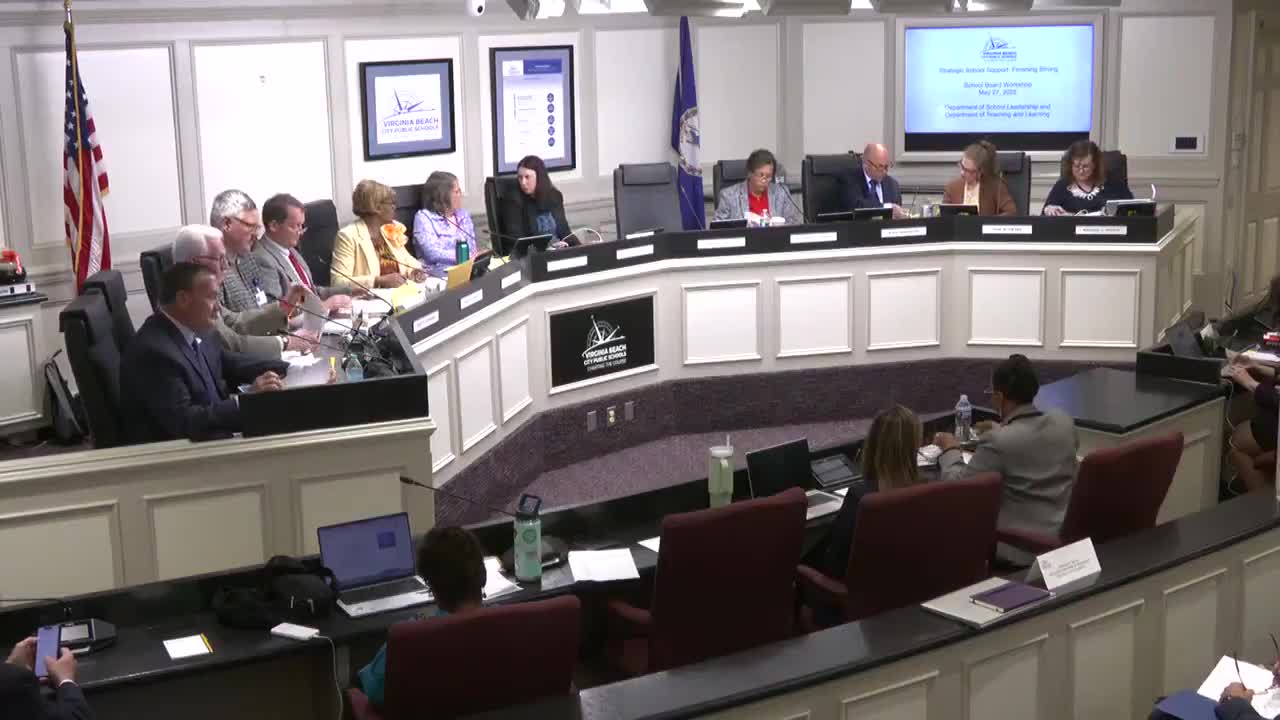
Summary
Virginia Beach City Public Schools Chief Schools Officer Matthew Delaney told the school board on May 27 that the division’s decade-old school support process will guide schools as state testing and accountability requirements change next year.
Virginia Beach City Public Schools Chief Schools Officer Matthew Delaney told the school board on May 27 that the division’s decade-old school support process will guide schools as state testing and accountability requirements change next year.
Delaney, speaking at an administrative workshop in the school board chamber, said the department will rely on the district’s strategic action agenda, school “concept maps,” and each school’s plan for continuous improvement to target resources where student data show need. “We’re not gonna have teachers operating on an island. We’re gonna support our schools and support our principals to ensure they have what they need,” Delaney said.
The update matters because the Virginia Department of Education (VDOE) has changed the School Performance and Support Framework and is extending the Virginia Literacy and Language Screening system (VALS) to grades 4–8 next school year, changes Delaney said are prompting schools to adjust screening and remediation plans. He also described a state-level push for greater student participation in the ASVAB career-readiness assessment; the division is “emphasizing the utilization of ASVAB,” he said, but “we are not requiring that across the board.”
Delaney summarized how the district categorizes schools as needing universal, targeted or intensive support and then allocates differentiated resources — tutoring funds, coaching, and reassigning central-office staff or coaches to where data indicate need. He said 68 schools are currently categorized as receiving universal supports. The plan for continuous improvement is reviewed midyear and finalized at year end and will be revised over the summer to align with the new VDOE framework and the division’s Compass to 2030 strategic plan.
Board members pressed for specifics about the VDOE-directed changes and their operational effects. School board member Miss Melnick asked what the VALS expansion “means” for practical scheduling and screening; Delaney replied that the division had received guidance but did not yet have “concrete examples” and that the state guidance may identify students who failed SOLs as candidates for screening, which "may" increase numbers of students identified for reading plans. Delaney said the district is reviewing that guidance and expects to provide more specific implementation details after further analysis.
Several board members raised questions about middle-school scheduling and elective time if more students need screening and reading intervention. Miss Rogers asked whether the district would use “Thrive time” for middle-school interventions so students would not lose elective opportunities; Delaney said that scheduling flexibility and consultation with reading specialists and principals has already begun and that the VDOE has given the division “a lot of flexibility” on implementation.
Members also sought clarity about ASVAB administration. Delaney said the state has signaled the ASVAB’s value as a career-readiness measure within the VDOE’s “3 E’s” (enrollment, enlistment, employment) emphasis and that the division is working with military partners and VDOE to streamline data access and participation. He said some schools have proactively increased ASVAB outreach and that the district has not imposed a division-wide requirement to test; local site-based decisions have occurred. “We are emphasizing the use of it at a greater level than we ever have previously, but we are not requiring that across the board,” he said.
Board members reported confusion among families about whether ASVAB testing is mandatory and concerns from staff about how testing is being presented. "This is very confusing for our families," said Miss Melnick. Delaney said the division will follow up to clarify which schools are adopting broader ASVAB participation and to ensure opt-out procedures are accessible.
Delaney reiterated that the district uses multiple local and state assessments — SOLs, VALS, NWEA MAP and local navigational markers — and that the division deploys staff and resources in response to performance trends, including remediation and expedited retesting initiatives during the testing season.
No formal policy changes were adopted at the workshop; after the presentation the board recessed into a closed session under Code of Virginia exceptions. A motion to enter closed session, moved by Vice Chair Weems and seconded by Mr. Culpepper, passed by recorded vote of 10–0. The board later certified the closed session by a 10–0 recorded vote.