Get Full Government Meeting Transcripts, Videos, & Alerts Forever!
Get email alerts on the Affordable Housing topic
No spam. Unsubscribe anytime.
Shorewood CDA votes to recommend Phase 1 for 19-unit affordable housing at 4450 N. Oakland Ave.
Summary
The Community Development Authority voted unanimously May 30 to recommend that the Village Board consider a Phase 1 application from Sperl Commercial to develop a three-story, 19-unit affordable housing building at 4450 North Oakland Avenue and to consider use of tax-increment financing extension funds to fill the project's financing gap.
SHOREWOOD, Wis. — The Community Development Authority on May 30 voted to recommend that the Village Board consider a Phase 1 application from Sperl Commercial for a three-story, 19-unit affordable housing project at 4450 North Oakland Avenue.
The CDA's recommendation asks the Village Board to permit the project to move to a Phase 2 submission under the village's Policy 40 for public assistance using tax-increment financing (TIF) extension funds. The developer's maximum request is $1,700,000 in TIF extension funds; Sperl Commercial indicated it expects to request about $750,000 if other gap funding is secured.
The recommendation is advisory: the village board retains final authority. Rebecca (village staff) explained the process, saying, "The CDA is requested to provide a recommendation on the application and that recommendation would then be forthcoming to the village board." The CDA vote does not commit the village to a specific subsidy amount or to a land transfer; it simply advances the application to the board for further review.
Baker Tilly Municipal Advisors presented a financial "but-for" analysis commissioned by the village. Joshua Davis of Baker Tilly said the firm's analysis of the developer's pro forma produced an estimated internal rate of return "about 8% with incentive," and that "without the incentive, the project's not feasible." Baker Tilly noted the project's small scale (19 units) and current elevated interest rates reduce revenue margins for affordable projects and that denser development would produce stronger cash flows.
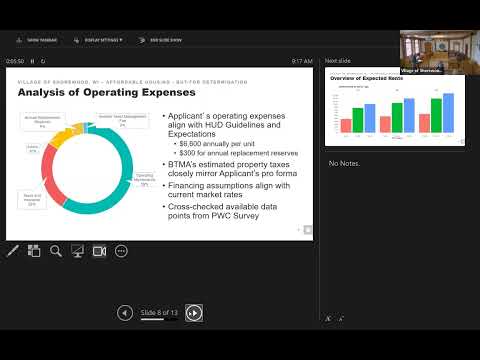
Baker Tilly reviewed the capital stack and pro forma assumptions supplied by the applicant and cross-checked construction costs against RSMeans, rent and vacancy data against CoStar, and expected investor returns against the PwC investor survey. The firm found the developer's cost assumptions were within benchmark ranges and did not recommend downward adjustments to the submitted budget. Key quantitative items in the packet include: a total development budget that assumes vertical construction at roughly $183 per square foot, annual operating expenses of about $6,000 per unit, replacement reserves of about $300 per unit per year, and a developer fee listed at roughly $330,000.
Sperl Commercial's proposal targets 100% of units at affordability levels between 30% and 60% of Milwaukee County median income to meet competitive low-income housing tax credit (LIHTC) scoring. Developer Brian Spruill said the rent and unit mix were chosen to make the project competitive for tax credits and noted his firm's experience: "I've won 2 tax credit deals already and, and only pursue the ones that I can win." Baker Tilly and the developer said much of the project's feasibility depends on securing tax credit equity; the presentation referenced about $3.5 million in tax-credit equity in the project's stack.
CDA members and staff pressed on several practical issues. Baker Tilly estimated that, under conservative assumptions (2024 mill rates and 3% growth), property taxes collected across jurisdictions from the completed project would total roughly $500,000 over 20 years — below the $750,000 the developer expects to request in TIF support. Baker Tilly said small changes in appraisal value or tax growth assumptions could materially shorten payback.
Committee members also discussed site density and parking. Staff noted similarly sized Shorewood redevelopment parcels produced substantially more units when they occupied most of a lot; the Sperl design reserves rear area for surface parking, which reduces unit count. Underground parking would raise construction costs substantially and require an elevator, pushing the project beyond the applicant's current budget.
On infrastructure, speakers clarified the developer's budget includes costs to connect water, sewer and storm services to existing mains. Baker Tilly and Sperl stated no off-site infrastructure projects (road widening, new mains) are included or expected for this site; if such public infrastructure were required, TIF funds are typically used for those public improvements, but none were identified as necessary for this proposal.
Public commenters were split. Resident Christine Suida urged the village to prioritize infrastructure and noted the village has a high rental rate, saying, "We were tasked to get more housing ... I don't believe we need more rentals." Dino Wagner questioned whether this is the highest and best use of the lot. Other speakers urged moving the proposal forward so the developer could meet time-sensitive tax-credit deadlines.
Trustee Kathy and other members asked for an appraisal of the land before the board makes final decisions; CDA members agreed an appraisal would be reasonable for the village board to request, but did not condition their recommendation on receiving one. The applicant and staff noted the WISCONSIN tax-credit process (referred to in the packet as the WIDA scoring system) requires land control, due diligence and entitlements in advance of competitive submissions; timeline guidance in the presentation identified conceptual applications due in December, conceptual award announcements in January, and full application outcomes in May.
Leslie moved that the CDA recommend the Phase 1 application to the village board, and the motion was seconded. The CDA voted by voice vote to forward the Phase 1 recommendation; the motion passed unanimously.
Next steps include Village Board review of the Phase 1 recommendation, further due diligence and negotiations over subsidy terms, consideration of a land appraisal by village staff or the board, and the developer's pursuit of LIHTC applications on the state timeline.