
Shorewood plan commission begins review of household definition and basement bedroom ban; seeks attorney opinion and public input
Get AI-powered insights, summaries, and transcripts
Subscribe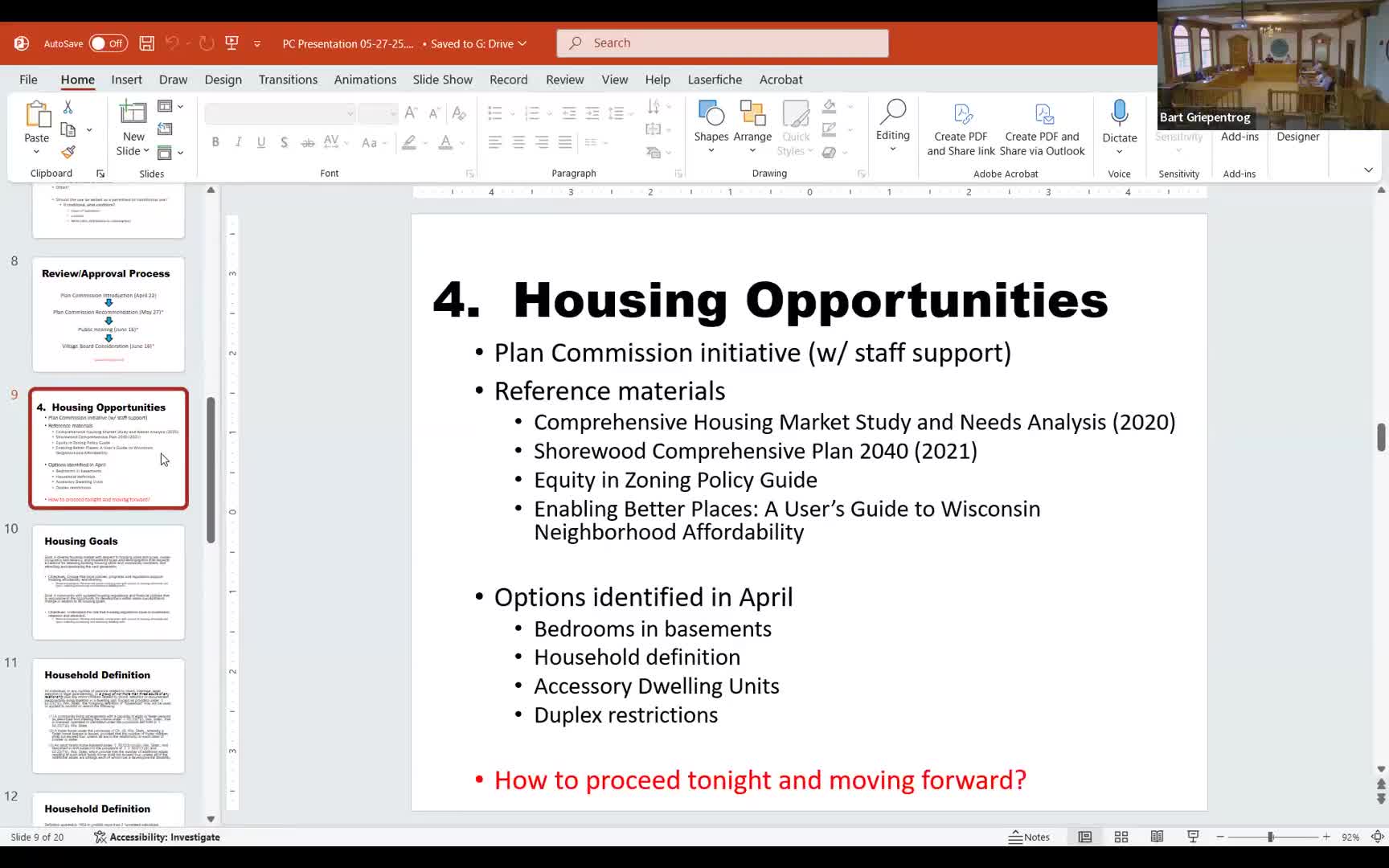
Summary
At a May 27 study session, the Village of Shorewood Plan Commission reviewed four housing‑policy ideas — household definition, basement bedrooms, accessory dwelling units (ADUs), and duplex restrictions — and directed staff to seek legal guidance and prepare draft code changes, with an open house planned for the fall.
The Village of Shorewood Plan Commission spent considerable time May 27 reviewing a multi‑pronged initiative to expand housing opportunities. Commissioners discussed the village’s household definition, minimum space requirements, a long‑standing prohibition on basement bedrooms, accessory dwelling units (ADUs) and duplex rules. The commission directed staff to obtain the village attorney’s opinion, draft ordinance language for likely changes, and plan public engagement before forwarding any amendments to the village board.
Planning staff said the existing household definition traces to mid‑20th century code updates and currently reads in part as “an individual or any number of persons related by blood, marriage, legal adoption or legal guardianship or a group of not more than 3 adults of any relationship plus minor children …” Staff noted the municipal definition originally appeared in 1937 and was changed over time; the regulation now limits unrelated adults and references state statute. The staff memo cited the American Planning Association (APA) equity guidance recommending communities avoid defining household by family relationship and instead focus on health‑and‑safety standards.
Staff explained there are two separate but related code tools: the household definition and minimum space/occupancy rules found in the village’s property standards (which require additional square footage where more than two occupants use a sleeping room). Director Bart said the square‑footage rules are “less exclusive and and easier to enforce” than a relationship‑based household definition. Commissioners and residents raised concerns about enforcement practicality, equity and the original intent of the limits; several said the household language felt exclusionary and rooted in mid‑20th‑century practice.
On the basement‑bedroom prohibition, staff said the 1956 municipal code rewrite added language that effectively prevents basements from being counted as bedrooms even if they meet modern building‑code egress and safety standards. Staff noted the department currently reviews renovation plans and requires labels consistent with code (e.g., finished basement space not listed as a bedroom), but that enforcement is rarely practical unless work is permitted and inspected. The commission discussed whether allowing code‑compliant basement bedrooms would improve safety and housing supply, while acknowledging modest tax/assessment implications and that adding egress windows can be expensive for homeowners.
Commissioners asked staff to: obtain the village attorney’s legal opinion on household definition and the basement prohibition; compare space requirements and occupancy rules in peer communities; draft language options (including the option to remove the household definition and rely on minimum space standards); and plan public engagement. The commission agreed to schedule a study sequence (ADUs and duplex restrictions) and to hold a public open house in the fall; staff will attempt to schedule a special June meeting and allocated two policy items for the next meeting (ADUs and basements). Public commenter Miss Kylie Miller said differentiating between student‑style group housing and multigenerational or extended families is a legal and policy challenge the village attorney will need to address.