
Tumwater planning staff present draft conservation element, highlight new state “enhance” requirement and timeline
Get AI-powered insights, summaries, and transcripts
Subscribe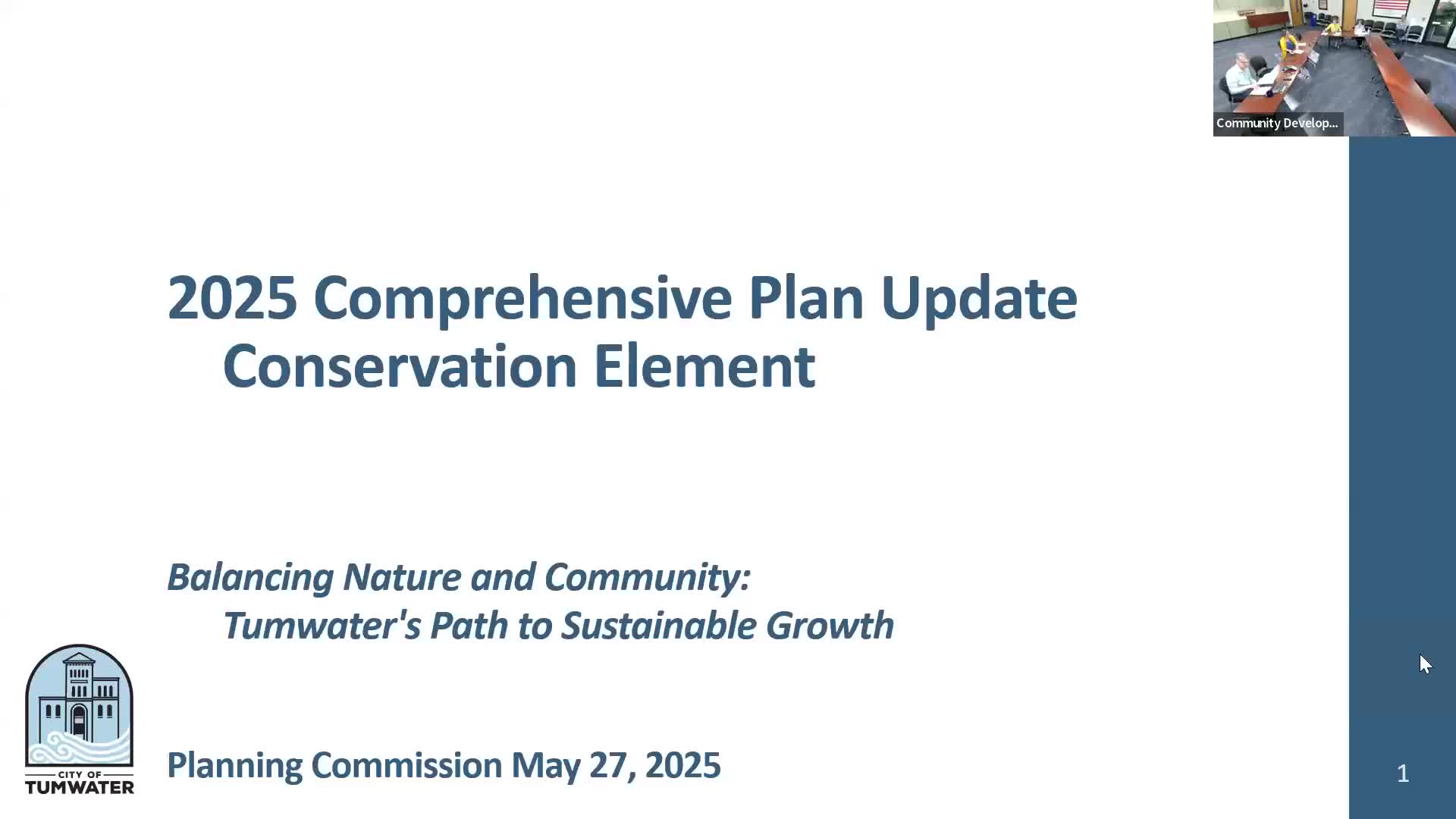
Summary
City of Tumwater planning staff presented the draft conservation element of the city’s comprehensive plan at the Planning Commission meeting on Tuesday, May 27, 2025, outlining the element’s structure, new state-driven “enhance” requirement for wetlands and habitat, and a schedule that moves the chapter toward public review this summer and a fall adoption process.
City of Tumwater planning staff presented the draft conservation element of the city’s comprehensive plan at the Planning Commission meeting on Tuesday, May 27, 2025, outlining the element’s structure, new state-driven “enhance” requirement for wetlands and habitat, and a schedule that moves the chapter toward public review this summer and a fall adoption process.
The draft, staff said, is divided into two parts: a goals/policies/actions document intended to feed the city’s annual work program, and a technical appendix covering natural resources and critical areas. “The conservation element has different, content in it, compared to the other elements, but it does all work together,” Associate Planner Dana Bowers said while introducing the document.
Why this matters: the conservation element frames local rules and implementation steps for wetlands, critical aquifer recharge areas, frequently flooded areas, geologically hazardous areas and fish-and-wildlife habitats. It cross-references other required planning and review processes — the city’s Habitat Conservation Plan, NEPA/SEPA environmental review, and local development code — and sets the policy foundation that will shape land-use decisions, development permits and future code updates.
Staff walked commissioners through the chapter breakdown and several substantive details. The natural-resources section distinguishes urban agriculture, forest lands and mineral resources (aggregate for construction), and notes that only about 7% of soils inside the city are classified as prime farmland. Bowers said the city and UGA hold roughly 371 acres enrolled under the state’s Open Space Taxation Act as forest land; those parcels receive tax incentives but may carry obligations, including replanting after harvest.
On critical areas, staff described a two-part wetland objective: a short-term goal of “no net loss” and a long-term goal of improving wetland function. Bowers said classification considers function, rarity and irreplaceability and that buffers are a primary protection tool: “The bigger the buffer, the more protection,” she said. Staff also explained wellhead and critical-aquifer capture zones marked by travel-time circles (six months, one year, five years and ten years) that indicate how long it takes recharge to reach a supply well; those zones inform allowable uses and buffer distances.
Staff emphasized linkage to other plans and codes. The draft conservations chapter references the city’s tree and vegetation regulations and a forthcoming tree-preservation/code update. It also cites federal and state authorities used in drafting — including the Clean Water Act, the Shoreline Management Act, state hydraulic rules and Tumwater’s local code protections for wetlands (listed in the packet as municipal code section 16.28).
On implementation and timing, staff said the city expects an internal draft of the Habitat Conservation Plan next week, followed by consultant revisions, agency review and then NEPA/SEPA environmental review once the HCP is released for public review. Bowers said stakeholder meetings are scheduled with the conservation district and the tree board and that the General Government Committee will see the chapter on June 11; staff recommended the planning commission forward detailed comments so revisions can be incorporated before public release later this summer or early fall.
Commissioners asked clarifying questions about what “enhance” means in practice. Bowers said the recent state change requiring enhancement goes beyond mitigation: “One of the big changes in the goal for conservation, is not only protect but enhance,” she said, explaining enhancement could include habitat restoration or fish-passage work that improves ecological function beyond baseline protection.
Staff also noted regional and technical constraints. Mineral resources were described as local aggregate deposits (not metal ores), with protection achieved by zoning and buffers where extraction is allowed; floodplain and hazard mapping reflect FEMA floodplain lines and the city’s hazard-mitigation planning. Salmon Creek Basin was called out in the packet as a local area of high groundwater and seasonal inundation.
Next steps and how to comment: staff asked commissioners to send specific questions and comments to the comp plan inbox; the packet lists a stakeholder notification process and an adoption schedule targeting fall 2025. Bowers closed the presentation by asking the commission to review the goals and the draft implementation actions in appendix A so those items can be considered for the city’s annual work program.
Ending: Staff said they will bring a more complete packet at adoption time and that specific implementation actions will be prioritized through the city’s annual work-program and budget process. Commissioners scheduled follow-up review as part of the broader comprehensive-plan adoption sequence.