Planning commission forwards middle-housing code update, withhold recommendation on 10% affordability rule
Summary
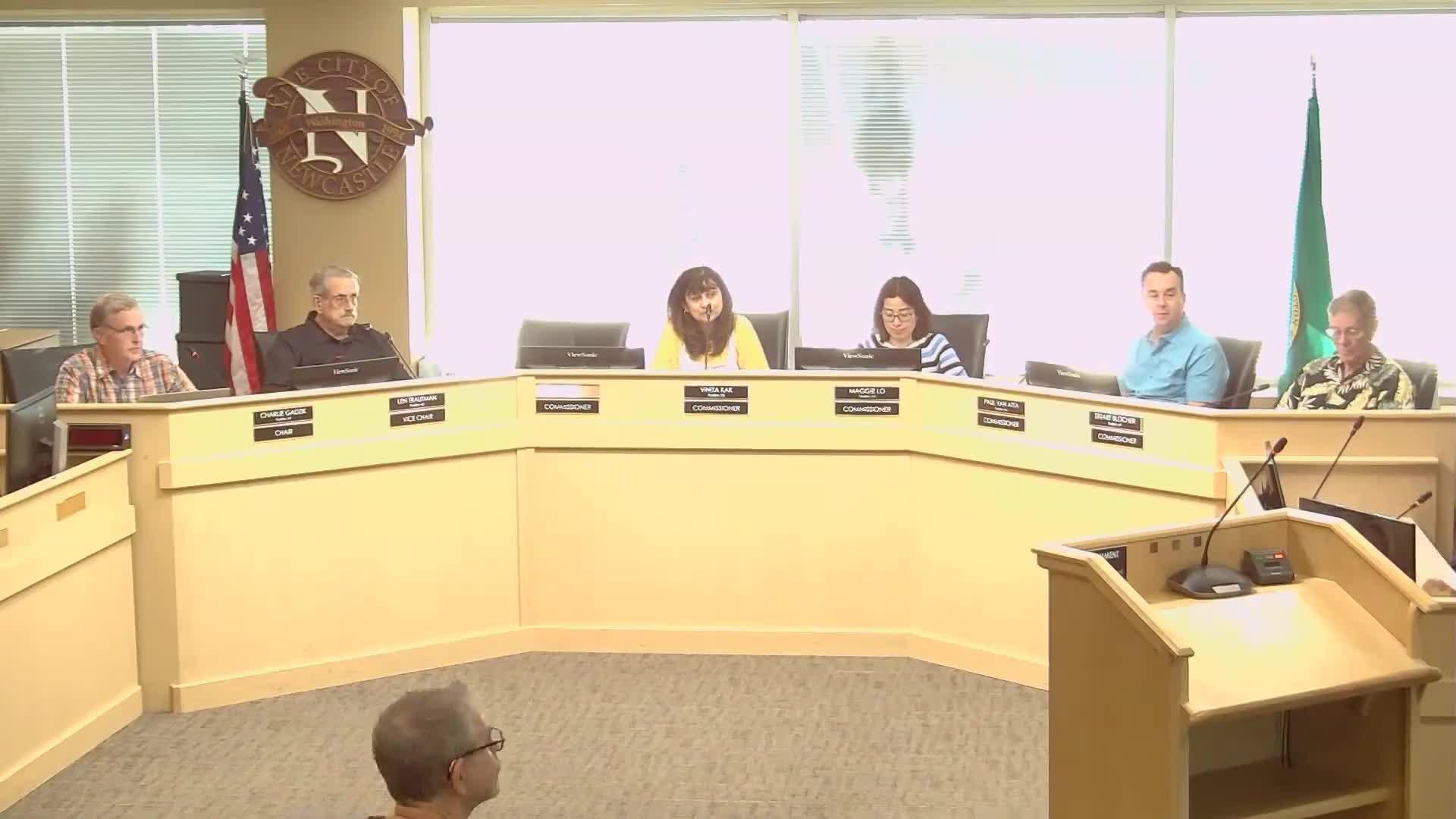
On May 28 the Newcastle Planning Commission voted to forward a middle-housing code update to the City Council but declined to recommend the proposed 10% affordable-housing requirement, instead asking the council to decide that provision.
The Newcastle Planning Commission voted May 28 to forward a draft middle-housing ordinance to the City Council after months of review, but the commission explicitly declined to recommend a proposed affordable-housing requirement and instead sent that question to the council.
Associate Planner Tyler Coyle presented the draft code and the changes required by recent state laws, and asked commissioners for clear direction by the end of the meeting. “Staff is hoping that commission could take action, at the end of this meeting,” Coyle said, listing setback options for accessory dwelling units (ADUs) and potential affordable-housing incentives as the key choices.
The commission debated several topics the staff highlighted: setback options for ADUs (a staff preference for a 5-foot rear setback versus a 10-foot or the current 20-foot standard), optional townhouse density bonuses along specific arterial streets, a proposed “10%” affordable-housing policy tied to new developments, and procedural changes required by state middle-housing and ADU legislation.
Coyle summarized state changes by name as they appeared in staff materials, saying the package includes statutes that require cities of Newcastle’s size to allow duplexes and limit how cities can regulate middle housing, to adopt a unit-lot-subdivision process, and to allow up to two ADUs per lot that must be saleable and may not require owner occupancy. He also described changes affecting shelters and co-living. “All of this will come into force, in July,” Coyle told the commission, and staff said updating local code before that date would avoid the state default rules from taking effect.
Public comment at the hearing was strongly mixed. Councilmember Jim Quigg, speaking during the general comment period, reminded commissioners of a city survey and said residents used the words “small, safe and quiet” to describe what they want Newcastle to remain. Resident Kim Snorski, who said she has lived in Newcastle more than 35 years, said townhomes on 116th Avenue would “completely change the character of our neighborhood” and urged commissioners to reject the townhouse bonus. Civil engineer Hartman Dierse supported smaller setbacks to maximize buildable area but urged the commission to consider broader infrastructure costs, saying an undergrounding program “cannot happen in my lifetime.”
Commissioners spent much of the meeting weighing the ADU setback options. Staff displayed scale diagrams showing how a reduced rear setback can yield a more usable courtyard between a primary house and a rear ADU; staff also proposed a 24-foot height cap for ADUs and optional semi-opaque rear windows for ADUs closer than 15 feet to neighboring lots to protect privacy. Multiple commissioners said they favored the 5-foot rear setback with privacy glass and the proposed 24-foot height cap.
On affordable housing, Coyle described a staff-proposed ‘‘10%’’ policy that would require developments of four or more units (with unit-size thresholds) to set aside roughly 10% of units at an affordability level (staff described 80% area median income for ownership and 70% for rental as an example), allow a fee-in-lieu ($13 per square foot in the draft) in certain fractional cases, and allow an ADU option to meet partial-unit obligations. Coyle and Director Fitzgibbons said the policy is optional and not required by state law, but that the commission would only have this opportunity to adopt such a policy while the city is updating zoning to comply with middle-housing statutes.
After debate and several roll-call-style motions, the commission rejected (tie votes) attempts to remove the 10% affordability language and to adopt it outright. The body ultimately approved a recommendation (option “H” in staff materials) to forward the draft ordinance to the City Council with the commission’s chosen ADU and development standards but without making a recommendation either way on the 10% affordable-housing provision, leaving that provision for council decision.
Votes at a glance: - Motion to add an option removing the 10% affordable-housing requirement (option G): failed, 3–3. - Motion to adopt option E (which included the 10% affordable-housing provision): failed, 3–3. - Motion to adopt option H (forward draft with no recommendation on the 10% affordable-housing provision and with ADU setbacks at 5 feet): passed (recorded as 5–0 with one commissioner noted as “present”).
The commission’s action moves most technical updates and the recommended ADU standards to the City Council while deferring the politically sensitive question of a local 10% affordable-housing mandate to council members. Staff told the commission the state’s middle-housing and ADU rules take effect in July, and recommended the council consider the draft promptly to avoid the state default rules.
The council will receive the planning commission’s recommendation; the commission’s record and the staff package include the ADU setback options, modeled diagrams, proposed height and window treatments, the unit-lot-subdivision approach, and the townhouse density-bonus map for arterials such as May Valley Road and parts of Coal Creek Parkway and Lake Washington Boulevard.