Council to Consider Ground Lease and Purchase Option for The Grid on Main After Bankruptcy Sale Approval
Loading...
Summary
City staff briefed the Mesa City Council on May 29 on proposed ground-lease and purchase documents that would follow a bankruptcy-court-approved sale of The Grid on Main to developer SoulTrust and are scheduled for council action June 2.
City staff briefed the Mesa City Council on May 29 on proposed ground-lease and purchase documents that would follow the bankruptcy-court-approved sale of The Grid on Main to developer SoulTrust and would be presented for council action at the June 2 meeting. Jeff McVeigh, manager of urban transformation, said the bankruptcy court approved the sale last week but the sale is contingent on council action on Monday.
The matter matters because the developer proposes to finish a partially completed mixed-use building downtown, triggering deed restrictions, parking licenses and city-funded electric work. If the council approves the lease and option to purchase, city staff said, SoulTrust would complete phase 1 under a construction schedule and then have a limited window to close on purchase of that parcel; phases 2 and 3 remain subject to amendment based on future feasibility and density studies.
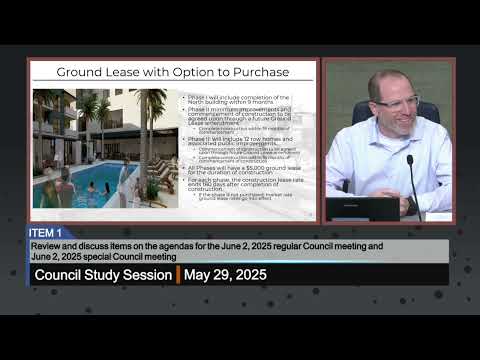
McVeigh outlined the city’s role and what the proposed agreements would require. The lease would cover three project parcels labeled phases 1 through 3. Phase 1 is the existing building; phase 2 is the dirt lot between phase 1 and the garage; and phase 3 is a narrow strip wrapping the Palmer Garage. Under the proposed agreement, SoulTrust must complete phase 1 construction within nine months of lease execution and then has six months after completion to close on purchase of the phase 1 parcel. If the phase 2 amendment is not completed by the phase 1 close date, phases 2 and 3 would revert to the city and the city could seek other developers.
McVeigh said the lease contemplates flexibility for phase 2 and phase 3: the MOU originally envisioned lower-density townhomes for phase 2 (12 units), but that plan “does not support or justify” the purchase price established by the city appraisal. The lease allows future amendments to increase density, heights and unit counts for phases 2 and 3 to achieve feasibility; the city manager would have authority to approve such amendments without returning to council, according to McVeigh.
Financial terms flagged in the briefing included a nonrefundable deposit required at lease execution, described by staff as $2,285,000, and a stated need to offset approximately $283,000 of unfinished electric work the city must complete to serve phase 1. McVeigh also said the city previously received $1,700,000 that had been escrowed to restore the site if the original developer failed; that restoration work is complete and Main Street and Pomeroy are open.
Staff described a construction-lease rate of $5,000 per phase during construction (below market) intended to reflect the city’s decision not to transfer fee title until completion. McVeigh also described a parking license for use of Pomeroy Garage spaces tied to each phase: phase 1 would require a minimum of 76 spaces (about one space per unit) with a maximum of 1.5 spaces per unit; phase 2 (as proposed assuming a 12-unit townhome product) would require a minimum of 24 spaces. The parking license term would be 50 years with an initial 10-year rate of $10 per space per month, then switching to whatever council-adopted rate applies (staff noted the current adopted rate is $45 per space per month).
Staff said the city will complete electric infrastructure work estimated at about $283,000 to serve phase 1; those transformers and primary feed lines will also serve later phases. McVeigh reported the city held roughly $774,000 in monetary claims against the bankruptcy estate (including about $500,000 for public electric infrastructure work) and that the settlement package resolved most subcontractor claims and required dismissal, with prejudice, of lawsuits against the city arising from the project as part of the bankruptcy resolution.
Council members asked for timing guardrails for phase 2. Council member Adams asked whether completion would be defined by certificate of occupancy; staff confirmed it would. Adams also asked about force majeure clauses addressing supply-chain or labor disruptions; McVeigh said modern lease forms now address broader force majeure risks. Council member Duff and others emphasized speed but also urged realistic timing given market conditions; staff said SoulTrust has signaled it wants to open a ground-floor restaurant tenant (Crest Italian eatery) and target an October opening for the restaurant.
At the study session no formal council action was taken; staff asked council to consider the lease and related resolutions at the June 2 meeting. The lease and option to purchase will be presented to council for approval on Monday, June 2, or the bankruptcy sale will not proceed under the trustee’s current order, staff said.
Sources: Presentation to Mesa City Council study session, May 29; remarks by Jeff McVeigh, manager of urban transformation; follow-up questions from council members.