Get Full Government Meeting Transcripts, Videos, & Alerts Forever!
Get email alerts on the TIF Sophia 380 Second Street topic
No spam. Unsubscribe anytime.
Everett council postpones vote on 21‑story Sophia TIF after extended debate
Summary
After hours of public comment and council questions about affordability, fees and the length of the tax‑increment financing deal, Everett City Council postponed a final vote on a proposed 21‑story mixed‑use project at 380 Second Street to its June 9 meeting.
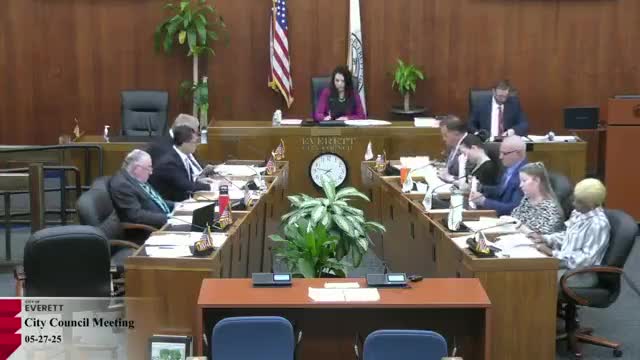
The Everett City Council on Thursday postponed a vote on a proposed tax‑increment financing (TIF) agreement for the “Sophia” redevelopment at 380 Second Street, a roughly 21‑story, roughly 600‑unit project, after more than three hours of public comment and council questions about affordability, fee waivers and the proposed 14‑year term.
Council President Stephanie Martins moved to take item 18 up for discussion and to invite the developer and consultants; the council later agreed to postpone final action to the council’s June 9 meeting.
The proposal’s backers said the TIF is necessary for the project’s financing and will bring substantial tax revenue, job opportunities and public improvements to Everett. “The project will not be feasible in terms of getting financing from equity partners without this agreement,” said John Brainard, a consultant who presented leasing and market data on behalf of the development team. Developer representative Scott Brown told the council: “Without this vote in favor by the city council, the Sophia will not be able to go forward.”
Why it matters: Councilors and dozens of residents said the project would reshape a large industrial parcel on Second Street and could set a precedent for other high‑density developments in the Commercial Triangle Economic Development District. Supporters emphasized union construction, site remediation and promises of ground‑floor retail for Everett businesses. Opponents and skeptical councilors pressed whether the city would receive fair value during the 14‑year TIF term and whether the project’s affordable‑housing commitments were deep enough.
Most important facts
- Project and commitments: The developer described the proposal as a 21‑story mixed‑use building with roughly 600+ apartments, about 42 affordable units (developers and city staff discussed figures in that range), and an emphasis on veterans’ housing. The team said 33 of the affordable/deed‑restricted units would be reserved as VASH (HUD veterans) units at 30% AMI.
- Money and credits discussed at the meeting: The developer and city consultants identified a range of financial elements tied to the project and the TIF language discussed at the meeting: an in‑lieu payment to replace the as‑of‑right linkage fee (developer proposed $2,000,000 in two payments in lieu of a $620,000 as‑of‑right linkage figure), an environmental remediation commitment of roughly $3,400,000, a Garden Street extension/infrastructure item of about $3,100,000, an I&I (inflow & infiltration) public‑infrastructure contribution of about $614,000, and a discussion of the building‑permit fee where the draft TIF document described the building‑permit fee treatment as waived or deferred while peer‑review and other permit‑related costs would be covered by the proponent.
- Planning and affordability: The planning board had granted a discretionary reduction in the city’s inclusionary requirement down to 10% affordable units for this project; the developer’s team said it had revised the TIF draft to direct affordable‑housing inclusionary payments to the Everett Affordable Housing Trust Fund.
- Jobs and community benefits: Proponents described the project as Everett’s first 100% union high‑rise and said it would produce construction‑period jobs and ground‑floor retail opportunities, and that the TIF funds would secure long‑term cleanup and infrastructure improvements that otherwise might not occur.
Council concerns and public comment
Councilors and a large public turnout raised several recurring concerns: the length of the proposed 14‑year TIF and whether shorter terms would be feasible; the draft language about building‑permit fees (whether the fee was waived, deferred or effectively replaced by other commitments); the depth and timing of affordable‑housing payments; how much the city would actually receive if lease‑up runs slower than projected; potential school impacts; and the risk that approving one TIF could encourage requests for similar treatment for other projects.
Several union representatives and union leaders testified in favor of the project, citing multi‑year construction jobs and apprenticeship opportunities. Neighbors and residents urged greater affordability, raised questions about traffic and service capacity, and said the city should not forgo fees that support city services.
Formal action and next steps
Councilors postponed the final vote on the TIF; the council agreed to reconvene the item at its June 9 meeting so the developer and city staff can submit revised language addressing council concerns. The postponement was taken after debate and concluded with a council announcement that the item would return on June 9.
What to watch next
Councilors asked for a clean, updated TIF document that clarifies timing of payments, the permit fee treatment, the affordable‑housing payment schedule and strengthened language on union, workforce‑diversity reporting and local hiring commitments. The council also requested a community meeting to brief residents and unions on the project and its workforce plans.
Ending
Because the council postponed the vote, no final TIF was adopted Thursday. The matter will return to the council on June 9 with revised contract language and written clarifications from the developer and city staff.