Get Full Government Meeting Transcripts, Videos, & Alerts Forever!
Get email alerts on the Student Loan Repayment Program topic
No spam. Unsubscribe anytime.
HCAI, DHCS outline Medi‑Cal Behavioral Health loan‑repayment program; applications open July 1
Summary
The Department of Health Care Access and Information (HCAI) and the California Department of Health Care Services (DHCS) on a webinar announced the Medi‑Cal Behavioral Health Student Loan Repayment Program and confirmed an application window opening July 1 with a deadline of Aug. 15 and awards expected in November.
The Department of Health Care Access and Information (HCAI) and the California Department of Health Care Services (DHCS) on a webinar announced the Medi‑Cal Behavioral Health Student Loan Repayment Program and said applications will open July 1, with an Aug. 15 deadline and award notifications expected in November, HCAI policy analyst Christian Jones said.
The program is part of BH Connect and uses federal approval through a Section 1115 demonstration waiver and related state plan amendments approved by the Centers for Medicare & Medicaid Services (CMS). HCAI told attendees the initiative aims to expand the behavioral‑health workforce in Medi‑Cal safety‑net settings by helping clinicians pay qualifying educational debt.
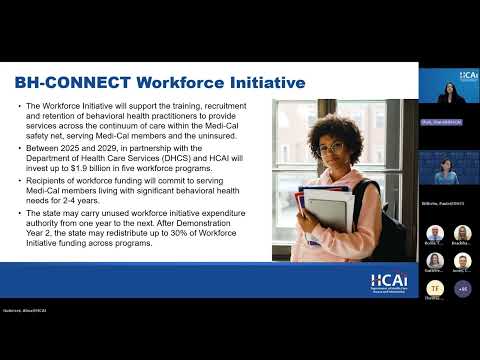
HCAI behavioral health and policy branch chief Sharmila Shah said the program is intended to “support and retain behavioral health providers, particularly in underserved and high‑need communities, by helping to reduce the burden of student loan debt.” The department also emphasized the program is one element of a larger BH Connect workforce initiative slated to invest up to $1,900,000,000 between 2025 and 2029.
Who is eligible and award amounts: HCAI and DHCS listed eligible professions and grouped maximum awards into three tiers based on licensure and prescribing authority. Christian Jones said licensed, prescribing practitioners (psychiatrists, psychiatric mental‑health nurse practitioners and similar) may be eligible for up to $240,000 in repayment. Licensed non‑prescribing clinicians and associate‑level prelicensure practitioners (clinical social workers, clinical psychologists, professional clinical counselors, marriage and family therapists and similar) may be eligible for up to $180,000. Non‑licensed, non‑prescribing categories (alcohol and other drug counselors, certified peer support specialists, certified wellness coaches if approved by a pending SPA, community health workers and registered nurses working in qualifying behavioral‑health settings) may be eligible for up to $120,000.
Service obligations and timing: HCAI said service obligations begin when awardees sign their grant agreements; retroactive service does not count. Licensed prescribing and licensed non‑prescribing practitioners will have a four‑year service obligation regardless of award amount. For non‑prescribing categories, obligations vary by award size: four years for awards of $20,000 or greater, three years for awards between $10,000 and $20,000, and two years for awards under $10,000. All service obligations must be served full time, and HCAI said a final definition of “full time” will appear in the program grant guide (HCAI noted its traditional definition is roughly 32 direct client hours per week, or 30 in school settings, but said that definition was not final).
Where service must be performed: The program requires recipients to serve in a “Medi‑Cal safety‑net setting,” language drawn from the program’s special terms and conditions (STC) with CMS. HCAI and DHCS described qualifying sites as federally qualified health centers (FQHCs), community mental health centers, rural health clinics, hospitals with a Medicaid or uninsured payer mix at or above 40 percent (30 percent for rural hospitals), or other behavioral‑health organizations that are enrolled in Medi‑Cal, deliver Medi‑Cal covered behavioral‑health services and meet the payer‑mix thresholds. DHCS Deputy Director Paula Wilhelm said some site types — school‑based programs, certain private practices or other common employer arrangements — require additional review and that HCAI and DHCS will publish further guidance in the grant guide.
Application process and payment mechanics: HCAI detailed an application window (opening July 1, closing Aug. 15), an anticipated award notice period in November and grant agreements beginning in December. Jones said awards will not be paid to individuals; funds will be paid directly to loan servicers. Recipients must provide loan documentation in the application and HCAI will coordinate with servicers. HCAI cautioned it will not pay for education that is unrelated to the profession for which loan repayment is sought.
Scope, prioritization and conflicts: HCAI and DHCS said the program may be oversubscribed. When demand exceeds funds, officials said awards will be determined by eligibility checks, a scoring mechanism and stated preferences such as geographic or provider‑type priorities tied to BH Connect objectives. Officials also cautioned that applicants with existing, overlapping service obligations from other programs may be ineligible for this cycle if those obligations extend into the planned grant start period. HCAI added that service obligations must be completed by Dec. 31, 2033, per federal terms.
Who is excluded or requires extra review: DHCS said Applied Behavioral Analysis (ABA) practitioners and board‑certified behavior analysts are not eligible because ABA is not classified as a specialty behavioral‑health benefit in Medi‑Cal. School‑based personnel, certain private practitioners and some administrative roles will be reviewed case‑by‑case; DHCS and HCAI said further clarifications will be published in July.
Additional program rules and policies: HCAI and DHCS said recipients remain responsible to make loan payments until their servicer confirms otherwise; awarding the grant does not automatically suspend borrower payments. Breach of the service obligation will trigger repayment to HCAI and potential collection; HCAI said it will publish a leave, suspension and waiver policy for extenuating circumstances in the grant guide. Officials noted the program can accept private loans so long as the debt is educational and tied to the qualifying credential path.
Where to get details and how to apply: HCAI said it will publish a grant guide and a second webinar shortly after the July 1 application opening with more detailed eligibility and scoring information. Officials asked interested applicants to monitor the HCAI website and subscribe to HCAI workforce notices; they also provided an email contact for program questions: mbhslrp@hcai.ca.gov.
The webinar review and the grant guide are intended to supply applicants with final definitions, lists of qualifying practitioner types and clearer examples of qualifying sites before the formal application period opens.