
Richfield council presses MnDOT on accessibility for Second Avenue pedestrian bridge and ownership questions
Get AI-powered insights, summaries, and transcripts
Subscribe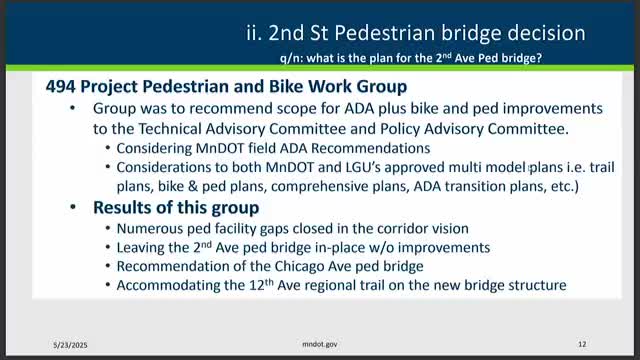
Summary
MnDOT and Richfield City staff told the May 27 work session that the project’s stakeholder committees prioritized building a new Chicago Avenue pedestrian crossing instead of upgrading the existing Second Avenue pedestrian bridge, and the council pressed MnDOT for clarity about ownership and a commitment to accessibility at replacement.
MnDOT and local officials discussed pedestrian access at a May 27 Richfield City Council work session after project partners decided to prioritize a new Chicago Avenue crossing rather than upgrading the existing Second Avenue pedestrian bridge to modern ADA standards.
Council members said they want clarity about who owns and will maintain the Second Avenue bridge and whether MnDOT or a bridge owner would replace it with an accessible structure at the end of the existing span’s service life. City staff and MnDOT told the council the corridor’s stakeholder committees reviewed multiple crossings and prioritized building a new Chicago Avenue connection; they left the Second Avenue bridge in place because it still had service life and because funds were limited.
MnDOT told the council the EA does not categorically state the existing Second Avenue bridge would be removed. That, the agency said, leaves the door open for future improvements if funding and ownership arrangements allow. MnDOT also said not all pedestrian bridges in the corridor are owned by MnDOT; for example, a regional trail bridge near Twelfth Avenue involves Three Rivers Park District and may have been built with a limited‑use permit.
City staff recalled advocating for Second Avenue improvements in earlier coordination meetings but said the working group was told funding was insufficient. Council members urged MnDOT to provide a stronger, documented commitment — not just verbal assurances — that accessible improvements would be considered or funded when the bridge reaches the end of its service life. MnDOT staff said that future funding, ownership details and the bridge’s condition would determine whether and when a full replacement could occur and that the EA’s current language gives some flexibility for future work.
No formal action or funding commitment was made at the session. Council members asked MnDOT to return with clearer documentation about (1) which crossings are owned by whom, (2) whether the EA contains any binding language about removal or replacement of the Second Avenue bridge, and (3) what options exist for securing funding to make the existing bridge accessible or to guarantee replacement with an accessible structure when the span reaches the end of its service life.