
MnDOT seeks Richfield input on I‑494 phase 2, warns federal grant requires E‑ZPass plan
Get AI-powered insights, summaries, and transcripts
Subscribe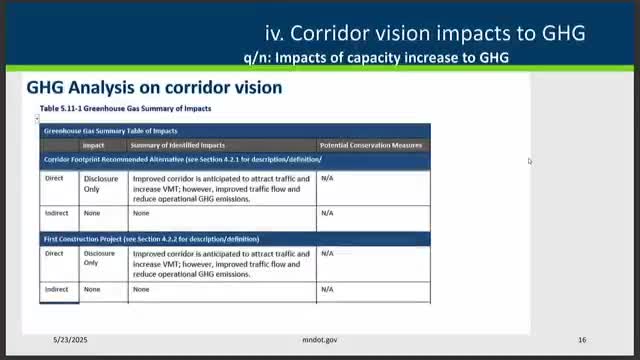
Summary
Minnesota Department of Transportation officials told the Richfield City Council May 27 that major grants backing a multi‑phase I‑494 corridor vision require the project to keep the currently proposed managed (E‑ZPass) lanes and that changing that design could threaten the funding.
Minnesota Department of Transportation officials told the Richfield City Council May 27 that major grants backing a multi‑phase I‑494 corridor vision require the project to keep the currently proposed managed (E‑ZPass) lanes and that altering that design could threaten the funding. Andrew Letai, a MnDOT project representative, said the INFRA federal grant applications and earlier state Corridors of Commerce requests shaped the scope of the first and upcoming phases.
The warning matters because the corridor vision covers roughly $1 billion in potential improvements and MnDOT has so far identified funding for only a portion of that total. Changing the lane plan now, Letai said, could cause grant money to be withdrawn and jeopardize the schedule for the stretch of 494 that passes through Richfield.
MnDOT described the corridor vision as a joint effort among state, regional and local partners and said the overall plan was broken into nine independent project elements so work could move forward as funding becomes available. Letai said project 1 focused on items that produced direct community benefits and that future elements could be built independently.
On managed lanes versus converting existing general‑purpose lanes, Letai told the council: "There is a statute. There is a state statute that prohibits conversion of lanes, general purpose lanes into HOV lanes." He added that interpretations of that statute have changed for subsequent projects, but that when this corridor vision was developed MnDOT did not plan lane conversions and the INFRA applications explicitly sought funding to add E‑ZPass lanes rather than converting existing lanes.
Council members asked whether switching from the proposed added managed lanes to a lane‑conversion approach would cost the project its federal INFRA funding. Letai confirmed the INFRA applications were premised on adding managed lanes and said altering the scope could put that funding at risk.
MnDOT also told the council it is re‑running environmental and traffic forecasts for phase 2. Letai said noise, air quality and greenhouse‑gas analyses will be updated using the latest traffic projections and that results should be available in time for a July work session. He and city staff said MnDOT intends to fold traffic‑management and construction‑staging decisions into the environmental document, with a target of having those planning decisions reflected in the document by December.
City and county staff pressed MnDOT for more detailed staging scenarios that quantify tradeoffs — for example, a three‑year construction window versus accelerated options that rely on full temporary closures to shorten the construction timeline. Letai said the baseline schedule for project construction is 2027–2029 and described a typical three‑year window that often leaves only two seasons for heavy bridge and mainline work because the first season is devoted to utility relocations and temporary widening.
MnDOT said some elements could be accelerated using full closures or accelerated bridge construction techniques but that such options require more analysis of where diverted traffic would travel, whether alternate routes can handle detours, and whether concurrent scheduled work on other corridors (for example Highway 13, Highway 62 and other regional projects) could be staged to reduce network impacts.
Council members asked for clearer, quantitative explanation of MnDOT's air‑quality and greenhouse‑gas findings tied to congestion relief, and MnDOT said it expects to have the specific phase‑2 numbers available by the July work session. The agency repeated that altering the scope of work that the federal INFRA grant funded could jeopardize that funding.
The council did not take any formal votes at the session. MnDOT said it will return with updated traffic, environmental and staging analysis and will hold additional public engagement events prior to advancing construction plans.