
Upper Darby superintendent outlines safety protocols, to review weapon-detection systems at September committee
Get AI-powered insights, summaries, and transcripts
Subscribe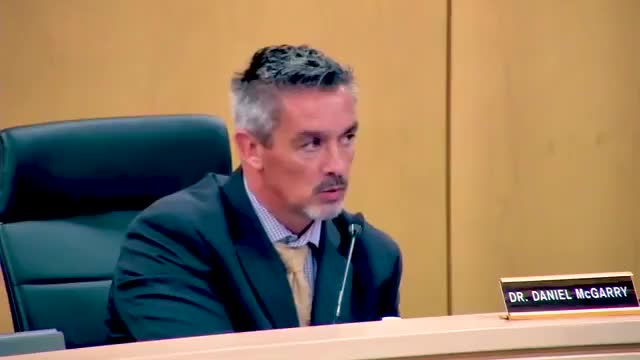
Summary
Superintendent Daniel McGarry told the Upper Darby School District Board of School Directors on Sept. 10 that the district will review the costs, logistics and community concerns around weapons-detection gates at a September committee meeting, but made clear no decision has been made.
Superintendent Daniel McGarry told the Upper Darby School District Board of School Directors on Sept. 10 that the district will review the costs, logistics and community concerns around weapons-detection gates at a September committee meeting, but made clear no decision has been made.
McGarry, speaking at the district's regular meeting, gave a detailed overview of current emergency procedures and the supports the district has added in recent years, saying the board asked administration to “explore weapons detection systems” and bring detailed information back to the committee. “We will be reviewing weapons detection systems from cost to places that we visited,” he said.
The presentation framed those future discussions by describing the district's existing, multi-layered approach to safety: lockout and lock-in procedures, lockdowns that only police can clear, evacuation protocols, a year-old external safety audit, a two-day tabletop exercise this summer with local emergency responders, and a memo of understanding the district maintains with local law enforcement.
McGarry defined the district terms for the public: “A lockout is a procedure where we're trying to keep all threats out of our school,” he said, explaining that a lockout is a school-level action to keep activities inside the building normal while preventing outside entry. He said a lock-in keeps students in classrooms during an internal disturbance. He said a lockdown is “the most severe thing that we can do,” and that only local law enforcement can release a lockdown.
McGarry described how the district communicates during incidents: the district uses a parent robocall/email system, a CrisisGo app that staff and local police join for real-time roll calls and alerts, district social media and the district website. He also described the Safe2Say Something anonymous tip line run by the Pennsylvania Office of the Attorney General and said tips that arrive through that service are vetted with police and the district and often lead the district to locate and check on students within minutes.
On mental-health and prevention efforts, McGarry said the district has expanded social workers, guidance counselors and satellite outpatient mental-health clinics in several schools, added behavior specialists and trauma-informed teams in every building, and implemented a social-emotional curriculum and PBIS recognition programs. He said the district is running student-mentorship coursework at the high school that will place trained students as mentors to younger pupils later this year.
McGarry also described threat assessments and Title IX processes. He said the district performs formal threat-assessment screenings when students show suicidal behavior or threats to others and provided counts from recent years: about 210 threat assessments in 2021–22, 491 in 2022–23 and 331 in 2023–24. He said Title IX investigations and a recently adopted Board policy (Policy 103.2) guide the district's response to harassment and discrimination allegations and that the district's Title IX coordinator is Kamisha Simpson, with Wendy Elgart named as deputy coordinator.
As examples of recent security changes, McGarry said the district implemented student ID scanners at its secondary schools to better control entry and that the district has considered additional cameras, more security officers and other measures. He said the district previously reviewed armed security and weapons-detection options — most recently in October 2022 — and brought a vendor presentation to the district then from a firm the district identified as “Evolve” during that presentation. McGarry told the board the vendor's system is an open-gate scan that highlights a specific area for targeted search and that similar systems have been implemented in other districts, although such systems can cause delays when first introduced.
McGarry repeated that the board had asked the administration to provide a fuller analysis at the next committee meeting covering cost, staffing, scheduling, community sentiment and operational examples from other districts; he emphasized that no change will be made without further study and public discussion. “Tonight is not a conversation where we're making a decision,” he said.
Public comment submitted by email and read into the record reflected that some parents want more screening equipment and security staff. One commenter, Kevin Cooper of the 500 block of Penn Avenue in Drexel Hill, wrote that “there should be metal detectors to ensure our children and the staff are safe during the school day” and offered to assist the district. Another emailed parent, Caitlin McCaskey of 32 Revere Road in Drexel Hill, asked whether the district has considered metal detectors for the high school following safety incidents elsewhere.
McGarry closed by saying the district will present the weapons-detection review at the September committee meeting and that the board will collect public input then. He encouraged residents to email questions and said the administration will continue to brief home-and-school and community groups as the process proceeds.