Get Full Government Meeting Transcripts, Videos, & Alerts Forever!
Get email alerts on the Housing topic
No spam. Unsubscribe anytime.
Live Baltimore tells City Council it committed $1.6M for Buyback the Block, seeks sustained funding
Summary
Live Baltimore told the Baltimore City Council it has fully committed $1.6 million in American Rescue Plan Act funds for its Buyback the Block down-payment program, reported $262.2 million in influenced home sales last fiscal year and urged the city to identify a steady funding source to sustain the program.
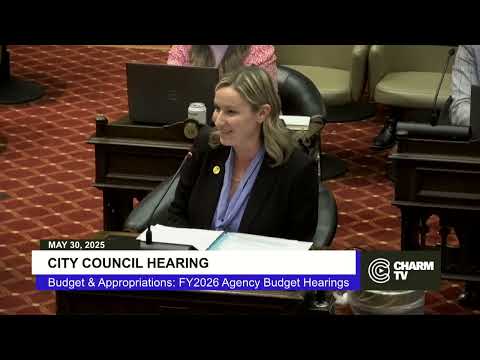
Megan McCorkle, executive director of Live Baltimore, told the Baltimore City Council on the evening of the agency’s budget hearing that Live Baltimore has committed all $1.6 million allocated for its Buyback the Block down-payment assistance program and urged the city to identify ongoing funding to sustain the work.
Live Baltimore’s Buyback the Block program, funded through American Rescue Plan Act (ARPA) resources administered by the mayor’s Office of Recovery Programs, provides up to $20,000 in down-payment assistance to eligible Baltimore City residents. “As of today, we have committed all of the $1,600,000 for this program,” McCorkle said. She said the program has helped “more than a hundred people” become homeowners in 50 neighborhoods across every council district, with buyers ranging in age from 23 to 78.
Why this matters: McCorkle presented figures the agency uses to argue for continued investment. Live Baltimore said influenced home purchases totaled $262,200,000 in fiscal year 2024, generating an estimated $12,100,000 in one-time tax revenue; McCorkle said that equates to roughly $66 returned in tax revenue for every $1 of city money spent on the Live Baltimore contract last year.
Council members asked about potential revenue sources to sustain Buyback the Block after ARPA funds are exhausted. Councilwoman Ramos raised the idea of a dedicated funding stream similar to how Visit Baltimore receives a portion of hotel tax revenues and asked about Live Baltimore’s relationship with Visit Baltimore. “They need to stay forever,” Ramos said about people who visit and then remain in the city; she urged alignment of marketing and stable funding to convert visitors into long-term residents.
McCorkle said Live Baltimore maintains an active relationship with Visit Baltimore and that a Live Baltimore staff member currently serves on Visit Baltimore’s marketing committee. She described the organization’s current staffing as 10 people — “the biggest Live Baltimore has ever been” — and said the proposed city contract includes a 3% increase that covers inflation and maintains the organization’s core neighborhood marketing and outreach work. She also reported recent program and outreach metrics: Live Baltimore’s website had almost 500,000 unique visitors last year and the organization’s most-attended spring trolley tour drew 540 prospective homebuyers.
Councilman Blanchard suggested examining transfer and recordation fees as a possible revenue source. Blanchard also praised Buyback the Block’s recent performance: “It’s like a really good policy that’s also really good politics and everyone loves it,” he said. McCorkle estimated that, to sustain the current pace of Buyback the Block activity, Live Baltimore would need roughly $750,000 annually for direct assistance plus additional overhead and at least one staff position — “so it would total close to a million dollars per year,” she said.
On program scope and outcomes, McCorkle said the Buyback the Block-assisted sales occurred across 50 neighborhoods (examples she named included Allendale, Highlandtown, Bel Air Edison, Cherry Hill, Park Heights and Upton), and that many recipients were first-time homebuyers and long-time city residents. She characterized the program as part of a broader retention and anti-displacement strategy the organization is trying to internalize into its core operations but said Buyback the Block is currently funded outside its core contract.
No formal council vote or directive on a funding source occurred during the hearing. Council members urged coordination between Live Baltimore, Visit Baltimore and the mayor’s office to explore dedicated funding streams; McCorkle said she was working with the mayor’s office and the mayor’s chief of staff to identify solutions.
Live Baltimore also described other activities funded through the city contract, including neighborhood marketing, virtual homeownership events and the trolley tours. The organization said it has nearly doubled its neighborhood ambassadors and enrolled nearly 30 employers in a Live Near Your Work incentive. McCorkle said some elements of Buyback the Block were seeded with ARPA funding and that staff had avoided rehiring a previously funded position when ARPA money was expected to expire.
Looking ahead: Live Baltimore asked for council support to secure ongoing funding; council members signaled interest in studying revenue options — such as transfer or recordation fees or portions of hotel tax receipts — but did not adopt a formal funding plan during the hearing.