Get Full Government Meeting Transcripts, Videos, & Alerts Forever!
Get email alerts on the Affordable Housing Redevelopment topic
No spam. Unsubscribe anytime.
Developer Proposes 83 Affordable Apartments at Weinbrenner Building; Council and CDA Seek More financial details
Summary
Jay Jeffers & Company presented a plan to convert the Weinbrenner building into 83 affordable apartments, seeking city conveyance of the building, PAYGO TIF support and predevelopment assistance; council and CDA requested detailed cost comparisons, potential TIF ranges and market-rate vs. tax-credit scenarios before committing.
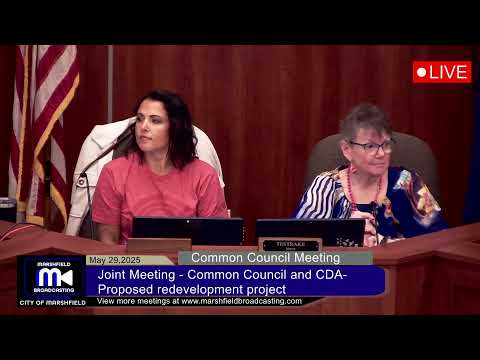
Jay Jeffers & Company outlined a plan on May 29 to convert the Weinbrenner building on West Second Street in Marshfield into 83 affordable apartments, asking the city to convey the building at no cost and to provide pay-as-you-go tax increment financing and predevelopment funding to support applications for federal and state tax-credit programs.
The proposal, presented to a joint meeting of the Marshfield City Council and the Marshfield Community Development Authority (CDA), would preserve the historic Weinbrenner structure and produce 34 one-bedroom, 46 two-bedroom and 3 three-bedroom units targeted to households at 60% of Wood County median income. Joe Dunn, vice president of real estate development for Jay Jeffers, described the project as adaptive reuse that “preserves the windows, the Weinbrenner sign and the structure” while delivering new residents to support West Second Street businesses.
Why it matters: the project is framed as the first catalytic redevelopment in the West Second Street District plan adopted in July 2022. The developer estimates total development costs just under $26 million and projects the new resident spending could generate an estimated $7.8 million in annual economic impact and support roughly 46 full‑time equivalent jobs.
Jay Jeffers said the team plans to finance the work with a conventional first mortgage, state and federal historic tax credits, federal Low Income Housing Tax Credits (LIHTC) including the Wisconsin state LIHTC, HOME‑ARP grant funds, and possible Brownfield grants administered by the Wisconsin Economic Development Corporation to address environmental conditions. The firm also asked the city to consider pay‑as‑you‑go TIF participation and to convey the building at no cost to reduce the financing gap.
The developer emphasized preservation and sustainability: original divided‑light windows would be retained with interior storm windows, and interior units would receive fresh outdoor air via dedicated systems. The plan includes a light well in a single‑story addition to bring natural light into interior units; the developer said units will meet building code requirements for natural light. On-site surface parking provision is planned for 52 stalls; the developer noted potential use or reconfiguration of existing adjacent angle parking.
Jay Jeffers expects to apply in the next LIHTC cycle: an initial concept application in December, a full application in March, with LIHTC awards expected in May 2026. The Weinbrenner company is tentatively expected to vacate the building in early 2026; if tax credits are awarded, project entitlement and permitting would move through 2026 with a target to transfer the property and begin construction in spring 2027.
Council and CDA questions focused on habitability and management, financing and alternatives. Natasha Tompkins (Alderman, District 3) asked whether original windows would open; Dunn replied they would not be operable and that a dedicated outdoor air system would be installed. Dunn also said Jay Jeffers typically hires a third‑party property manager (the firm referenced Gorman as an example) to handle tenant intake, compliance paperwork and maintenance.
Public comment and staff discussion raised alternatives and gaps. Dave Krause, a resident and Forward Bank commercial lender, urged the bodies to consider a mixed‑income or market‑rate component, arguing market‑rate units could attract higher‑income downtown residents and raise overall property value and tax increment. Economic development consultant Josh Miller and planning staff said they had reviewed financing scenarios and observed a significant gap for a fully market‑rate or mixed‑rate scheme under current construction costs and interest‑rate conditions; staff and the CDA noted that all four teams that responded to the RFQ had proposed some version of affordable housing.
Next steps described by city staff would begin with an exclusive right to negotiate, then a development agreement term sheet to be reviewed by CDA and Council, followed by a formal development agreement if both bodies approve. No formal action or vote was taken at the May 29 meeting; council members asked the developer and staff to provide more detailed financial comparisons, an itemized estimate of the city’s costs for grant and application support (HOME‑ARP, LIHTC, Brownfields, etc.), and illustrative TIF participation ranges before any formal commitment.
The presentation and subsequent discussion kept the project at an informational stage: officials said additional analysis and negotiated terms would be required before the city conveys the property or commits local incentives.