Get Full Government Meeting Transcripts, Videos, & Alerts Forever!
Get email alerts on the Wildfire Underinsurance topic
No spam. Unsubscribe anytime.
Experts tell Board of Equalization most wildfire-hit homeowners are underinsured; blame point-of-sale algorithms
Summary
Vice Chair Lieber convened the Board of Equalization for an informational hearing on wildfire disaster relief and recovery, where experts told the board that a substantial share of homeowners who lost houses to recent wildfires did not have enough insurance to rebuild.
Vice Chair Lieber convened the Board of Equalization for an informational hearing on wildfire disaster relief and recovery, where experts told the board that a substantial share of homeowners who lost houses to recent wildfires did not have enough insurance to rebuild.
The hearing brought consumer advocates, construction valuation specialists, an academic researcher and insurance professionals to describe why underinsurance persists, how far short typical policies fall and what policy and market remedies the panelists recommend. No formal action was taken during the hearing; board members said they will continue work on the issue.
Two-thirds of wildfire victims shorted on reconstruction costs, experts said. Kenneth R. Klein, Lewis and Hermione Brown Professor of Law at California Western School of Law, summarized Department of Insurance claims data he analyzed: "Over these four years...roughly 6,000 of [losses]...were still [underinsured] — 65% of the time," he said, adding that the average shortfall, including extended replacement cost endorsements, was roughly 35 percent. Klein told the board that demand surge and post‑loss price increases amplify the problem but are not the root cause: instead, algorithms used to produce point‑of‑sale replacement estimates are systematically low. "My research finds that these algorithms are the heart of the problem," he said.
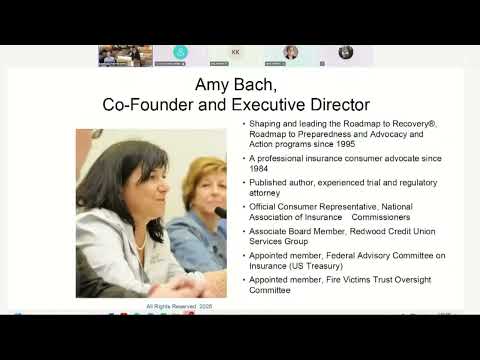
Consumer advocate Amy Bach, executive director and co‑founder of United Policyholders, described long‑standing survey work showing persistent underinsurance after major fires and walked the board through policy features consumers can buy — including extended replacement cost (ERC) endorsements and building‑code/ordinance coverage. Bach told the board, "one of I think 1 of the main recommendations that we're looking at that might take a bite out of this problem would be to require insurers to offer a 50% or higher, ERC endorsement. Just an idea. Just 1 idea."
Builders and valuation specialists explained the practical gap between insurer estimates and real rebuild bids. Matt Everson, co‑founder of BW Builders and a reconstruction estimator, said independent scope‑of‑loss reports his firm prepares routinely exceed the industry calculators' numbers and that the discrepancy is large enough to mislead homeowners and slow recovery. "They're wrong," Everson said of the standard point‑of‑sale tools, and added bluntly, "That's fraud."
Industry and market context. Panelists and board members discussed the role of admitted carriers versus surplus (non‑admitted) lines, the California FAIR Plan, and the California Insurance Guarantee Association (CIGA). Amy Bach warned that growth of non‑admitted carriers reduces consumer protections because surplus lines do not participate in state guarantee funds. David Schafer, a veteran independent agent and vice president at Heffernan Brignole Insurance Services, argued for a uniform, higher standard for replacement‑cost estimates and a certified process for producing them.
Quantitative details and examples cited to the board: - Professor Klein (analysis of California DOI claims, 2018–2021): roughly 65% of complete wildfire losses were underinsured, average shortfall about 35% including ERC endorsements. - United Policyholders surveys: historically more than 50% of wildfire‑impacted homeowners report being underinsured after major events; Boulder/Marshall Fire (Colorado) survey showed about 80% underinsured in that sample. - Industry and construction figures offered by builders: public examples ranged from about $400 per square foot (certain production builders) to roughly $800/sq ft for typical contractor rebuilds and significantly more — up to $1,700/sq ft in higher‑end Malibu examples.
Proposed remedies discussed by witnesses and board members: - Require insurers to offer a higher ERC endorsement (panelists suggested 50% as a practical starting point; some experts proposed higher levels for broader protection). - Create a public, statewide construction‑cost index or database (county/ZIP‑level) that insurers, agents and consumers could consult when setting replacement limits. - Establish a uniform, higher standard for replacement‑cost estimates and an independent, certified inspection or valuation process before policy issuance or renewal. - Increase transparency and error‑rate reporting by insurer (public disclosure of how often point‑of‑sale estimates fall below actual reconstruction costs). - Explore affordability measures — subsidies, vouchers or risk‑pooling changes — to address the fact that higher replacement limits raise premiums and may reduce availability for low‑income homeowners.
Board response and next steps. Board members thanked participants and said they will continue to work on the topic. Vice Chair Lieber and others signaled interest in convening further stakeholder meetings and legislative options. The hearing was informational; no motion or vote was taken.
Why this matters. When replacement estimates are low and homeowners cannot rebuild, communities face long delays in recovery and sustained reductions in property tax rolls that fund local services and schools. Experts at the hearing repeatedly warned that the issue will become more urgent as wildfire frequency increases.
Additional material given to the board included practitioner scope‑of‑loss reports, academic data tables and references to the California Department of Insurance regulation requiring insurer estimates at point‑of‑sale (discussed at the hearing) and to Insurance Code references such as the 10% minimum building‑code endorsement currently required by California law. The board invited the presenters to provide follow‑up materials and said staff will coordinate next steps.